MCQ
A copper ring is held horizontally and a bar magnet is dropped through the ring with its length along the axis of the ring. The acceleration of the falling magnet while it is passing through the ring is
  • A
    Equal to that due to gravity
  • Less than that due to gravity
  • C
    More than that due to gravity
  • D
    Depends on the diameter of the ring and the length of the magnet
Answer

Correct option: B.
Less than that due to gravity
 Less than that due to gravity

Need a full question paper?

Generate a complete, print-ready paper with questions like this in minutes — across 16+ boards, with answer keys.

Start Generating Free

Similar questions

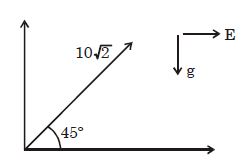
A particle of mass $1\ gm$ and charge $ - 0.1\,\mu C$ is projected from ground with a velocity $10\sqrt 2 $ at an $45^o$ with horizontal in the area having uniform electric field $1\ kV/cm$ in horizontal direction. Acceleration due to gravity is $10\ m/s^2$ in vertical downward direction. Select $INCORRECT$ statement
Neutrino is a particle, which is
In a series $LCR$ circuit, resonance occurring at $105 Hz$ . At that time, the potential difference across the $100$ resistance is $40 V$ while the potential difference across the pure inductor is $30 v$ . The inductance $L$ of the inductor is equal to.
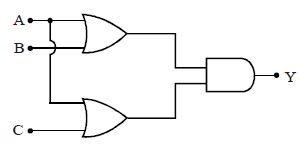
The output of given logic circuit is
Needles $N_I,  N_2$ and $N_3$ are made of a ferromagnetic, a paramagnetic and a diamagnetic substance respectively. A magnet when brought close to them will
A solid which is not transparent to visible light and whose conductivity increases with temperature is formed by
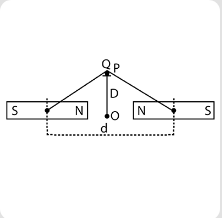
Two identical bar magnets are fixed with their centres at a distance d apart. A stationary charge $Q$ is placed at $P$ in between the gap of the two magnets at a distance $D$ from the centre $O$ as shown in the figure. The force on the charge $Q$ is:
A spherical portion has been removed from a solid sphere having a charge distributed uniformly in its volume as shown in the figure. The electric field inside the emptied space is
The work function of a metal is 4.2 eV, its threshold wavelength will be
The heavier nuclei tend to have larger $\frac{\text{N}}{\text{Z}}$ ratio because: