A copper wire has a square cross-section, $2.0\, mm$ on a side. It carries a current of $8\, A$ and the density of free electrons is $8 \times {10^{28}}\,{m^{ - 3}}$. The drift speed of electrons is equal to
Easy
Download our app for free and get started
(a) ${v_d} = \frac{i}{{nAe}} = $$\frac{8}{{8 \times {{10}^{28}} \times {{(2 \times {{10}^{ - 3}})}^2} \times 1.6 \times {{10}^{ - 19}}}}$
$=$ $0.156 \times {10^{ - 3}}\, m/sec$.

Download our appand get started for free
Experience the future of education. Simply download our apps or reach out to us for more information. Let's shape the future of learning together!No signup needed.*
Similar Questions
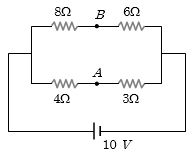
- 1The potential difference between point $A$ and $B$ is ............. $V$View Solution
- 2In a potentiometer arrangement, a cell of emf $1.20\, V$ gives a balance point at $36\, cm$ length of wire. This cell is now replaced by another cell of emf $1.80\, V$. The difference in balancing length of potentiometer wire in above conditions will be $....cm$.View Solution
- 3View SolutionThe reciprocal of resistance is
- 4A bulb rated at ($100\,W$ - $200\,V$) is used on a $100\,V$ line. The current in the bulb isView Solution
- 5View SolutionCarbon resistor has resistance specified by three bands having colours red, yellow and black. If the resistor is remolded to make a resistor twice of previous length, the new colour code will be
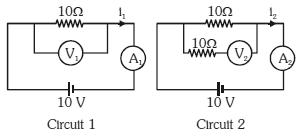
- 6View SolutionIn the circuits shown below, the readings of the voltmeters and the ammeters will be
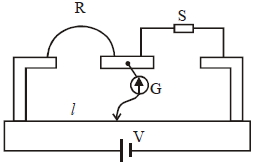
- 7In a meter bridge experiment $\mathrm{S}$ is a standard resistance. $\mathrm{R}$ is a resistance wire. It is found that balancing length is $l=25 \;\mathrm{cm} .$ If $\mathrm{R}$ is replaced by a wire of half length and half diameter that of $\mathrm{R}$ of same material, then the balancing distance $\left.l^{\prime} \text { (in } \mathrm{cm}\right)$ will now beView Solution
- 8The terminal voltage across a battery of $\mathrm{emf}$ $E$ can beView Solution
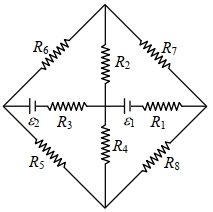
- 9The figure shows a circuit having eight resistances of $1 \Omega$ each, labelled $R_1$ to $R_8$, and two ideal batteries with voltages $\varepsilon_1=12 V$ and $\varepsilon_2=6 V$.View Solution
Which of the following statement($s$) is(are) correct?
$(A)$ The magnitude of current flowing through $R_1$ is $7.2 A$.
$(B)$ The magnitude of current flowing through $R_2$ is $1.2 A$.
$(C)$ The magnitude of current flowing through $R_3$ is $4.8 A$.
$(D)$ The magnitude of current flowing through $R_5$ is $2.4 A$.
- 10In the circuit element given here, if the potential at point $B$, $V_B = 0$, then the potentials of $A$ and $D$ are given asView Solution
