A copper wire is held at the two ends by rigid supports. At $50^{\circ} C$ the wire is just taut, with negligible tension. If $Y=1.2 \times 10^{11} \,N / m ^2, \alpha=1.6 \times 10^{-5} /{ }^{\circ} C$ and $\rho=9.2 \times 10^3 \,kg / m ^3$, then the speed of transverse waves in this wire at $30^{\circ} C$ is .......... $m / s$
Diffcult


Download our appand get started for free
Experience the future of education. Simply download our apps or reach out to us for more information. Let's shape the future of learning together!No signup needed.*
Similar Questions
- 1Beats are produced with the help of two sound waves of amplitudes $3$ and $5$ units. The ratio of maximum to minimum intensity in the beats isView Solution
- 2A train, standing in a station yard, blows a whistle of frequency $400 \,\,Hz$ in still air. The wind starts blowing in the direction from the yard to the station with a speed of $10\,\,m/s.$ Given that the speed of sound in still air is $340\,\,m/s.$ Mark the INCORRECT statement :View Solution
- 3A toy-car, blowing its horn, is moving with a steady speed of $5\, m/s$ , away from a wall. An observer, towards whom the toy car is moving, is able to hear $5\, beats$ per second. If the velocity of sound in air is $340\, m/s$, the frequency of the horn of the toy car is close to ... $Hz$View Solution
- 4View SolutionThe nature of sound waves in gases is
- 5View SolutionTwo sound waves of slightly different frequencies propagating in the same direction produce beats due to
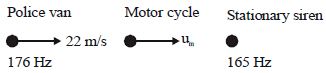
- 6A police van, moving at $22\, m/s$ , chases a motor-cyclist. The police man sounds horn at $176\, Hz$ , while both of them move towards a stationary siren of frequency $165\, Hz$ as shown in the figure. If the motor-cyclist does not observe any beats, his speed must be .... $m/s$ (take the speed of sound $= 330\, m/s$ )View Solution
- 7View SolutionVelocity of sound is maximum in
- 8Two open organ pipes of length $60 \mathrm{~cm}$ and $90 \mathrm{~cm}$ resonate at $6^{\text {th }}$ and $5^{\text {th }}$ harmonics respectively. The difference of frequencies for the given modes is . . . . . $\mathrm{Hz}$.View Solution
(Velocity of sound in air $=333 \mathrm{~m} / \mathrm{s}$ )
- 9A transverse harmonic wave on a string is given by $y(x, t)=5 \sin (6 t+0.003 x)$ where $x$ and $y$ are in $cm$ and $t$ in $sec$. The wave velocity is $...........\,ms ^{-1}$.View Solution
- 10A stationary source is emitting sound at a fixed frequency $\mathrm{f}_0$, which is reflected by two cars approaching the source. The difference between the frequencies of sound reflected from the cars is $1.2 \%$ of $f_0$. What is the difference in the speeds of the cars (in $\mathrm{km}$ per hour) to the nearest integer? The cars are moving at constant speeds much smaller than the speed of sound which is $330 \mathrm{~ms}^{-1}$.View Solution