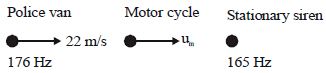
A police van, moving at $22\, m/s$ , chases a motor-cyclist. The police man sounds horn at $176\, Hz$ , while both of them move towards a stationary siren of frequency $165\, Hz$ as shown in the figure. If the motor-cyclist does not observe any beats, his speed must be .... $m/s$ (take the speed of sound $= 330\, m/s$ )
Diffcult
Download our app for free and get started
The apparent frequency of the hom of police van as heard by Motor-cyclist is
$v^{\prime}=\left(\frac{v-u_{m}}{v-22}\right) 176 \mathrm{Hz} \quad\left(\because v^{\prime}=\left(\frac{v-v_{0}}{v-v_{s}}\right) v\right)$
$\because v=330 \mathrm{m} / \mathrm{s}$
$\mathrm{v}^{\prime}=\frac{\left(330-\mathrm{u}_{\mathrm{m}}\right)}{308} \times 176 \mathrm{Hz}$ ......$(i)$
The apparent frequency of. siren as heard by the motor cyclist must also be v' because the motorcyclist does not observe any beats. Thus,
$\mathrm{v}^{\prime}=\left(\frac{330+\mathrm{u}_{\mathrm{m}}}{330}\right) \times 165$ ......$(ii)$
$\left(\because v^{\prime}=\frac{v+v_{0}}{v} v\right)$
From eq. $(i),$ and $(ii),$ we get
$\frac{330-\mathrm{u}_{\mathrm{m}}}{308} \times 176=\frac{330+\mathrm{u}_{\mathrm{m}}}{330} \times 165$
Solving it for $u_{m}$, we get
$\mathrm{u}_{\mathrm{m}}=22 \mathrm{m} / \mathrm{s}$

Download our appand get started for free
Experience the future of education. Simply download our apps or reach out to us for more information. Let's shape the future of learning together!No signup needed.*
Similar Questions
- 1A metal rod of $1\; m$ length, is dropped exact vertically on to a hard metal floor. With an oscilloscope, it is determined that the impact produces a longitudinal wave of $1.2 \;k Hz$ frequency. The speed of sound in the metal rod isView Solution
- 2A sonometer wire, with a suspended mass of $M = 1\, kg$, is in resonance with a given tuning fork. The apparatus is taken to the moon where the acceleration due to gravity is $(1/6)$ that on earth. To obtain resonance on the moon, the value of $M$ should be ......... $kg$View Solution
- 3Two waves are represented by the equations : $y_1 = a\, sin\,(\omega t + kx + 0.57)\, m$ and $y_2 = a\, cos\,(\omega t + kx)\, m$, where $x$ is in $metres$ and $t$ is in $seconds$ . The phase difference between them is ..... $radian$View Solution
- 4View SolutionSpeed of sound at constant temperature depends on
- 5Two waves $y = 0.25\sin 316\,t$ and $y = 0.25\sin 310\,t$ are travelling in same direction. The number of beats produced per second will beView Solution
- 6The clocktower ("ghantaghar") of Dehradun is famous for the sound of its bell, which can be heard, albeit faintly, upto the outskirts of the city $8 \,km$ away. Let the intensity of this faint sound be $30 \,dB$. The clock is situated $80 \,m$ high. The intensity at the base of the tower is .............$\,dB$View Solution
- 7The resultant amplitude due to superposition of two waves $y_1 = 5\,\,sin (wt - kx)$ and $y_2 = -5 \,\,cos (wt - kx - 150^o)$View Solution
- 8A source of sound of frequency $500 Hz$ is moving towards an observer with velocity $30 m/s$. The speed of sound is $330 m/s$. the frequency heard by the observer will be .... $Hz$View Solution
- 9Spacing between two successive nodes in a standing wave on a string is $x$ . If frequency of the standing wave is kept unchanged but tension in the string is doubled, then new spacing between successive nodes will becomeView Solution
- 10At a certain moment, the photograph of a string on which a harmonic wave is travelling to the right is shown. Then, which of the following is true regarding the velocities of the points $P, Q$ and $R$ on the string.View Solution