Question
A copper wire of cross $-$ sectional area $0.01\ cm^2$ is under a tension of $20N$. Find the decrease in the cross $-$ sectional area. Young's modulus of copper $= 1.1 \times 10 ^{11}N/m^2$ and Poisson's ratio $=\  0.32.\Big  [$Hint: $\frac{\triangle\text{A}}{\text{A}}=2\frac{\triangle\text{r}}{\text{r}}\Big]$
Answer

Given:
Cross-sectional area of copper wire $A = 0.01\ cm^{2 }= 10^{-6}m^2$
Applied tension $T = 20N$
Young modulus of copper $Y = 1.1 \times 10^{11}N/m^2$
Poisson ratio $\sigma=0.32$
We know that:
$\text{Y}=\frac{\text{FL}}{\text{A}\triangle\text{L}}$
$\Rightarrow\frac{\triangle\text{L}}{\text{L}}=\frac{\text{F}}{\text{AY}}$
$=\frac{20}{10^{-6}\times1.1\times10^{11}}=18.18\times10^{-5}$
Poisson's ratio, $\sigma =\frac{\frac{\triangle\text{d}}{\text{d}}}{\frac{\triangle\text{L}}{\text{L}}}=0.32$
Where $d$ is the transverve length

So, $\frac{\triangle\text{d}}{\text{d}}=(0.32)\times\frac{\triangle\text{L}}{\text{L}}$
$=0.32\times (18.18)\times10^{-5}=5.81\times10^{-5}$
Again, $\frac{\triangle\text{A}}{\text{A}}=\frac{2\triangle \text{r}}{\text{r}}=\frac{2\triangle \text{d}}{\text{d}}$
$\Rightarrow\triangle\text{A}=\frac{2\triangle\text{d}}{\text{d}}\text{A}$
$\Rightarrow\triangle\text{A}=2\times(5.8\times10^{-5})\times(0.01)$
$=1.165\times10^{-6}\text{ cm}^2$
Hence, the required decrease in the cross-sectional area is $1.164 \times 10^{-6}cm^2.$

Need a full question paper?

Generate a complete, print-ready paper with questions like this in minutes — across 16+ boards, with answer keys.

Start Generating Free

Similar questions

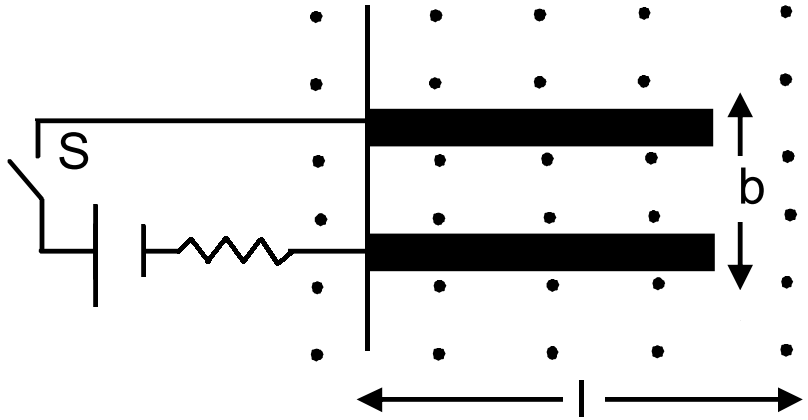
Two metal strips, each of length l, are clamped parallel to each other on a horizontal floor with a separation b between them. A wire of mass m lies on them perpendicularly, as shown in A vertically-upward magnetic field of strength B exists in the space. The metal strips are smooth but the coefficient of friction between the wire and the floor is $\mu.$ A current i is established when the switch S is closed at the instant t = 0. Discuss the motion of the wire after the switch is closed. How far away from the strips will the wire reach?
In a Young's double slit experiment, two narrow vertical slits placed 0.800mm apart are illuminated by the same source of yellow light of wavelength 589nm. How far are the adjacent bright bands in the interference pattern observed on a screen 2.00m away?
Which currents are produced when an external electric field is applied on a semi-conductor?
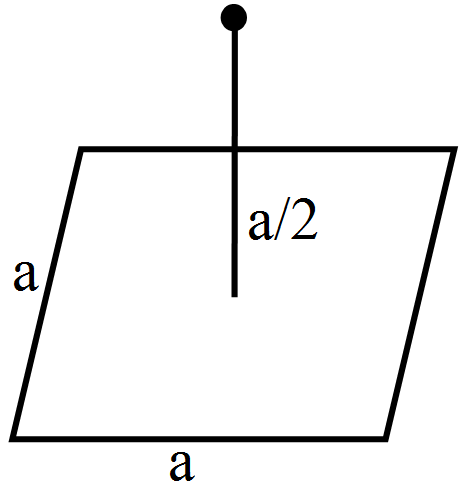
$A$ charge $Q$ is placed at a distance $\frac{\text{a}}{2}$ above the centre of a horizontal, square surface of edge a as shown in figure. Find the flux of the electric field through the square surface.
Answer the following questions:
In any ac circuit, is the applied instantaneous voltage equal to the algebraic sum of the instantaneous voltages across the series elements of the circuit? Is the same true for rms voltage?
Write relation between conductivity and mobility of metal.
Write the equation of electric potential for electric dipole and discuss its special cases.
Two metallic wires of the same material have the same length but cross-sectional areas are in the ratio 1 : 2. They are connected (i) in series and (ii) in parallel. Compare the drift velocities of electrons in the two wires in both the cases (i) and (ii).
Can the potential difference across a battery be greater than its emf?
Balmer series was observed and analysed before the other series. Can you suggest a reason for such an order?