Question types

Some Mechanical Properties of Matter question types

87 questions across 5 question groups — pick any mix to generate a Physics paper with step-by-step answer keys.

87
Questions
5
Question groups
5
Question types
Sample Questions

Some Mechanical Properties of Matter questions

One sample from each question group in this chapter. Select any group above to see the full set with answer keys.

Air is pushed into a soap, bubble of radius r to double its radius. If the surface tension of the soap solution is S, the work done in the process is:
  1. $8\ \pi\text{r}^2\text{S}$
  2. $12\ \pi\text{r}^2\text{S}$
  3. $16\ \pi\text{r}^2\text{S}$
  4. $24\ \pi\text{r}^2\text{S}\cdot$
View full solution
The length of a metal wire is $l_1$ when the tension in it $T_1$and is $l_2$ when the tension is $T_2$. The natural length of the wire is:
  • A
    $\frac{\text{l}_1+\text{l}_2}{2}$
  • B
    $\sqrt{\text{l}_2\text{l}_2}$
  • $\frac{\text{l}_1\text{T}_2-\text{l}_2\text{T}_1}{\text{T}_2-\text{T}_1}$
  • D
    $\frac{\text{l}_1\text{T}_2+\text{l}_2\text{T}_1}{\text{T}_2+\text{T}_1}$

Answer: C.

View full solution
Two wires A and B are made of same material. The wore A has a length l and diameter r while the wire B has a length 2l and diameter $\frac{\text{r}}{2}$. If the two wires are stretched by the same force, the elongation in A divided by the elongation in 8 is:
  1. $\frac{1}{8}$
  2. $\frac{1}{4}$
  3. $4$
  4. $8$
View full solution
The excess pressure inside a soap bubble is twice the excess pressure inside a second soap bubble. The volume of the first bubble is n times the volume of the second where n is:
  1. 4
  2. 2
  3. 1
  4. 0.125.
View full solution
The viscous force acting between two layers of a liquid is given by $\frac{\text{F}}{\text{A}}=-\eta\frac{\text{dv}}{\text{dz}}$ This $\frac{\text{F}}{\text{A}}$ may be called:
  1. Pressure.
  2. Longitudinal stress.
  3. Tangential stress.
  4. Volume stress.
View full solution
A capillary tube of radius $0.50\ mm$ is dipped vertically in a pot of water. Find the difference between the pressure of the water in the tube $5.0\ cm$ below the surface and the atmospheric pressure. Surface tension of water $= 0.075N/m.$
View full solution
When the size of a soap bubble is increased by pushing more air in it, the surface area increases. Does it mean that the average separation between the surface molecules is increased?
View full solution
A vertical metal cylinder of radius $2\ cm$ and length $2\ m$ is fixed at the lower end and a load of $100\ kg$ is put on it. Find
  1. The stress.
  2. The strain and.
  3. The compression of the cylinder. Young's modulus of the metal $= 2 \times 10^{11} N/m^2.$
View full solution
A steel plate of face area $4\ cm^2$ and thickness $0.5\ cm$ is fixed rigidly at the lower surface. A tangential force of $10N$ is applied on the upper surface. Find the lateral displacement of the upper surface with respect to the lower surface. Rigidity modulus of steel $= 8.4 \times 10^{10}N/m^2.$
View full solution
The elastic limit of steel is $8 \times 10^8N/m^2$ and its Young's modulus $2 \times 10^{11}N/m^2.$ Find the maximum elongation of a half meter steel wire that can be given without exceeding the elastic limit.
View full solution
A copper wire of cross $-$ sectional area $0.01\ cm^2$ is under a tension of $20N$. Find the decrease in the cross $-$ sectional area. Young's modulus of copper $= 1.1 \times 10 ^{11}N/m^2$ and Poisson's ratio $=\  0.32.\Big  [$Hint: $\frac{\triangle\text{A}}{\text{A}}=2\frac{\triangle\text{r}}{\text{r}}\Big]$
View full solution
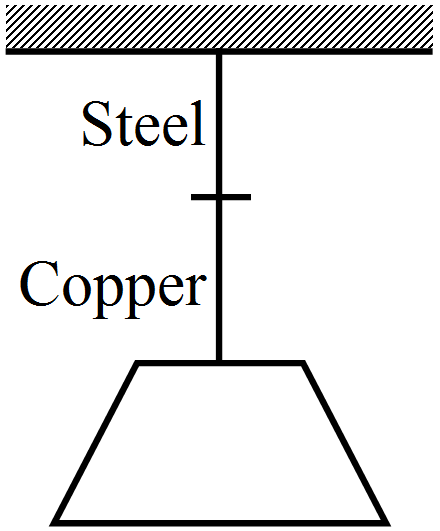
In the upper wire is made of steel and the lower of copper. The wires have equal cross-section. Find the ratio of the longitudinal strains developed in the two wires.
View full solution
A steel wire and a copper wire of equal length and equal cross-sectional area are joined end to end and the combination is subjected to a tension. Find the ratio of.
  1. The stresses developed in the two wires.
  2. The strains developed. $Y$ of steel $= 2 \times 10^{11}N/m^2. Y$ of copper $= 1.3 \times 10^{11}N/m^2.$
View full solution
Q 163 Marks Question3 Marks

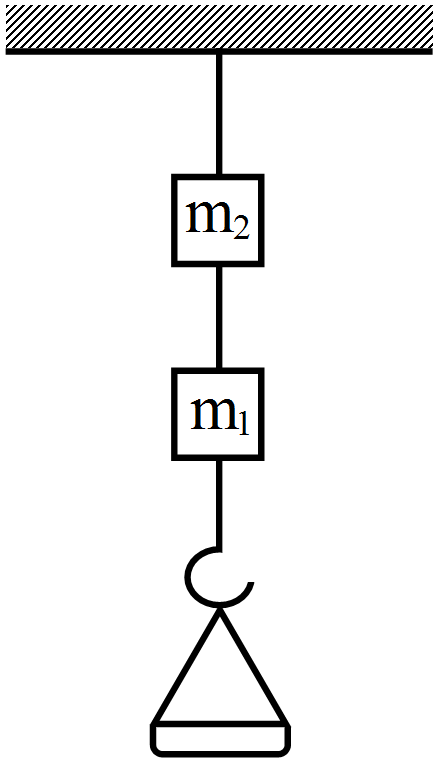
The two wires shown in are made of the,
same material which has a breaking stress of $8 \times 10^8N/m^2$.
The area of cross$-$section of the upper wire is $0.006\ cm^2$ and that of the lower wire is $0.003\ cm^2$.
The mass $m_1 = 10\ kg, m_2= 20\ kg$ and the hanger is light:
  1. Find the maximum load that can be put on the hanger without breaking a wire. Which wire will break first if the load is increased?
  2. Repeat the above part if $m_1 = 10\ kg$ and $m_2 = 36\ kg$.
View full solution
Q 173 Marks Question3 Marks
Estimate the change in the density of water in ocean at a depth of $400m$ below the surface. The density of water at the surface $= 1030\ kg/m^3$ and the bulk modulus of water $= 2 \times 10^9\ N/m^2.$
View full solution
Q 183 Marks Question3 Marks
A steel wire of original length $1m$ and cross$-$sectional area $4.00\ mm^2$ is clamped at the two ends so that it lies horizontally and without tension. If a load of $2.16\ kg$ is suspended from the middle point of the wire, what would be its vertical depression? $Y$ of the steel $= 2.0 \times 10^{11}N/m^2$ Take $g = 10m/s^2.$
View full solution
Q 193 Marks Question3 Marks
The force of surface tension acts tangentially to the surface whereas the force due to air pressure acts perpendicularly on the surface. How is then the force due to excess pressure inside a bubble balanced by the force due to the surface tension?
View full solution
Q 203 Marks Question3 Marks
A sphere of mass $20\ kg$ is suspended by a metal wire of unstretched length $4m$ and diameter $1\ mm$. When in equilibrium, there is a clear gap of $2\ mm$ between the sphere and the floor. The sphere is gently pushed aside so that the wire makes an angle $\theta$ with the vertical and is released. Find the maximum value of $\theta$ so that the sphere does not rub the floor. Young's modulus of the metal of the wire is $2.0 \times 10^{11}\ N/m^2$. Make appropriate approximations.
View full solution
When a glass capillary tube is dipped at one end in water, water rises in the tube. The gravitational potential energy is thus increased. Is it a violation of conservation of energy?
View full solution

Generate a Some Mechanical Properties of Matter paper free

Pick question groups from the list above, set marks and difficulty, and export a branded PDF with step-by-step answer keys. First 3 chapters free — no signup.

Download App