A copper wire $(Y = 1 \times 10^{11}\, N/m^2)$ of length $6\, m$ and a steel wire $(Y = 2 \times 10^{11}\, N/m^2)$ of length $4\, m$ each of cross section $10^{-5}\, m^2$ are fastened end to end and stretched by a tension of $100\, N$. The elongation produced in the copper wire is ......... $mm$
Medium
Download our app for free and get started
$\Delta \mathrm{L}=\frac{\mathrm{FL}}{\mathrm{YA}}$
$\Delta \mathrm{L}=\frac{(100)(6)}{10^{11}\left(10^{-5}\right)}=0.6 \times 10^{-3} \mathrm{m}$

Download our appand get started for free
Experience the future of education. Simply download our apps or reach out to us for more information. Let's shape the future of learning together!No signup needed.*
Similar Questions
- 1A cube of aluminium of sides $0.1\, m$ is subjected to a shearing force of $100\, N$. The top face of the cube is displaced through $0.02 \,cm$ with respect to the bottom face. The shearing strain would beView Solution
- 2A boy’s catapult is made of rubber cord which is $42\, cm$ long, with $6\, mm$ diameter of cross -section and of negligible mass. The boy keeps a stone weighing $0.02\, kg$ on it and stretches the cord by $20\, cm$ by applying a constant force. When released, the stone flies off with a velocity of $20\, ms^{-1}$. Neglect the change in the area of cross section of the cord while stretched. The Young’s modulus of rubber is closest toView Solution
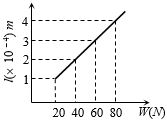
- 3A uniform rod of length $L$ has a mass per unit length $\lambda$ and area of cross-section $A$. If the Young's modulus of the rod is $Y$. Then elongation in the rod due to its own weight is ...........View Solution
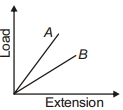
- 4In the given figure, if the dimensions of the two wires are same but materials are different, then Young's modulus is $ ........$View Solution
- 5View SolutionThe only elastic modulus that applies to fluids is
- 6A rod is fixed between two points at $20°C$. The coefficient of linear expansion of material of rod is $1.1 \times {10^{ - 5}}/^\circ C$ and Young's modulus is $1.2 \times {10^{11}}\,N/m$. Find the stress developed in the rod if temperature of rod becomes $10°C$View Solution
- 7View SolutionThe correct increasing order for modulus of elasticity for copper, steel, glass and rubber is
- 8View SolutionModulus of rigidity of a liquid
- 9View SolutionIn the three states of matter, the elastic coefficient can be
- 10The adjacent graph shows the extension $(\Delta l)$ of a wire of length $1m$ suspended from the top of a roof at one end with a load $W$ connected to the other end. If the cross sectional area of the wire is ${10^{ - 6}}{m^2},$ calculate the young’s modulus of the material of the wireView Solution