Question
(a) Copy and complete the following table which refers to two practical applications of electrolysis
  Anode Electrolyte Cathode
Silver plating of a spoon   A solution of potassium argentocyanide  
Purification of copper      
(iii) Extraction of sodium      
(b) Write the equation taking place at the anode for Q. 2(a).

Answer

(a)
  Anode Electrolyte Cathode
Silver plating of a spoon The plate of pure clean The solution of potassium argentocyanide Article to be electroplated
Purification of copper Impure copper The solution of copper sulphate and dilute sulphuric acid The thin strip of pure copper
(iii) Extraction of sodium Nickel Fused sodium chloride Iron
(b)
  1. $Ag - e^- → Ag^+$
  2. $Cu - e^-→ Cu^{2+}$
  3. $Cl^- - e^- → Cl$
  4. $Cl + Cl → Cl_2$

Need a full question paper?

Generate a complete, print-ready paper with questions like this in minutes — across 16+ boards, with answer keys.

Start Generating Free

Similar questions

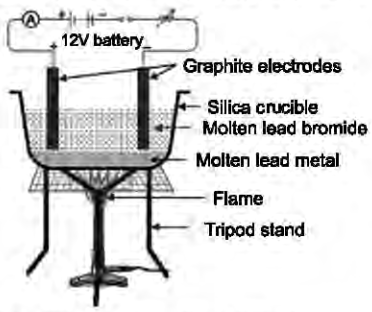
A diagram of the apparatus set up is given below for the electrolysis of fused lead bromide.
Image
(i) Write two properties of silica crucible used in the above apparatus.
(ii) Molten (fused) lead bromide is used as an electrolyte instead of solid lead bromide. Give reason.
(iii) Write the conditions required during the process.
(iv) Write the reactions taking place at the electrodes.
(v) Write the observations during the process.
Calculate the volume of air at $\text{STP},$ required to convert $300 \ mL$ of sulphur dioxide to sulphur trioxide. Air contains $21\%$ of oxygen by volume.
M is a metal above hydrogen in the activity series and its oxide has the formula $M_2O$. The oxide when dissolved in water forms the corresponding hydroxide which is a good conductor of electricity. In the above context answer the following:
(i) What kind of combination exists between $M$ and $O$?
(ii) How many electrons and there in the outermost shell of $M$?
(iii) Name the group to which M belongs
(iv) State the reaction taking place in the cathode
(v) Name the product at the anode
Make a neatly labeled sketch to show how a brass spoon can be plated with silver. Explain your choice of electrolyte used.
Describe an experiment to prove the following:
HCI is highly soluble in water.
Copy and complete the following table which relates to three homologus series of hydrocarbons:
General formula $C_nH_{2n}$ $C_nH_{2n-2}$ $C_nH_{2n+2}$​​​​​​​
IUPAC name of the homologus series      
Characteristic bond type     Single bond
IUPAC name of the first member of the series      
Type of reaction with chlorine   Addition  
Name the substance used for drying ammonia gas? Why cannot substances such as conc.$H_2SO_4$​​​​​​​, anhydrous calcium chloride and phosphorus pentoxide be used for drying ammonia gas?
A metal $M,$ forms a volatile chloride containing $65.5\%$ Chlorine. If the density of the chloride relative to hydrogen is $162.5,$ find the molecular formula of the chloride. $[M = 56, Cl = 35.5]$
A compound X when treated with an organic acid Y (having vinegar-like smell) in the presence of the acid Z, forms a compound P which has a fruity smell.
(a) Identify X, Y, and Z
(b) Write the structural formula of X and Y.
(c) What type of compound P is?
(d)Name the above reaction.
(e) If compound X and Y both have 2 carbon atoms. Write the reaction.
Calculate the empirical formula of the compound having $37.6\%$ sodium$, 23.1\%$ silicon and $39.3\%$ oxygen.$($Answer correct to two decimal places$) (O = 16, Na = 23, Si = 28)$