Question types

Electrolysis question types

144 questions across 7 question groups — pick any mix to generate a Chemistry paper with step-by-step answer keys.

144
Questions
7
Question groups
5
Question types
Sample Questions

Electrolysis questions

One sample from each question group in this chapter. Select any group above to see the full set with answer keys.

Q 1MCQ1 Mark
An electrolyte Which completely dissociates into ions is:
  • A
    Alcohol
  • B
    Carbonic acid
  • C
    Sucrose
  • Sodium hydroxide

Answer: D.

View full solution
Q 2MCQ1 Mark
Electrolysis of acidulated water is an example of ......
  • A
    Reduction
  • B
    oxidation
  • redox reaction
  • D
    synthesis

Answer: C.

View full solution
Q 3MCQ1 Mark
Assertion: In electrolysis of aqueous NaCl the product obtained is not $H _2$ gas.
Reason: Generally, gases are liberated faster than the metals.
  • A
    Assertion and Reason both are correct statements and reason is the correct explanation of the assertion.
  • B
    Assertion and Reason both are correct statements, but reason is not the correct explanation of the assertion.
  • C
    Assertion is true, but reason is false.
  • D
    Assertion is false, but reason is true.
View full solution
Q 4MCQ1 Mark
Assertion: In cell current stops flowing when $E _{\text {cell }}=0$.
Reason: Equilibrium of the cell reaction is attained.
  • A
    Assertion and Reason both are correct statements and reason is the correct explanation of the assertion.
  • B
    Assertion and Reason both are correct statements, but reason is not the correct explanation of the assertion.
  • C
    Assertion is true, but reason is false.
  • D
    Assertion is false, but reason is true.
View full solution
Q 5MCQ1 Mark
During electrolysis, where do cations migrate?
  • A
    Towards the anode
  • B
    Towards the cathode
  • C
    Away from both electrodes
  • D
    Remain stationary in the solution
View full solution
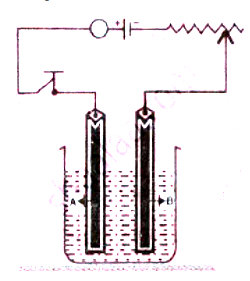
Copper sulphate solution is electrolysed using a platinum anode. Study the diagram given alongside and answer the following questions:
  1. Give the names of the electrodes A and B.
  2. Which electrode is the oxidising electrode?
View full solution
Choose A, B, C or D to match the descriptions (i) to (v) below. Some letters may be repeated.
A. non-electrolyte
B. strong electrolyte
C. weak electrolyte
D. metallic conductor
i. Molten ionic compound
ii. Carbon tetrachloride
iii. An aluminum wire
iv. A solution containing solvent molecules, solute molecules, and ions formed by the dissociation of solute molecules.
v. A sugar solution with sugar molecules and water molecules.
View full solution
Classify the following substance under three headings:
(a) strong electrolytes (b) Weak electrolytes (c) Non-electrolytes.
Acetic acid, ammonium chloride, ammonium hydroxide, carbon tetrachloride, dilute hydrochloric acid, sodium acetate, dilute sulphuric acid.
View full solution
Fill in the blanks :
Electrolysis is the passage of……………. (electricity/electrons) through a liquid or a solution accompanied by a ………….. (physical/chemical) change.
View full solution
Fill in the blanks :
A solution of HCl gas in water conducts electricity because ………......., but a solution of HCl gas in toluene does not conduct an electric current because ………....... 
View full solution
During electrolysis of an aqueous solution of sulphuric acid between platinum electrodes, two types of anions migrate towards the anode but only one of themis discharged:
(a) Name the two anions,
(b) Name the main product of the discharge of anion at the anode and write the anode reaction,
(c) Name the product at the cathode and write the reaction.
(d) How you notice any change in colour. State why?
(e) Why this electrolysis, is considered as an example of catalysis?
View full solution
(a) Copy and complete the following table which refers to two practical applications of electrolysis
  Anode Electrolyte Cathode
Silver plating of a spoon   A solution of potassium argentocyanide  
Purification of copper      
(iii) Extraction of sodium      
(b) Write the equation taking place at the anode for Q. 2(a).
View full solution
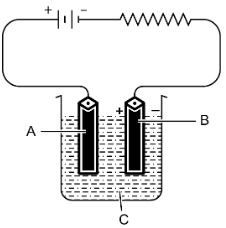
Given below in column A is a schematic diagram of the electrolysis of copper sulphate. Identify the parts labelled as A, B and C with the correct options from the column B.
Column AColumn B
Image1. Cathode
2. Graphite
3. Anode
4. Copper sulphate solution
View full solution
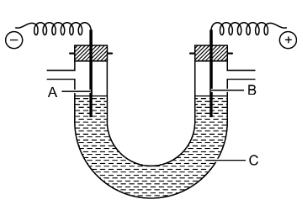
Given below in column $A$ is a schematic diagram of the electrolysis of copper(II) chloride. Identify the parts labelled as A, B and C with the correct options from the column B.
Column AColumn B
Image1. Copper
2. Graphite
3. Aluminium.
4. Electrolytic mixture
View full solution

Generate a Electrolysis paper free

Pick question groups from the list above, set marks and difficulty, and export a branded PDF with step-by-step answer keys. First 3 chapters free — no signup.

Download App