MCQ
A couple produces a:
  • A
    Pure linear motion.
  • Pure rotational motion.
  • C
    Both linear and rotational motion.
  • D
    No motion.

Answer

Correct option: B.
Pure rotational motion.
A couple has turning effect and produces pure rotational motion.

Need a full question paper?

Generate a complete, print-ready paper with questions like this in minutes — across 16+ boards, with answer keys.

Start Generating Free

Similar questions

A person standing on an open ground hears the sound of a jet aeroplane, coming from north at an angle $60^o$ with ground level. But he finds the aeroplane right vertically above his position. If $\upsilon $ is the speed of sound, speed of the plane is
What is the change in temperature on Fahrenheit scale and Kelvin scale, if an iron piece is heated from $30\ ^oC$ to $90\ ^oC$?
A body weight $ W $ newton at the surface of the earth. Its weight at a height equal to half the radius of the earth will be
When we jump out of a boat standing in water it moves
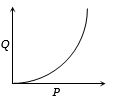
The graph shows the behaviour of a length of wire in the region for which the substance obeys Hook’s law. $P$ and $Q$ represent
Measure of two quantities along with the precision of respective measuring instrument is: $\text{A} = 2.5\text{ms}^{-1} \pm 0.5\text{ms}^{-1}$ $\text{B} = 0.10\text{s} \pm 0.01\text{s}$ The value of $A B$ will be,
A small block of mass $m$ is kept on a rough inclined surface of inclination $\theta$ fixed in an elevator. The elevator goes up with a uniform velocity $v$ and the block does not slide on the wedge. The work done by the force of friction on the block in time $t$ will be:
A particle of mass $200 \,g$, is whirled into a vertical circle of radius $80 \,cm$ using a massless string. The speed of the particle when the string makes an angle of $60^{\circ}$ with the vertical line is $1.5 \,ms ^{-1}$. The tension in the string at this position is ........... $N$
A body is executing simple harmonic motion with frequency $'n',$ the frequency of its potential energy is :
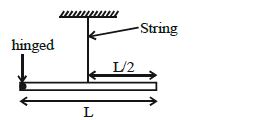
A uniform rod of mass $M$ and length $L$ is hinged about a point as shown in the fig. Initially the rod is kept horizontal by a massless string as shown. When string is cut the angular acceleration of the rod is