Question types

Systems of Particles and Rotational Motion question types

696 questions across 8 question groups — pick any mix to generate a Physics paper with step-by-step answer keys.

696
Questions
8
Question groups
5
Question types
Sample Questions

Systems of Particles and Rotational Motion questions

One sample from each question group in this chapter. Select any group above to see the full set with answer keys.

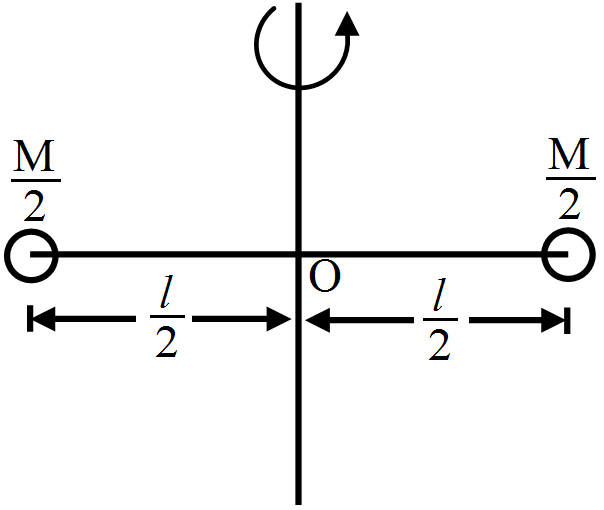
Two masses are joined with a light rod and the system is rotating about the fixed axis as shown in the figure. The $MI$ of the system about the axis is:
  • A
    $\frac{\text{Ml}^2}{2}$
  • $\frac{\text{Ml}^2}{2}$
  • C
    $\frac{\text{Ml}}{2}$
  • D
    $\frac{\text{Ml}^2}{6}$

Answer: B.

View full solution
A system of particles is called a rigid body when:
  • A
    Any two of particles of system may have displacements in opposite directions under action of a force.
  • B
    Any two of particles of system may have velocities in opposite directions under action of a force.
  • Any two particles of system may have a non$-$zero relative velocity.
  • D
    Any two of particles of system may have displacements in same direction under action of a force.

Answer: C.

View full solution
While opening a tap with two fingers, the forces applied by the fingers are:
  • A
    Equal in magnitude.
  • B
    Parallel to each other.
  • C
    Opposite in direction.
  • All the above.

Answer: D.

View full solution
Sagar was playing with the spinning top, after some time he realized that motion of top is same as motion of earth spinning about its own axis. Identify the type of motion?
  • Rotational motion.
  • B
    Oscillatory motion.
  • C
    Rectilinear motion.
  • D
    None of these.

Answer: A.

View full solution
Read statement below carefully, and state, with reasons, if it is true or false: During rolling, the force of friction acts in the same direction as the direction of motion of the CM of the body.
View full solution
Read statement below carefully, and state, with reasons, if it is true or false: For perfect rolling motion, work done against friction is zero.
View full solution
Read statement below carefully, and state, with reasons, if it is true or false: A wheel moving down a perfectly frictionless inclined plane will undergo slipping (not rolling) motion.
View full solution
Read statement below carefully, and state, with reasons, if it is true or false: The instantaneous acceleration of the point of contact during rolling is zero.
View full solution
Read statement below carefully, and state, with reasons, if it is true or false: The instantaneous speed of the point of contact during rolling is zero.
View full solution
Give the location of the centre of mass of a:
  1. Sphere.
  2. Cylinder.
  3. Ring, and
  4. Cube, each of uniform mass density.
Does the centre of mass of a body necessarily lie inside the body?
View full solution
State whether the statement given below is true or false giving reason in brief. A ring of mass 0.3kg and radius 0.1m and a solid cylinder of mass 0.4kg and of the same radius are given the same kinetic energy and released simultaneously on a flat horizontal surface such that they begin to roll as soon as released towards a wall which is at the same distance from the ring and cylinder. The rolling friction in both the cases is negligible. The cylinder will reach the wall first.
View full solution
A car is moving on road with speed 54kmh. What should be the value of torque if the car is brought to rest in 15 seconds? Radius and moment of inertia of wheel about the axis of rotation are 0.35m and 3kgm respectively.
View full solution
A boy is standing on a platform which is free to rotate about its axis. The boy holds an open umbrella in his hand. The axis of the umbrella coincides with that of the platform. The moment of inertia of ''the platform plus the boy system'' is $3.0 \times 10^{-3}kg-m^2$ and that of the umbrella is $2.0 \times 10^3kg-m^2$. The boy starts spinning the umbrella about the axis at an angular speed of $2.0rev/s$ with respect to himself. Find the angular velocity imparted to the platform.
View full solution
Find the moment of inertia of a pair of spheres, each having a mass m and radius r, kept in contact about the tangent passing through the point of contact.
View full solution
Q 173 Marks Question3 Marks
A solid cylinder rolls up an inclined plane of angle of inclination 30°. At the bottom of the inclined plane the centre of mass of the cylinder has a speed of 5m/s.
  1. How far will the cylinder go up the plane?
  2. How long will it take to return to the bottom?
View full solution
Q 193 Marks Question3 Marks
A solid cylinder of mass $20kg$ rotates about its axis with angular speed $100rads^{-1}$. The radius of the cylinder is $0.25m$. What is the kinetic energy associated with the rotation of the cylinder? What is the magnitude of angular momentum of the cylinder about its axis?
View full solution
Q 203 Marks Question3 Marks
Find the moment of inertia of a sphere about a tangent to the sphere, given the moment of inertia of the sphere about any of its diameters to be $2MR^2/ 5$, where M is the mass of the sphere and R is the radius of the sphere.
View full solution
Q 213 Marks Question3 Marks
Given the moment of inertia of a disc of mass M and radius R about any of its diameters to be $\frac{\text{MR}^2}{4},$ find its moment of inertia about an axis normal to the disc and passing through a point on its edge.
View full solution
The oxygen molecule has a mass of $5.30 \times 10^{-26}kg$ and a moment of inertia of $1.94 \times 10^{-46}kgm^2$ about an axis through its centre perpendicular to the lines joining the two atoms. Suppose the mean speed of such a molecule in a gas is $500m/s$ and that its kinetic energy of rotation is two thirds of its kinetic energy of translation. Find the average angular velocity of the molecule.
View full solution
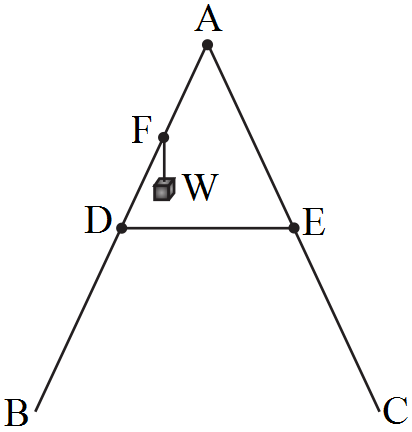
As shown in the two sides of a step ladder BA and CA are 1.6m long and hinged at A. A rope DE, 0.5m is tied half way up. A weight 40kg is suspended from a point F, 1.2m from B along the ladder BA. Assuming the floor to be frictionless and neglecting the weight of the ladder, find the tension in the rope and forces exerted by the floor on the ladder. (Take $g = 9.8m/s^2$​​​​​​​) (Hint: Consider the equilibrium of each side of the ladder separately).
 
View full solution
A solid sphere rolls down two different inclined planes of the same heights but different angles of inclination.
  1. Will it reach the bottom with the same speed in each case?
  2. Will it take longer to roll down one plane than the other?
  3. If so, which one and why?
View full solution
  1. Prove the theorem of perpendicular axes.
(Hint: Square of the distance of a point (x, y) in the x - y plane from an axis through the origin and perpendicular to the plane is $x^2+ y^2$).
  1. Prove the theorem of parallel axes.
(Hint: If the centre of mass of a system of n particles is chosen to be the origin $\sum\text{m}_{\text{i}}\text{r}_\text{i}=0)$
View full solution
Two discs of moments of inertia $I_1$ and $I_2$ about their respective axes (normal to the disc and passing through the centre), and rotating with angular speeds $\omega_1$ and $\omega_2$ are brought into contact face to face with their axes of rotation coincident.
  1. What is the angular speed of the two-disc system?
  2. Show that the kinetic energy of the combined system is less than the sum of the initial kinetic energies of the two discs. How do you account for this loss in energy? Take $\omega_1\neq\omega_2$
View full solution
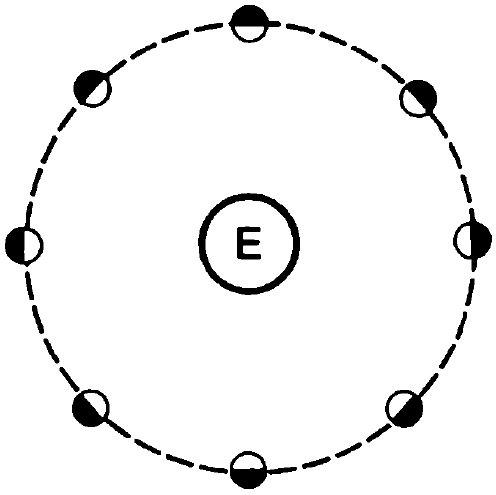
The moon rotates about the earth in such a way that only one hemisphere of the moon faces the earth. Can we ever see the ''other face'' of the moon from the earth? Can a person on the moon ever see all the faces of the earth?
View full solution
A ladder is resting with one end on a vertical wall and the other end on a horizontal floor. Is it more likely to slip when a man stands near the bottom or near the top?
View full solution
What can be said about the centre of mass of a uniform hemisphere without making any calculation? Will its distance from the centre be more than $\frac{\text{r}}{2}$ or less than $\frac{\text{r}}{2}?$
View full solution
Read statement below carefully, and state, with reasons, if it is true or false: During rolling, the force of friction acts in the same direction as the direction of motion of the CM of the body.
View full solution
Read statement below carefully, and state, with reasons, if it is true or false: A wheel moving down a perfectly frictionless inclined plane will undergo slipping (not rolling) motion.
View full solution
Read statement below carefully, and state, with reasons, if it is true or false: The instantaneous acceleration of the point of contact during rolling is zero.
View full solution

Generate a Systems of Particles and Rotational Motion paper free

Pick question groups from the list above, set marks and difficulty, and export a branded PDF with step-by-step answer keys. First 3 chapters free — no signup.

Download App