MCQ
A couple produces:
  • A
    No motion.
  • B
    Linear and rotational motion.
  • C
    Purely rotational motion.
  • D
    Purely linear motion.

Answer

  1. Purely rotational motion.

Explanation:

Hint: The forces that cause something to turn in a circle is called a couple.

A couple is nothing but two equal and opposite forces acting on a body having some separation between their line of action, as shown.
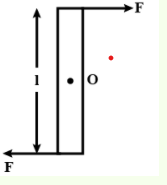
As the net force acting on the rod is zero so there will be no translational motion.

Net torque about O will not be zero as both forces are rotating the rod in the clockwise direction.

Need a full question paper?

Generate a complete, print-ready paper with questions like this in minutes — across 16+ boards, with answer keys.

Start Generating Free

Similar questions

The centre of mass of a body
A projectile is thrown from a point $O$ on the ground at an angle $45^{\circ}$ from the vertical and with a speed $5 \sqrt{2} m / s$. The projectile at the highest point of its trajectory splits into two equal parts. One part falls vertically down to the ground, $0.5 s$ after the splitting. The other part, $t$ seconds after the splitting, falls to the ground at a distance $x$ meters from the point $O$. The acceleration due to gravity $g =10 m / s ^2$.

($1$) The value of $t$ is. . . . . . 

($2$) The value of $x$ is. . . . . 

Give the answer or qution ($1$) and ($2$)
The force exerted by the floor of an elevator on the foot of a person standing there is more than the weight of the person if the elevator is:
  1. Going up and slowing down.
  2. Going up and speeding up.
  3. Going down and slowing down.
  4. Going down and speeding up.
Two rings of radii 1 meter and 5 meter start rolling simultaneously on an inclined plane without slipping. Which ring will reach the earth's surface first?
Three identical particle $A , B$ and $C$ of mass $100\, kg$ each are placed in a straight line with $AB = BC =13 \,m$. The gravitational force on a fourth particle $P$ of the same mass is $F$, when placed at a distance $13 \,m$ from the particle $B$ on the perpendicular bisector of the line $AC$. The value of $F$ will be approximately$....G$
If the velocity $v$ of a particle moving along a straight line decreases linearly with its displacement $s$ from $20\,ms ^{-1}$ to a value approaching zero at $s=30\,m$, then acceleration of the particle at $s=15\,m$ is $........$
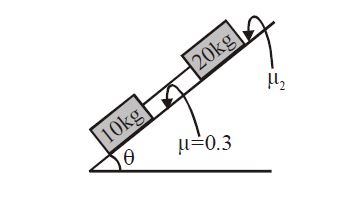
Value of $\theta$  is increased gradually from $\theta  = 0$ At $\theta=tan^{-1}(\frac{1}{2})$ both the block just start slipping. Then value of $\mu_2$ is : $(g = 10 m/s^2)$
Blood velocity: The flow of blood in a large artery of an anesthetised dog is diverted through a Venturi meter. The wider part of the meter has a crosssectional area equal to that of the artery. $A = 8\; mm^2$. The narrower part has an area $a = 4 \;mm^2$. The pressure drop in the artery is $24\; Pa$. What is the speed (in $m/s$) of the blood in the artery?
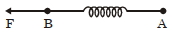
Two masses $A$ and $B ,$ each of mass $M$ are fixed together by a massless spring. $A$ force acts on the mass $B$ as shown in figure. If the mass $A$ starts moving away from mass $B$ with acceleration $'a',$ then the acceleration of mass $B$ wil be :-
A particle moves on the X-axis according to the equation $\text{x}=\text{x}_0\sin^2\omega\text{t.}$ The motion is simple harmonic.
  1. With amplitude x0
  2. With amplitude 2x0
  3. With time period $\frac{2\pi}{\omega}$.
  4. With time period $\frac{\pi}{\omega}.$