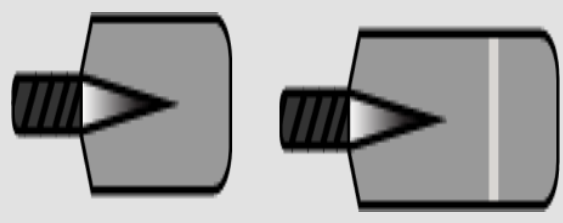
- AThe two pieces will have the same mass.
- BThe bottom piece will have large mass.
- CThe upper piece will have large mass .
- DNone of these.
Question types
Systems of Particles and Rotational Motion question types
697 questions across 8 question groups — pick any mix to generate a Physics paper with step-by-step answer keys.
697
Questions
8
Question groups
5
Question types
01
M.C.Q (1 Marks)
229 Q→02Fill In The Blanks[1 Marks ]
1 Q→03True False[1 Marks ]
5 Q→041 Marks Question
97 Q→052 Marks Questions
74 Q→063 Marks Question
137 Q→074 Marks Question
15 Q→085 Marks Questions
139 Q→Sample Questions
Systems of Particles and Rotational Motion questions
One sample from each question group in this chapter. Select any group above to see the full set with answer keys.
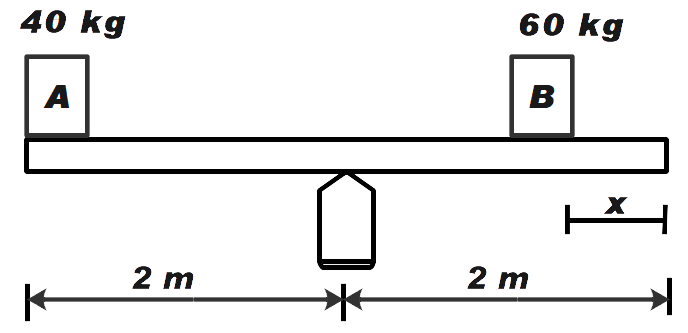
- A$\frac{4}{3}\text{m}$
- B$1\text{m}$
- C$\frac{2}{3}\text{m}$
- D$\text{Zero}$
Eight point masses m that are held in a cubical array by rods of length 1 (whose masses are negligible). Find the moments of inertia of the system about the following axes:
- AAn axis parallel to one face passing through the center of the cube;
- BAn axis coinciding with one edge;
- CAn axis passing through the centers of opposite edges of one face; and
- DAn axis passing through diagonally opposite corners of one face.
Which of the following in the measure of inertia:
- AMomentum
- BMass
- CAcceleration
- DNone of these
Two identical rods of mass M and length I are lying in a horizontal plane at an angle a. The MI of the system of two rods about an axis passing through O and perpendicular to the plane of the rods is:
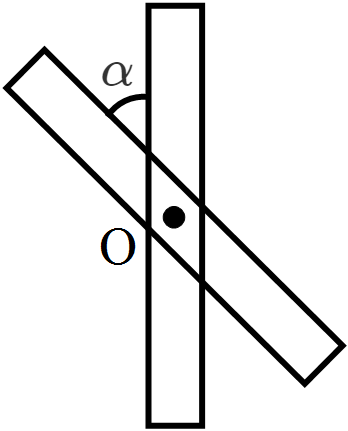
- A$\frac{\text{Ml}^2}{3}$
- B$\frac{\text{Ml}^2}{12}$
- C$\frac{\text{Ml}^2}{4}$
- D$\frac{\text{Ml}^2}{6}$
Geometrically, angular momentum of a particle revolving about an axis is equal to _______.
Read statement below carefully, and state, with reasons, if it is true or false:
The instantaneous speed of the point of contact during rolling is zero.
The instantaneous speed of the point of contact during rolling is zero.
Read statement below carefully, and state, with reasons, if it is true or false:
The instantaneous acceleration of the point of contact during rolling is zero.
The instantaneous acceleration of the point of contact during rolling is zero.
Read statement below carefully, and state, with reasons, if it is true or false:
During rolling, the force of friction acts in the same direction as the direction of motion of the CM of the body.
During rolling, the force of friction acts in the same direction as the direction of motion of the CM of the body.
Read statement below carefully, and state, with reasons, if it is true or false:
For perfect rolling motion, work done against friction is zero.
For perfect rolling motion, work done against friction is zero.
Read statement below carefully, and state, with reasons, if it is true or false:
A wheel moving down a perfectly frictionless inclined plane will undergo slipping (not rolling) motion.
A wheel moving down a perfectly frictionless inclined plane will undergo slipping (not rolling) motion.
Read statement below carefully, and state, with reasons, if it is true or false:
The instantaneous speed of the point of contact during rolling is zero.
The instantaneous speed of the point of contact during rolling is zero.
A cylinder of mass 10kg and radius 15cm is rolling perfectly on a plane of inclination 30°. The coefficient of static friction $\mu_\text{s}= 0.25$
View full solution →- How much is the force of friction acting on the cylinder?
- What is the work done against friction during rolling?
- If the inclination $\theta$ of the plane is increased, at what value of $\theta$ does the cylinder begin to skid, and not roll perfectly?
Read statement below carefully, and state, with reasons, if it is true or false:
The instantaneous acceleration of the point of contact during rolling is zero.
The instantaneous acceleration of the point of contact during rolling is zero.
Read statement below carefully, and state, with reasons, if it is true or false:
During rolling, the force of friction acts in the same direction as the direction of motion of the CM of the body.
During rolling, the force of friction acts in the same direction as the direction of motion of the CM of the body.
Read statement below carefully, and state, with reasons, if it is true or false:
For perfect rolling motion, work done against friction is zero.
For perfect rolling motion, work done against friction is zero.
Give the location of the centre of mass of a:
- Sphere.
- Cylinder.
- Ring, and
- Cube, each of uniform mass density.
Find the torque of a force $7 \tilde{ i }$ $+3 \overline{ j }-5 \tilde{ k }$ about the origin. The force acts on a particle whose position vector is $\tilde{ i }-\tilde{ j }+\tilde{ k }$.
View full solution →Find the scalar and vector products of two vectors. $a =(3 \hat{ i }-4 \hat{ j }+5 \hat{ k })$ and $b =(-2 \hat{ i }+\hat{ j }+3 \hat{ k })$
View full solution →Obtain $\omega=\omega_0+\alpha t$ from first principles.
View full solution →When is a body lying in a gravitation field in stable equilibrium?
A solid cylinder of mass 20kg rotates about its axis with angular speed 100rads-1. The radius of the cylinder is 0.25m. What is the kinetic energy associated with the rotation of the cylinder? What is the magnitude of angular momentum of the cylinder about its axis?
Find the moment of inertia of a sphere about a tangent to the sphere, given the moment of inertia of the sphere about any of its diameters to be 2MR2/ 5, where M is the mass of the sphere and R is the radius of the sphere.
Given the moment of inertia of a disc of mass M and radius R about any of its diameters to be $\frac{\text{MR}^2}{4},$ find its moment of inertia about an axis normal to the disc and passing through a point on its edge.
View full solution →To maintain a rotor at a uniform angular speed of 200rad s-1, an engine needs to transmit a torque of 180Nm. What is the power required by the engine?
(Note: uniform angular velocity in the absence of friction implies zero torque. In practice, applied torque is needed to counter frictional torque). Assume that the engine is 100% efficient.
(Note: uniform angular velocity in the absence of friction implies zero torque. In practice, applied torque is needed to counter frictional torque). Assume that the engine is 100% efficient.
Show that the child’s new kinetic energy of rotation is more than the initial kinetic energy of rotation. How do you account for this increase in kinetic energy?
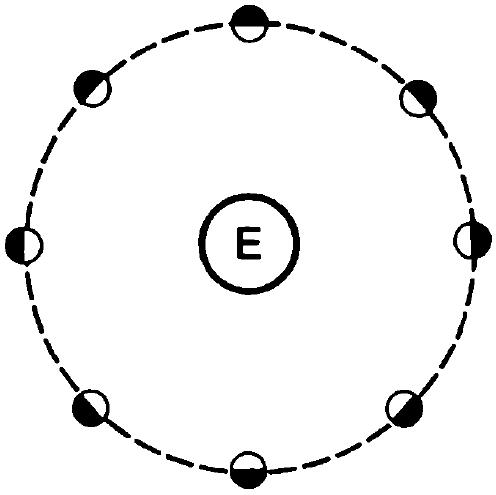
The moon rotates about the earth in such a way that only one hemisphere of the moon faces the earth. Can we ever see the ''other face'' of the moon from the earth? Can a person on the moon ever see all the faces of the earth?
A ladder is resting with one end on a vertical wall and the other end on a horizontal floor. Is it more likely to slip when a man stands near the bottom or near the top?
Mr. Verma (50kg) and Mr. Mathur (60kg) are sitting at the two extremes of a 4m long boat (40kg) standing still in water. To discuss a mechanics problem, they come to the middle of the boat. Neglecting friction with water, how far does the boat move on the water during the process?
A kid of mass M stands at the edge of a platform of radius R which can be freely rotated about its axis. The moment of inertia of the platform is I. The system is at rest when a friend throws a ball of mass m and the kid catches it. If the velocity of the ball is v horizontally along the tangent to the edge of the platform when it was caught by the kid, find the angular speed of the platform after the event.
The weight Mg of an extended body is generally shown in a diagram to act through the centre of mass. Does it mean that the earth does not attract other particles?
A solid disc and a ring, both of radius 10cm are placed on a horizontal table simultaneously, with initial angular speed equal to 10 π rad s-1. Which of the two will start to roll earlier? The co-efficient of kinetic friction is $\mu_\text{k}=0.2$
View full solution →Prove the result that the velocity v of translation of a rolling body (like a ring, disc, cylinder or sphere) at the bottom of an inclined plane of a height h is given by $\text{v}^2=\frac{2\text{gh}}{\Big(\frac{1+\text{k}^2}{\text{R}^2}\Big)}$ using dynamical consideration (i.e. by consideration of forces and torques).
Note: k is the radius of gyration of the body about its symmetry axis, and R is the radius of the body. The body starts from rest at the top of the plane.
View full solution →Note: k is the radius of gyration of the body about its symmetry axis, and R is the radius of the body. The body starts from rest at the top of the plane.
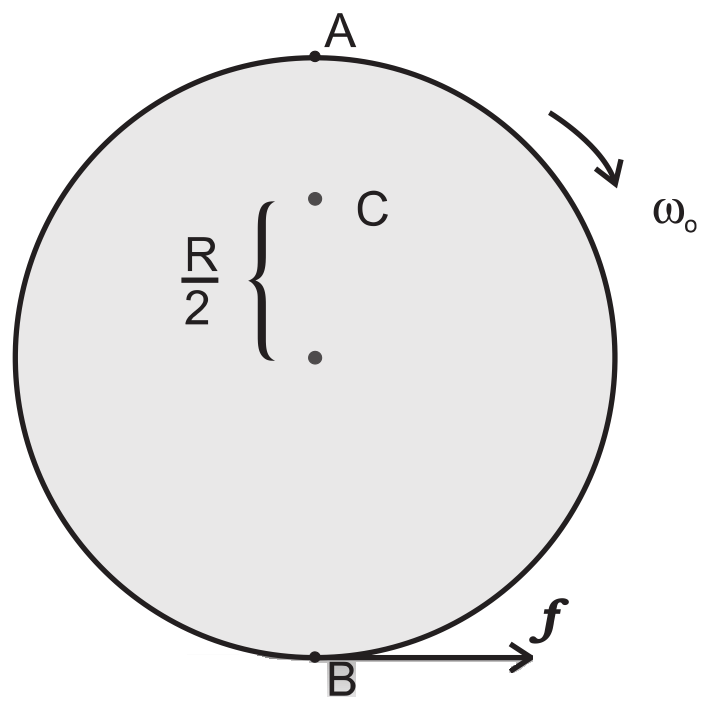
A disc rotating about its axis with angular speed $\omega_0$ is placed lightly (without any translational push) on a perfectly frictionless table. The radius of the disc is R. What are the linear velocities of the points A, B and C on the disc shown in will the disc roll in the direction indicated?
View full solution →The oxygen molecule has a mass of 5.30 × 10⁻²⁶kg and a moment of inertia of 1.94 × 10-46kgm2 about an axis through its centre perpendicular to the lines joining the two atoms. Suppose the mean speed of such a molecule in a gas is 500m/s and that its kinetic energy of rotation is two thirds of its kinetic energy of translation. Find the average angular velocity of the molecule.
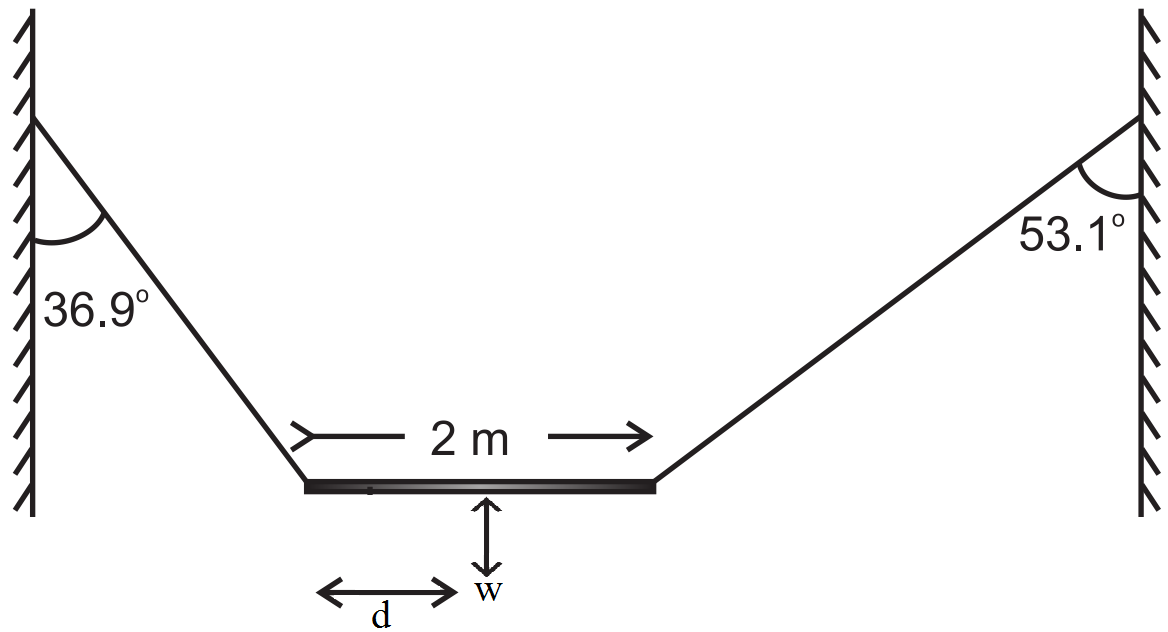
A non-uniform bar of weight W is suspended at rest by two strings of negligible weight as shown in. The angles made by the strings with the vertical are 36.9° and 53.1° respectively. The bar is 2m long. Calculate the distance d of the centre of gravity of the bar from its left end.
Generate a Systems of Particles and Rotational Motion paper free
Pick question groups from the list above, set marks and difficulty, and export a branded PDF with step-by-step answer keys. First 3 chapters free — no signup.