MCQ
A couple produces
  • A
    Purely linear motion                 
  • Purely rotational motion
  • C
    Linear and rotational motion
  • D
    No motion

Answer

Correct option: B.
Purely rotational motion
b
Couple (formed by two equal and opposite forces) produces purely rotational motion.

Need a full question paper?

Generate a complete, print-ready paper with questions like this in minutes — across 16+ boards, with answer keys.
Start Generating Free

Similar questions

Two circular loops of equal radii are placed coaxially at some separation. The first is cut and a battery is inserted in between to drive a current in it. The current c~anges slightly because of the variation in resistance with temperature. During this period, the two loops:
  1. Attract each other.
  2. Repel each other.
  3. Do not exert any force on each other.
  4. Attract or repel each other depending on the sense of the current.
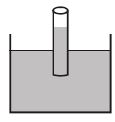
A long capillary tube of mass $'\pi '\,gm$ , radius $2\,mm$ and negligible thickness, is partially immersed in a liquid of surface tension $0.1\,N/m$ . Take angle of contact zero and neglect buoyant force of liquid. Find the force required to hold the tube vertically. $(g = 10\,m/s^2)$
$Assertion$ : When a particle moves in a circle with a uniform speed, its velocity and acceleration both changes.

$Reason$ : The centripetal acceleration in circular motion is dependent on angular velocity of the body.
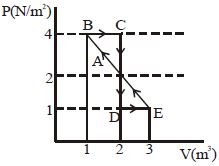
One mole of a monoatomic gas is carried along process $ABCDEA$ as shown in diagram. Find the net work done by gas ......... $J$
A beaker containing a liquid is kept inside a big closed jar. If the air inside the jar is continuously pumped out the pressure in the liquid near the bottom of the liquid will:
  1. Increase
  2. Decrease
  3. Remain constant
  4. First decrease and then increase.
The maximum velocity of a body undergoing $S.H.M$. is $0.2\,m/s$ and its acceleration at $0.1\,m$ from the mean position is $0.4\,m/s^2$. The amplitude of the $S.H.M.$ is .... $m$
Which of the following parameters is the same for molecules of all gases at a given temperature?
Sound waves of wavelength $\pi$ travelling in a medium with a speed of v m/ s enter into another medium where its speed is 2v m/ s. Wavelength of sound waves in the second medium is:

  1. $\pi$

  2. $\frac{\pi}{2}$

  3. $2\pi$

  4. $4\pi$

A particle is constrained to move on a straight line path. It returns to the starting point after $10\, sec$. The total distance covered by the particle during this time is $30\, m$. Which of the following statements about the motion of the particle is false
Dimensions of time in power are