MCQ
Dimensions of time in power are
- A${T^{ - 1}}$
- B${T^{ - 2}}$
- ✓${T^{ - 3}}$
- D${T^0}$
Generate a complete, print-ready paper with questions like this in minutes — across 16+ boards, with answer keys.
($A.F.$ = adhesive force, $C.F.$ = cohesive force)
$\frac{1}{2}\overrightarrow{\text{a}}$
$\overrightarrow{\text{a}}$
$2\overrightarrow{\text{a}}$
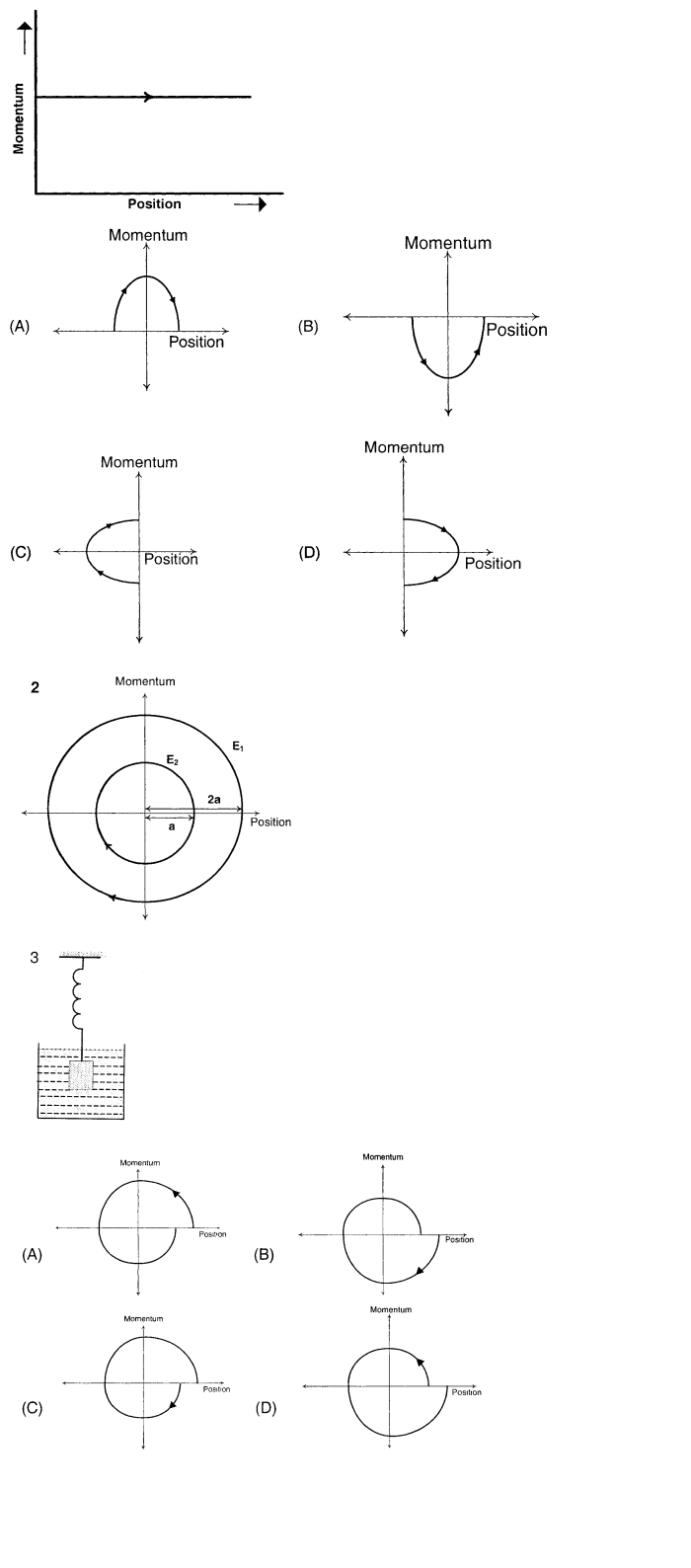
$1.$ The phase space diagram for a ball thrown vertically up from ground is
mcq $Image$
$2.$ The phase space diagram for simple harmonic motion is a circle centered at the origin. In the figure, the two circles represent the same oscillator but for different initial conditions, and $E_1$ and $E_2$ are the total mechanical energies respectively. Then $Image$
$(A)$ $ E_1=\sqrt{2} E_2$ $(B)$ $ E_1=2 E_2$
$(C)$ $ E_1=4 E_2$ $(D)$ $ E_1=16 E_2$
$3.$ Consider the spring-mass system, with the mass submerged in water, as shown in the figure. The phase space diagram for one cycle of this system is $Image$
mcq $Image$
Give the answer question $1,2$ and $3.$