MCQ
A cricketer can throw a ball to a maximum horizontal distance of $100 \,m$. With the same effort, he throws the ball vertically upwards. The maximum height attained by the ball is  ......... $m$
  • A
    $100$
  • B
    $80 $
  • C
    $60$
  • $50 $

Answer

Correct option: D.
$50 $
d
(d) Maximum range $ = \frac{{{u^2}}}{g} = 100\,m$
 Maximum height $ = \frac{{{u^2}}}{{2g}} = \frac{{100}}{2} = 50\,m$

Need a full question paper?

Generate a complete, print-ready paper with questions like this in minutes — across 16+ boards, with answer keys.

Start Generating Free

Similar questions

If wavelength of a wave is $\lambda = 6000Å.$ Then wave number will be
Statement$-1:$ Two longitudinal waves given by equations $y _{1}( x , t )=2 a \sin (\omega t - kx )$ and $y _{2}( x , t )= a \sin (2 \omega t -2 kx )$ will have equal intensity.

Statement$-2:$ Intensity of waves of given frequency in same medium is proportional to square of amplitude only.

A bullet of $'4\,g'$ mass is fired from a gun of mass $4 \,{kg}$. If the bullet moves with the muzzle speed of $50\, {ms}^{-1}$, the impulse imparted to the gun and velocity of recoil of gun are :
The following four wires of length $L$ and radius $r$ are made of the same material. Which of these will have the largest extension, when the same tension is applied?
A ball falling freely from a height of $4.9\,m,$ hits a horizontal surface. If $e = \frac {3}{4}$ , then the ball will hit the surface, second time after .............. $\mathrm{s}$
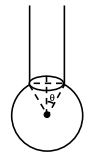
When liquid medicine of density $\rho$ is to be put in the eye, it is done with the help of a dropper. As the bulb on the top of the dropper is pressed, a drop forms at the opening of the dropper. We wish to estimate the size of the drop. We first assume that the drop formed at the opening is spherical because that requires a minimum increase in its surface energy. To determine the size, we calculate the net vertical force due to the surface tension $T$ when the radius of the drop is $\mathrm{R}$. When the force becomes smaller than the weight of the drop, the drop gets detached from the dropper.

$1.$ If the radius of the opening of the dropper is $\mathrm{r}$, the vertical force due to the surface tension on the drop of radius $R$ (assuming $\mathrm{r} \ll R$ ) is

$(A)$ $2 \pi r T$ $(B)$ $2 \pi R T$ $(C)$ $\frac{2 \pi r^2 T}{R}$ $(D)$ $\frac{2 \pi R^2 T}{r}$

$2.$ If $\mathrm{r}=5 \times 10^{-4} \mathrm{~m}, \rho=10^3 \mathrm{~kg} \mathrm{~m}^{-3}, \mathrm{~g}=10 \mathrm{~m} / \mathrm{s}^2, \mathrm{~T}=0.11 \mathrm{Nm}^{-1}$, the radius of the drop when it detaches from the dropper is approximately

$(A)$ $1.4 \times 10^{-3} \mathrm{~m}$ $(B)$ $3.3 \times 10^{-3} \mathrm{~m}$

$(C)$ $2.0 \times 10^{-3} \mathrm{~m}$ $(D)$ $4.1 \times 10^{-3} \mathrm{~m}$

$3.$ After the drop detaches, its surface energy is

$(A)$ $1.4 \times 10^{-6} \mathrm{~J}$ $(B)$ $2.7 \times 10^{-6} \mathrm{~J}$

$(C)$ $5.4 \times 10^{-6} \mathrm{~J}$ $(D)$ $8.1 \times 10^{-6} \mathrm{~J}$

Give the answer question $1,2$ and $3.$
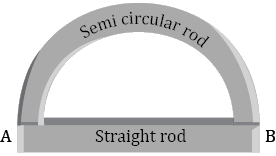
Two rods (one semi-circular and other straight) of same material and of same cross-sectional area are joined as shown in the figure. The points $A$ and $B$ are maintained at different temperature. The ratio of the heat transferred through a cross-section of a semi-circular rod to the heat transferred through a cross section of the straight rod in a given time is
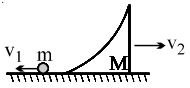
A particle of mass $m$ moving horizontally with $v_0$ strikes $a$ smooth wedge of mass $M$, as shown in figure. After collision, the ball starts moving up the inclined face of the wedge and rises to $a$ height $h$. Suppose the particle when reaches the horizontal surfaces, its velocity with respect to ground is $v_1$ and that of wedge is $v_2$. Choose the correct statement(s)
An ideal gas undergoes an adiabatic process obeying the relation $PV^{4/3} =$ constant. If its initial temperature is $300\,\, K$ and then its pressure is increased upto four times its initial value, then the final temperature is (in Kelvin):
A cyclist riding the bicycle at a speed of $14\sqrt 3  ms^{-1}$takes a turn around a circular road of radius  $20\sqrt 3 $ m without skidding. Given $g = 9.8 ms^{-2},$ what is his inclination to the vertical ....... $^o$