MCQ
A cyclist riding the bicycle at a speed of $14\sqrt 3  ms^{-1}$takes a turn around a circular road of radius  $20\sqrt 3 $ m without skidding. Given $g = 9.8 ms^{-2},$ what is his inclination to the vertical ....... $^o$
  • A
    $30$
  • B
    $90$
  • C
    $45$
  • $60$

Answer

Correct option: D.
$60$
d
(d)$\theta = {\tan ^{ - 1}}\left( {\frac{{{v^2}}}{{rg}}} \right) = {\tan ^{ - 1}}\left[ {\frac{{{{(14\sqrt 3 )}^2}}}{{20\sqrt 3 \times 9.8}}} \right] = {\tan ^{ - 1}}[\sqrt 3 ]$$ = 60^\circ $

Need a full question paper?

Generate a complete, print-ready paper with questions like this in minutes — across 16+ boards, with answer keys.

Start Generating Free

Similar questions

A steel ball of radius $2\, cm$ is at rest on a frictionless surface. Another ball of radius $4\,cm$ moving at a velocity of $81 \,cm/sec$ collides elastically with first ball. After collision the smaller ball moves with speed of ............. $\mathrm{cm} / \mathrm{sec}$
A ring and a solid sphere rotating about an axis passing through their centers have same radii of gyration. The axis of rotation is perpendicular to plane of ring. The ratio of radius of ring to that of sphere is $\sqrt{\frac{2}{x}}$. The value of $x$ is $.......$
The equation of stationary wave along a stretched string is given by $y = 5\sin \frac{{\pi x}}{3}\cos 40\pi t$, where $x $ and $y$ are in $cm$ and $t$ in second. The separation between two adjacent nodes is..... $cm$
Two bodies $A$ & $B$ rotate about an axis, such that angle $\theta_A$ (in radians) covered by first body is proportional to square of time, & $\theta_B$ (in radians) covered by second body varies linearly. At $t = 0, \theta \,A = \theta \,B = 0$. If $A$ completes its first revolution in $\sqrt \pi$ sec. & $B$ needs $4\pi \,sec$. to complete half revolution then; angular velocity $\omega_A : \omega_B$ at $t = 5\, sec$. are in the ratio
The pair having the same dimensions is
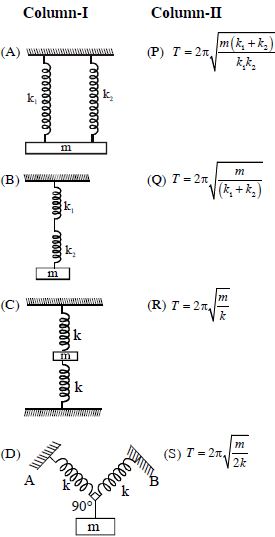
In the following questions, match column $-I$ with column $-II$ and choose the correct options
The period of oscillation of a simple pendulum in the experiment is recorded as $2.63\, s, 2.56 s, 2.42\, s, 2.71\, s$ and $2.80 \,s$ respectively. The average absolute error is ......... $s$
The amplitude of a particle executing $S.H.M.$ with frequency of $60 \,Hz$ is $0.01 \,m$. The maximum value of the acceleration of the particle is
A wave equation which gives the displacement along the $Y$ direction is given by the equation $y = {10^4}\sin (60t + 2x)$, where $x$ and $y$ are in metres and $t$ is time in seconds. This represents a wave
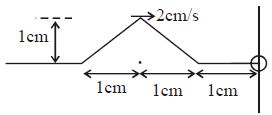
A trianguler pulse moving at $2\ cm/s$ on a rope approches an end at which it is free to slide on vertical pole. What is the particle speed at the free end at $\frac{3}{4}\  sec$  from the instant shown ...... $cm/s$