A cube of aluminium of sides $0.1\, m$ is subjected to a shearing force of $100\, N$. The top face of the cube is displaced through $0.02 \,cm$ with respect to the bottom face. The shearing strain would be
Easy


Download our appand get started for free
Experience the future of education. Simply download our apps or reach out to us for more information. Let's shape the future of learning together!No signup needed.*
Similar Questions
- 1View SolutionStress vs strain curve for the elastic tissue of the aorta, the large tube (vessel) carrying blood from the heart, will be : [stress is proportional to square of the strain for the elastic tissue of the aorta]
- 2View SolutionIn solids, inter-atomic forces are
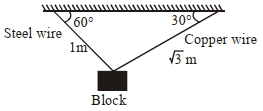
- 3A block of weight $100 N$ is suspended by copper and steel wires of same cross sectional area $0.5 cm ^2$ and, length $\sqrt{3} m$ and $1 m$, respectively. Their other ends are fixed on a ceiling as shown in figure. The angles subtended by copper and steel wires with ceiling are $30^{\circ}$ and $60^{\circ}$, respectively. If elongation in copper wire is $\left(\Delta \ell_{ C }\right)$ and elongation in steel wire is $\left(\Delta \ell_{ s }\right)$, then the ratio $\frac{\Delta \ell_{ C }}{\Delta \ell_{ S }}$ is. . . . . .View Solution
[Young's modulus for copper and steel are $1 \times 10^{11} N / m ^2$ and $2 \times 10^{11} N / m ^2$ respectively]
- 4On applying a stress of $20 \times {10^8}N/{m^2}$ the length of a perfectly elastic wire is doubled. Its Young’s modulus will beView Solution
- 5A wire of length $L$ is hanging from a fixed support. The length changes to $L _{1}$ and $L _{2}$ when masses $1 \,kg$ and $2 \,kg$ are suspended respectively from its free end. Then the value of $L$ is equal to ..................View Solution
- 6The compressibility of water is $6 \times 10^{-10} N ^{-1} m ^{2} .$ If one litre is subjected to a pressure of $4 \times 10^{7} Nm ^{-2}$ the decrease in its volume is (in $cc$)View Solution
- 7A wire is suspended by one end. At the other end a weight equivalent to $20\, N$ force is applied. If the increase in length is $1.0\, mm$, the increase in energy of the wire will be ....... $joule$View Solution
- 8View SolutionThe breaking stress of a wire depends upon
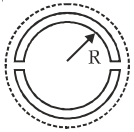
- 9A wooden wheel of radius $R$ is made of two semicircular part (see figure). The two parts are held together by a ring made of a metal strip of cross section area $S$ and length $L$. $L$ is slighly less than $2\pi R$. To fit the ring on the wheel, it is heated so that its temperature rises by $\Delta T$ and it just steps over the wheel.As it cools down to surronding temperature, it presses the semicircular parts together. If the coefficint of linear expansion of the metal is $\alpha$, and its young's modulus is $Y$, the force that one part of wheel applies on the other part isView Solution
- 10View SolutionThe longitudinal strain is only possible in