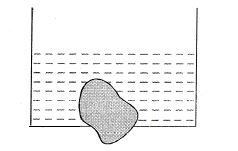
A cubical block of steel of each side equal to $l$ is floating on mercury in a vessel. The densities of steel and mercury ar $\rho _s$ and $\rho _m$ . The height of the block above the mercury level is given by
Medium
Download our app for free and get started
Volume of block $ = {l^3}$. Let h be the height of the block above the surface of mercury. Volume of mercury displaced $ = (l - {\rm{h}}){l^2}.$ Weight of mercury displaced $ = (l - {\rm{h}}){l^2}{\rho _{\rm{m}}}{\rm{g}}.$ This is equal to the weight of the block which is ${\rho _{\rm{s}}}{l^3}.$
Thus $(l - {\rm{h}}){l^2}{\rho _{\rm{m}}}{\rm{g}} = {\rho _{\rm{s}}}{l^3}{\rm{g}}$
which gives $h = l\left( {1 - \frac{{{\rho _s}}}{{{\rho _{\rm{m}}}}}} \right)$

Download our appand get started for free
Experience the future of education. Simply download our apps or reach out to us for more information. Let's shape the future of learning together!No signup needed.*
Similar Questions
- 1A liquid is kept in a cylindrical vessel. When the vessel is rotated about its axis, the liquid rises at its sides. If the radius of the vessel is $0.05\,\, m$ and the speed of rotation is $2$ revolutions per second, the difference in the heights of the liquid at the centre and at the sides of the vessels will be ...... $cm.$ $($ take $g = 10\,\, ms^{-2}$ and $\pi^2 = 10)$View Solution
- 2$10,000 $ small balls, each weighing $1\, gm$, strike one square cm of area per second with a velocity $100 \,m/s$ in a normal direction and rebound with the same velocity. The value of pressure on the surface will beView Solution
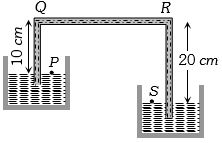
- 3A siphon in use is demonstrated in the following figure. The density of the liquid flowing in siphon is $ 1.5 gm/cc. $ The pressure difference between the point $P$ and $S$ will beView Solution
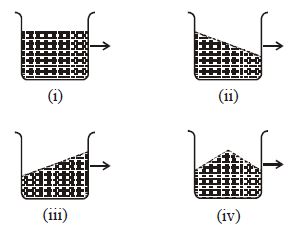
- 4View SolutionA vessel containing water is moving with a constant speed towards right along a straight horizontal path. Which of the following diagrams represents the surface of liquid?
- 5The approximate depth of an ocean is $2700\,\, m.$ The compressibility of water is $45.4 \times 10^{-11} Pa^{-1}$ and density of water is $10^3 \,kg/m^3 $. What fractional compression of water will be obtained at the bottom of the ocean?View Solution
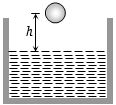
- 6A ball of radius $r $ and density $\rho$ falls freely under gravity through a distance $h$ before entering water. Velocity of ball does not change even on entering water. If viscosity of water is $\eta$, the value of $h$ is given byView Solution
- 7A solid sphere of specific gravity $27$ has a concentric spherical cavity and it just sinks in water. The ratio of cavity radius to that of outer radius of sphere isView Solution
- 8A cylindrical tank of height $1$ $m$ and cross section area $A$ $=$ $4000$ $cm^2$ is initially empty when it is kept under a tap of cross sectional area $1$ $cm^2$. Water starts flowing from the tap at $t$ $=$ $0$, with a speed $= $ $2$ $m/s$. There is a small hole in the base of the tank of cross-sectional area $0.5$ $cm^2$. The variation of height of water in tank (in meters) with time $t$ is best depicted byView Solution
- 9An object is fitted in a hole at base of a container as shown in figure, the force due to liquid on object is (Assume no leakage of water, volume of object inside container is $V$ and density of liquid is $\rho $ )View Solution
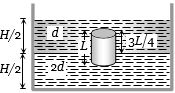
- 10A homogeneous solid cylinder of length $L$$(L < H/2)$. Cross-sectional area $A/5$ is immersed such that it floats with its axis vertical at the liquid-liquid interface with length $L/4$ in the denser liquid as shown in the fig. The lower density liquid is open to atmosphere having pressure ${P_0}$. Then density $D$ of solid is given byView Solution