MCQ
A current-carrying conductor is held in exactly vertical direction. In order to produce a clockwise magnetic field around the conductor, the current should passed in the conductor:
  • A
    From top towards bottom.
  • B
    From left towards right.
  • C
    From bottom towards top.
  • D
    From right towards left.

Answer

  1. From top towards bottom.

Explanation:

It is given that the current-carrying conductor is held in exactly vertical direction. In order to produce a clockwise magnetic field around the conductor, the current should be passed in the conductor from top towards bottom. It is concluded by applying right-hand thumb rule.

Need a full question paper?

Generate a complete, print-ready paper with questions like this in minutes — across 16+ boards, with answer keys.

Start Generating Free

Similar questions

A piece of wire of resistance R is drawn to double its length. The new resistance is.
The pattern of the magnetic field produced by the straight current carrying conducting wire is:
The strength of magnetic field produced by current carrying solenoid depends on.
Change in focal length of an eye-lens to focus the image of the object at varying distances is done by the action of:
To obtain a magnification of, -0.5 with a convex lens, the object should be placed:
  1. At F
  2. Between optical centre and F.
  3. Between F and 2F.
  4. Beyond 2F.
A teacher sets up the stand carrying a convex lens of focal length 15cm at 42.7cm mark on the optical bench. He asks four students A, B, C and D to suggest the position of screen on the optical bench so that a distinct image of a distant tree is obtained almost immediately on it. The positions suggested by the students were as:
  1. 12.7cm.
  2. 29.7cm.
  3. 57.7cm.
  4. 72.7cm.
The correct position of the screen was suggested by.
An electric bulb is rated 220V and 100W. When it is operated on 110V, the power consumed will be:
A rectangular coil of copper wire is rotated in a magnetic field. The direction of induced current changes once in each:
  1. Two revolutions.
  2. One revolution.
  3. Half revolutionH.
  4. One-fourth revolution.
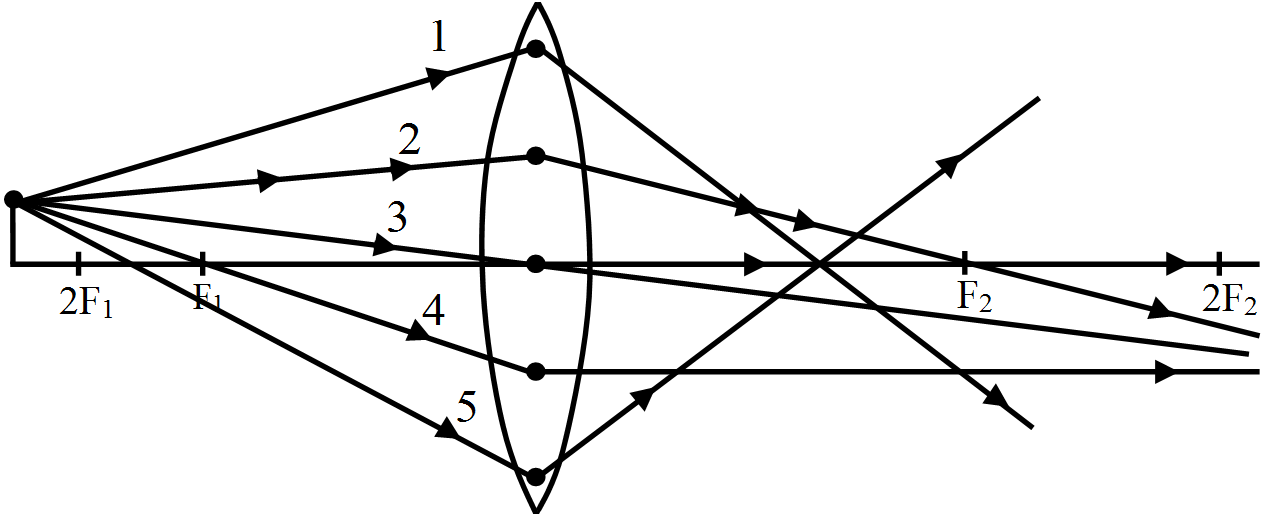
Out of the five incident rays shown in the figure find the three rays that are obeying the laws of refraction and may be used for locating the position of image formed by a convex lens:
An electron is moving towards east in a magnetic field acting vertically downwards. So the electron is deflected towards: