MCQ
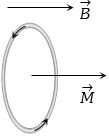
A current carrying loop is free to turn in a uniform magnetic field. The loop will then come into equilibrium when its plane is inclined at
  • A
    $0^\circ $ to the direction of the field
  • B
    $45^\circ $ to the direction of the field
  • $90^\circ $ to the direction of the field
  • D
    $135^\circ $ to the direction of the field

Answer

Correct option: C.
$90^\circ $ to the direction of the field
c
In equilibrium angle between $\overrightarrow M $and $\overrightarrow B $ is zero. It is happened, when plane of the coil is perpendicular to $\overrightarrow B $

Need a full question paper?

Generate a complete, print-ready paper with questions like this in minutes — across 16+ boards, with answer keys.

Start Generating Free

Similar questions

If the intensity of the radiation incident on a photo$-$sensitive plate is doubled, how does the stopping potential change?
There are ${n_1}$ photons of frequency ${\gamma _1}$ in a beam of light. In an equally energetic beam, there are ${n_2}$ photons of frequency ${\gamma _2}$. Then the correct relation is
According to de-Broglie, the de-Broglie wavelength for electron in an orbit of hydrogen atom is $10^{-9} m$. The principle quantum number for this electron is
In a charge free region, electric field lines can be taken to be continuous curves:
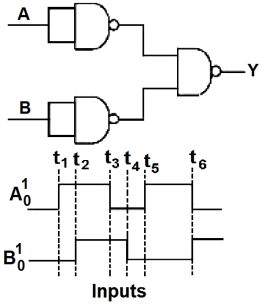
The output waveform of the given logical circuit for the following inputs $A$ and $B$ as shown below, is:
Five cells each of emf $E$ and internal resistance $r$ are connected in series. Due to oversight one cell is connected wrongly. The equivalent internal resistance of the combination is ........... $r$
A charged particle moves in a uniform magnetic field. The velocity of the particle at some instant makes an acute angle with the magnetic field. The path of the particle will be:
The radius of a circular current carrying coil is $R$. At what distance from the centre of the coil on its axis, the intensity of magnetic field will be $\frac{1}{2 \sqrt{2}}$ times that at the centre?
Which is reverse biased diode
 
A number of capacitors each of capacitance $1\,\mu F$ and each one of which get punctured if a potential difference just exceeding $500\,volt$ is applied, are provide, then an arrangement suitable for givin  a capacitance of $2\,\mu F$ across which $3000\,volt$ may be applied requires at least