MCQ 11 Mark
A tightly wound $100$ turns coil of radius $10 \mathrm{~cm}$ carries a current of $7 \mathrm{~A}$. The magnitude of the magnetic field at the centre of the coil is (Take permeability of free space as $4 \pi \times 10^{-7} \mathrm{SI}$ units):
- A
$4.4 \mathrm{~T}$
- ✓
$4.4 \mathrm{mT}$
- C
$44 \mathrm{~T}$
- D
$44 \mathrm{mT}$
AnswerCorrect option: B. $4.4 \mathrm{mT}$
b
The magnitude of magnetic field due to circular coil of $N$ turns is given by
$B_c=\frac{\mu_0 i N}{2 R} $
$=\frac{4 \pi \times 10^{-7} \times 7 \times 100}{2 \times 0.1} $
$=4.4 \times 10^{-3} \mathrm{~T} $
$=4.4 \mathrm{mT}$
View full question & answer→MCQ 21 Mark
In a uniform magnetic field of $0.049 \mathrm{~T}$, a magnetic needle performs $20$ complete oscillations in $5$ seconds as shown. The moment of inertia of the needle is $9.8 \times 10^{-5} \mathrm{~kg} \mathrm{~m}^2$. If the magnitude of magnetic moment of the needle is $x \times 10^{-5} \mathrm{Am}^2$, then the value of ' $x$ ' is :
- A
$128 \pi^2$
- B
$50 \pi^2$
- ✓
$1280 \pi^2$
- D
$5 \pi^2$
AnswerCorrect option: C. $1280 \pi^2$
c
Time period of Oscillation, $T=2 \pi \sqrt{\frac{1}{M B}}$
$\Rightarrow \frac{1}{4}=2 \pi \sqrt{\frac{9.8 \times 10^{-6}}{M \times 0.049}}$
$\Rightarrow \frac{1}{16}=4 \pi^2 \times \frac{9.8 \times 10^{-6}}{M \times 49 \times 10^{-3}}$
$\Rightarrow M=\frac{4 \pi^2 \times 9.8 \times 10^{-6}}{49 \times 10^{-3}} \times 16$
$\frac{4 \pi^2 \times 9.8 \times 16 \times 10^{-3}}{49}$
$\quad=12.8 \pi^2 \times 10^{-3} \times 10^{-2} \times 10^2$
$=1280 \pi^2 \times 10^{-5} \mathrm{Am}^2$
View full question & answer→MCQ 31 Mark
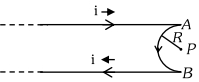
A very long conducting wire is bent in a semicircular shape from $A$ to $B$ as shown in figure. The magnetic field at point $P$ for steady current configuration is given by:
- A
$\frac{\mu_0 i }{4 R }\left[1-\frac{2}{\pi}\right]$ pointed into the page
- B
$\frac{\mu_0 i }{4 R }$ pointed into the page
- C
$\frac{\mu_0 i }{4 R }$ pointed away from the page
- ✓
$\frac{\mu_0 i }{4 R }\left[1-\frac{2}{\pi}\right]$ pointed away from page
AnswerCorrect option: D. $\frac{\mu_0 i }{4 R }\left[1-\frac{2}{\pi}\right]$ pointed away from page
d
$B =\frac{\mu_0}{4 \pi} \frac{I}{R}(\pi)-\frac{\mu_0}{4 \pi} \frac{2 I }{ R }$
$=\frac{\mu_0 I }{4 R }\left[1-\frac{2}{\pi}\right] \text { outward i.e away from page. }$
View full question & answer→MCQ 41 Mark
A wire carrying a current $I$ along the positive $x$-axis has length $L$ It is kept in a magnetic field $\overrightarrow{ B }=(2 \hat{ i }+3 \hat{ j }-4 \hat{ k }) T$. The magnitude of the magnetic force acting on the wire is $..........IL$
- A
$\sqrt{3}$
- B
$3$
- C
$\sqrt{5}$
- ✓
$5$
Answerd
$\overrightarrow{ F } = I (\vec{\ell} \times \overrightarrow{ B })$
$= I [( L \hat{ i }) \times(2 \hat{ i }+3 \hat{ j }-4 \hat{ k })]$
$= I (4 L \hat{ j }+3 L \hat{ k })$
$|\overrightarrow{ F }| =5\,IL$
View full question & answer→MCQ 51 Mark
Given below are two statements$:$
Statement $I:$ Biot-Savart's law gives us the expression for the magnetic field strength of an infinitesimal current element (IdI) of a current carrying conductor only.
Statement $II :$ Biot-Savart's law is analogous to Coulomb's inverse square law of charge $q$, with the former being related to the field produced by a scalar source, Idl while the latter being produced by a vector source, $q$. In light of above statements choose the most appropriate answer from the options given below:
- A
Both Statement $I$ and Statement $II$ are incorrect
- ✓
Statement $I$ is correct and Statement $II$ is incorrect
- C
Statement $I$ is incorrect and Statement $II$ is correct
- D
Both Statement $I$ and Statement $II$ are correct
AnswerCorrect option: B. Statement $I$ is correct and Statement $II$ is incorrect
b
$d \overrightarrow{ B }=\frac{\mu_{0}( Id \vec{\ell} \times \overrightarrow{ r })}{4 \pi r ^{3}}$
As per Biot Savart law, the expression for magnetic field depends on current carrying element $\operatorname{Id} \vec{\ell}$, which is a vector quantity, therefore, statement-I is correct and statement-II is wrong.
View full question & answer→MCQ 61 Mark
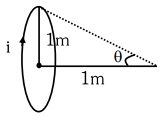
The magnetic field on the axis of a circular loop of radius $100\,cm$ carrying current $I=\sqrt{2}\,A$, at point $1\,m$ away from the centre of the loop is given by
- ✓
$3.14 \times 10^{-7}\,T$
- B
$6.28 \times 10^{-7}\,T$
- C
$3.14 \times 10^{-4}\,T$
- D
$6.28 \times 10^{-4}\,T$
AnswerCorrect option: A. $3.14 \times 10^{-7}\,T$
a
$B _{ A }= B _0 \sin ^3 \theta$
$=\frac{\mu_0 i }{2 R } \times \sin ^3 \theta$
$=\frac{4 \pi \times 10^{-7} \times \sqrt{2}}{2 \times 1} \times\left(\frac{1}{2 \sqrt{2}}\right)$
$B _{ A }=3.14 \times 10^{-7}\,T$
View full question & answer→MCQ 71 Mark
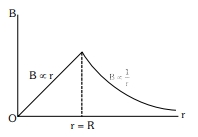
From Ampere's circuital law for a long straight wire of circular cross-section carrying a steady current, the variation of magnetic field in the inside and outside region of the wire is :
AnswerCorrect option: B. a linearly increasing function of distance $r$ upto the boundary of the wire and then decreasing one with $1 / r$ dependence for the outside region.
b
View full question & answer→MCQ 81 Mark
A closely packed coil having $1000$ turns has an average radius of $62.8\,cm$. If current carried by the wire of the coil is $1\,A$, the value of magnetic field produced at the centre of the coil will be (permeability of free space $=4 \pi \times 10^{-7}\,H / m$ ) nearly
- A
$10^{-1}\,T$
- B
$10^{-2}\,T$
- C
$10^{2}\,T$
- ✓
$10^{-3}\,T$
AnswerCorrect option: D. $10^{-3}\,T$
d
$B =\frac{\mu_0 Ni }{2 R }$
$=\frac{4 \pi \times 10^{-7} \times 1000 \times 1}{2 \times 62.8 \times 10^{-2}}$
$=\frac{4 \times 3.14 \times 10^{-7} \times 10^3}{2 \times 62.8 \times 10^{-2}}$
$=10^{-3}\,T$
View full question & answer→MCQ 91 Mark
A long solenoid of radius $1\,mm$ has $100 $turns per $mm$. If $1\,A$ current flows in the solenoid, the magnetic field strength at the centre of the solenoid is:
- ✓
$12.56 \times 10^{-2}\,T$
- B
$12.56 \times 10^{-4}\,T$
- C
$6.28 \times 10^{-4}\,T$
- D
$6.28 \times 10^{-2}\,T$
AnswerCorrect option: A. $12.56 \times 10^{-2}\,T$
a
$B =\mu_{0} ni =\mu_{0} \frac{ N }{\ell} i$
$\therefore B =4 \pi \times 10^{-7} \times \frac{100}{10^{-3}} \times 1=12.56 \times 10^{-2} T$
View full question & answer→MCQ 101 Mark
The shape of the magnetic field lines due to an infinite long, straight current carrying conductor is :
Answerb
Straight current carring wire produces circular magnetic field.
View full question & answer→MCQ 111 Mark
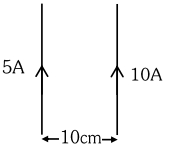
Two very long, straight, parallel conductors $A$ and $B$ carry current of $5\,A$ and $10\,A$ respectively and are at a distance of $10\,cm$ from each other. The direction of current in two conductors is same. The force acting per unit length between two conductors is: $\left(\mu_0=4 \pi \times 10^{-7}\right.$ SI unit)
- A
$2 \times 10^{-4}\,Nm ^{-1}$ and is attractive
- B
$2 \times 10^{-4}\,Nm ^{-1}$ and is repulsive
- ✓
$1 \times 10^{-4}\,Nm ^{-1}$ and is attractive
- D
$1 \times 10^{-4}\,Nm ^{-1}$ and is repulsive
AnswerCorrect option: C. $1 \times 10^{-4}\,Nm ^{-1}$ and is attractive
c
$\frac{ F _{ M }}{\ell}=\frac{\mu_0 i _1 i _2}{2 \pi r }$
$=\frac{4 \pi \times 10^{-7} \times 5 \times 10}{2 \pi \times 0.1}=10^{-4}\,N / m$
View full question & answer→MCQ 121 Mark
In the product
$\overrightarrow{\mathrm{F}} =\mathrm{q}(\vec{v} \times \overrightarrow{\mathrm{B}})$
$=\mathrm{q} \vec{v} \times\left(\mathrm{B} \hat{i}+\mathrm{B} \hat{j}+\mathrm{B}_{0} \hat{k}\right)$
For $\mathrm{q}=1$ and $\vec{v}=2 \hat{i}+4 \hat{j}+6 \hat{k}$ and
$\overrightarrow{\mathrm{F}}=4 \hat{i}-20 \hat{j}+12 \hat{k}$
What will be the complete expression for $\vec{B}$ ?
- A
$-8 \hat{i}-8 \hat{j}-6 \hat{k}$
- ✓
$-6 \hat{i}-6 \hat{j}-8 \hat{k}$
- C
$8 \hat{i}+8 \hat{j}-6 \hat{k}$
- D
$6 \hat{i}+6 \hat{j}-8 \hat{k}$
AnswerCorrect option: B. $-6 \hat{i}-6 \hat{j}-8 \hat{k}$
b
$\mathrm{F}=\mathrm{q}(\overrightarrow{\mathrm{V}} \times \overrightarrow{\mathrm{B}})$
By check options
$(C)$ $-6 \hat{i}-6 \hat{j}-8 \hat{k}$
$\left|\begin{array}{ccc}\mathrm{i} & \mathrm{j} & \mathrm{k} \\ 2 & 4 & 6 \\ -6 & -6 & -8\end{array}\right|$ $\overrightarrow{\mathrm{V}} \times \overrightarrow{\mathrm{B}}=\hat{\mathrm{i}}(-32+36)+\hat{\mathrm{j}}(-36+16)+\mathrm{K}(-12+24)$
$=4 \hat{i}-20 \hat{j}+12 \hat{k}$
View full question & answer→MCQ 131 Mark
An infinitely long straight conductor carries a current of $5 \,\mathrm{~A}$ as shown. An electron is moving with a speed of $10^{5} \, \mathrm{~m} / \mathrm{s}$ parallel to the conductor. The perpendicular distance between the electron and the conductor is $20 \, \mathrm{~cm}$ at an instant. Calculate the magnitude of the force experienced by the electron at that instant in $\times 10^{-20} \,N$
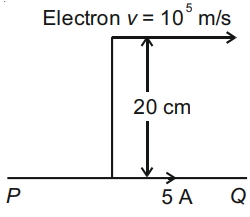
Answerd
$B =\frac{\mu_{0} I}{2 \pi R}$
$F =B V q \sin \theta$
$\theta =90^{\circ}$
$F =B V q$
$F=\frac{\mu_{0} I}{2 \pi R} \times V \times e=\frac{2 \times 10^{-7} \times 5}{20 \times 10^{-2}} \times 10^{5} \times 1.6 \times 10^{-19}$
$F=8 \times 10^{-20}\, \mathrm{~N}$
View full question & answer→MCQ 141 Mark
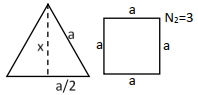
A uniform conducting wire of length $12 \mathrm{a}$ and resistance $'R'$ is wound up as a current carrying coil in the shape of,
$(i)$ an equilateral triangle of side $'a'.$
$(ii)$ a square of side $'a'.$
The magnetic dipole moments of the coil in each case respectively are:
- ✓
$\sqrt{3} \mathrm{Ia}^{2}$ and $3 \mathrm{Ia}^{2}$
- B
$3 \mathrm{Ia}^{2}$ and $\mathrm{Ia}^{2}$
- C
$3 \mathrm{Ia}^{2}$ and $4 \mathrm{Ia}^{2}$
- D
$4 \mathrm{Ia}^{2}$ and $3 \mathrm{Ia}^{2}$
AnswerCorrect option: A. $\sqrt{3} \mathrm{Ia}^{2}$ and $3 \mathrm{Ia}^{2}$
a
$x=\sqrt{a^{2}-\frac{a^{2}}{4}}=\sqrt{\frac{3 a^{2}}{4}}=\sqrt{\frac{3 a^{2}}{4}}=\frac{\sqrt{3}}{2} a$
$\mathrm{A}_{1}=\frac{1}{2} \times \mathrm{a} \times \frac{\sqrt{3}}{2} \mathrm{a}$
$\mathrm{A}_{1}=\frac{\sqrt{3}}{4} \mathrm{a}^{2}$
$\mu_{1}=\mathrm{N}_{1} \mathrm{IA}_{1}$
$\mu_{1}=\frac{4 \mathrm{I} \sqrt{3}}{4} \mathrm{a}^{2}$
$\mu_{1}=\sqrt{3} \mathrm{I} a^{2}$
$A_{2}=a^{2}$
$\mu_{2}=N_{2} I A_{2}$
$=3 \times I \times a^{2}$
$\mu_{2}=3 \mathrm{Ia}^{2}$
View full question & answer→MCQ 151 Mark
A long solenoid of $50\, cm$ length having $100$ turns carries a current of $2.5$ $A.$ The magnetic field at the centre of the solenold is $...... \times 10^{-5}\;T$
$\left(\mu_{0}=4 \pi \times 10^{-7}\, T\, m\, A ^{-1}\right)$
- A
$3.14$
- ✓
$62.8$
- C
$31.4$
- D
$6.28$
AnswerCorrect option: B. $62.8$
b
$B =\mu_{0} \frac{ N }{\ell} I$
$=4 \pi \times 10^{-7} \times \frac{100}{(0.5)} \times 2.5$
$=6.28 \times 10^{-4} T$
View full question & answer→MCQ 161 Mark
A wire of length $L$ metre carrying a current of $I$ ampere is bent in the form of circle. Its magnetic moment is
- ✓
$\frac{I L^{2}}{4 \pi} A \;m^{2}$
- B
$\frac{I L^{2}}{4} A \;m^{2}$
- C
$\frac{I \pi L^{2}}{4} A \;m^{2}$
- D
$\frac{2 I L^{2}}{\pi} A \;m^{2}$
AnswerCorrect option: A. $\frac{I L^{2}}{4 \pi} A \;m^{2}$
a
Length of wire, $L =2 \pi R$
Radius of loop, $R=\frac{L}{2 \pi}$
Magnetic moment, $M =I A$
$=I\left(\frac{\pi L^{2}}{4 \pi^{2}}\right)$
$=\frac{I L^{2}}{4 \pi} A \;m^{2}$
View full question & answer→MCQ 171 Mark
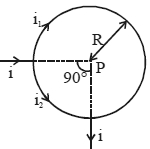
A straight conductor carrying current $i$ splits into two parts as shown in the figure. The radius of the circular loop is $R$. The total magnetic field at the centre $P$ of the loop is
- ✓
$0$
- B
$\frac {3 \mu_{0} i} {32 R}$, outward
- C
$\frac {3 \mu_{0} i} {32 \mathrm{R}},$ Inward
- D
$\frac{\mu_{0} \mathrm{i}}{2 \mathrm{R}},$ inward
Answera
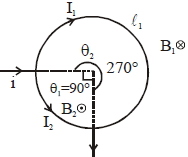
$\frac{\mathrm{R}_{1}}{\mathrm{R}_{2}}=\frac{\ell_{1}}{\ell_{2}}= \frac{\mathrm{I}_{2}}{\mathrm{I}_{1}}=\frac{\theta_{1}}{\theta_{2}} \Rightarrow \theta_{1} \mathrm{I}_{1}=\theta_{2} \mathrm{I}_{2}$
$\left.\begin{array}{l}{\mathrm{B}_{1}=\frac{\mu_{0}}{4 \pi} \frac{\mathrm{I}_{1} \theta_{1}}{\mathrm{r}}} \\ {\mathrm{B}_{2}=\frac{\mu_{0}}{4 \pi} \frac{\mathrm{I}_{1} \theta_{1}}{\mathrm{r}}}\end{array}\right\} \Rightarrow \mathrm{B}_{1}=\mathrm{B}_{2}$
View full question & answer→MCQ 181 Mark
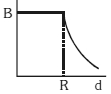
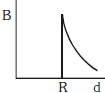
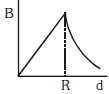
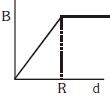
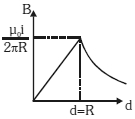
A cylindrical conductor of radius $R$ is carrying a constant current. The plot of the magnitude of the magnetic field, $B$ with the distance $d$, from the centre of the conductor, is correctly represented by the figure
Answerc
$B=\left\{\begin{array}{l}{\frac{\mu_{0}Id}{2 \pi R^{2}}: d \leq R} \\ {\frac{\mu_{0} I}{2 \pi d} \quad: \quad d>R}\end{array}\right.$
View full question & answer→MCQ 191 Mark
Ionized hydrogen atoms and $\alpha$ -particles with same momenta enters perpendicular to a constant magnetic field $B$. The ratio of their radii of their paths $\mathrm{r}_{\mathrm{H}}: \mathrm{r}_{\alpha}$ will be
Answera
$\frac{\mathrm{q}_{\mathrm{H}}}{\mathrm{q}_{\mathrm{\alpha}}}=\frac{1}{2}$
$r=\frac{m v}{q B}$
For same momenta, $r \propto \frac{1}{q}$
$\frac{r_{H}}{r_{\alpha}}=\frac{q_{\alpha}}{q_{H}}=\frac{2}{1}$
View full question & answer→MCQ 201 Mark
Two toroids $1$ and $2$ have total number of tums $200$ and $100 $ respectively with average radii $40\; \mathrm{cm}$ and $20 \;\mathrm{cm}$ respectively. If they carry same current $i,$ the ratio of the magnetic flelds along the two loops is
Answera
$\mathrm{B}=\frac{\mu_{0} \mathrm{N}_{\mathrm{i}}}{2 \pi \mathrm{r}}$
$\frac{\mathrm{B}_{1}}{\mathrm{B}_{2}}=\frac{\mathrm{N}_{1}}{\mathrm{N}_{2}} \frac{\mathrm{r}_{2}}{\mathrm{r}_{1}}=\left(\frac{200}{100}\right)\left(\frac{20}{40}\right)=1: 1$
View full question & answer→MCQ 211 Mark
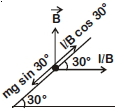
A metallic rod of mass per unit length $0.5\; kg\; m^{-1}$ is lying horizontally on a smooth inclined plane which makes an angle of $30^o$ with the horizontal. The rod is not allowed to slide down by flowing a current through it when a magnetic field of induction $0.25\; T$ is acting on it in the vertical direction. The current flowing in the rod to keep it stationary is.....$A$
- A
$7.14 $
- B
$\;$$5.98 $
- ✓
$11.32 $
- D
$\;$$14.76 $
AnswerCorrect option: C. $11.32 $
c
For equilibrium,
$m g \sin 30^{\circ}=I l B \cos 30^{\circ}$
$\mathrm{I}=\frac{\mathrm{mg}}{\mathrm{lB}} \tan 30^{\circ}$
$=\frac{0.5 \times 9.8}{0.25 \times \sqrt{3}}=11.32 \,\mathrm{A}$
View full question & answer→MCQ 221 Mark
Current sensitivity of a moving coil galvanometer is $5\,div/mA$ and its voltage sensitivity (angular deflection per unit voltage applied) is $20\,div/V$. The resistance of the galvanometer is ................. $\Omega$
AnswerCorrect option: D. $ 250$
d
Current sensitivity
$\mathrm{I}_{\mathrm{s}}=\frac{\mathrm{NBA}}{\mathrm{c}}$
Voltage sensitivity
$\mathrm{v}_{\mathrm{s}}=\frac{\mathrm{NBA}}{\mathrm{CR}_{\mathrm{G}}}$
So, resistance of galvanometer
$R_{G}=\frac{l_{s}}{V_{s}}=\frac{5 \times 1}{20 \times 10^{-3}}=\frac{5000}{20}=250\, \Omega$
View full question & answer→MCQ 231 Mark
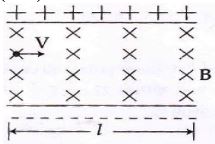
An electron moves straight inside a charged parallel plate capacitor of uniform charge density. The space between the plates is filled with uniform magnetic field of intensity $B ,$ as shown in the figure, Neglecting effect of gravity, the time of straight line motion of the electron in the capacitor is
- A
$\frac{\sigma }{{{\varepsilon _0}lB}}$
- B
$\frac{{{\varepsilon _0}B}}{\sigma }$
- C
$\;\frac{\sigma }{{{\varepsilon _0}B}}$
- ✓
$\;\frac{{{\varepsilon _0}lB}}{\sigma }$
AnswerCorrect option: D. $\;\frac{{{\varepsilon _0}lB}}{\sigma }$
d
$F _{ E }= F _{ B }$
$eE = evB$
$E =\frac{l}{t} B$
$t =\frac{l B \varepsilon_{0}}{\sigma}$
View full question & answer→MCQ 241 Mark
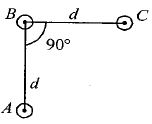
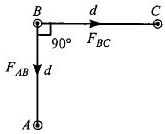
An arrangement of three parallel straight wires placed perpendicular to plane of paper carrying same current $'I'$ along the same direction as shown in figure. Magnitude of force per unit length on the middle wire $'B'$ is given by
- A
$\frac{{2{\mu _0}{I^2}}}{{\pi d}}$
- B
$\frac{{\sqrt 2 {\mu _0}{I^2}}}{{\pi d}}$
- ✓
$\;\frac{{{\mu _0}{I^2}}}{{\sqrt 2 \pi d}}$
- D
$\;\frac{{{\mu _0}{I^2}}}{{2\pi d}}$
AnswerCorrect option: C. $\;\frac{{{\mu _0}{I^2}}}{{\sqrt 2 \pi d}}$
c
Force between wires $A$ and $B$ $=$ force between wires $B$ and $C$
$\therefore \quad F_{B C}=F_{A B}=\frac{\mu_{0} I^{2} l}{2 \pi d}$
As, $\vec{F}_{A B} \perp \vec{F}_{B C}$ net force on wire $B$
$F_{\text {net }}=\sqrt{2} F_{B C}=\frac{\sqrt{2} \mu_{o} I^{2} l}{2 \pi d}$
$F_{\text {net }}=\frac{\mu_{o} I^{2} l}{\sqrt{2} \pi d}$ or $\frac{F_{\text {net }}}{l}=\frac{\mu_{o} I^{2}}{\sqrt{2} \pi d}$
View full question & answer→MCQ 251 Mark
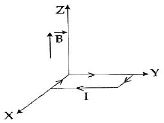
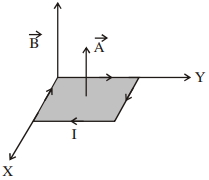
A uniform magnetic field of $0.3\; T$ is established along the positive $Z$ -direction. A rectangular loop in $XY$ plane of sides $10 \;cm$ and $5 \;cm$ carries a current of $I =12\; A$ as shown. The torque on the loop is
- A
$-1.8 \times 10^{-2}$$\hat j\;Nm$
- ✓
$0$
- C
$-1.8 \times 10^{-2}$ $\hat i\;Nm$
- D
$+1.8 \times 10^{-2}$ $\hat i\;Nm$
Answerb
$\vec{\tau}= NIA \times \overline{ B }$
Here $\overrightarrow{ A } \| \overrightarrow{ B }$
$\theta=0$
$\vec{\tau}= NIAB \sin \theta$
$\vec{\tau}=0$
View full question & answer→MCQ 261 Mark
A long straight wire of radius $a$ carries a steady current $I.$ The current is uniformly distributed over its cross-section. The ratio of the magnetic fields $B$ and $B',$ at radial distances $\frac{a}{2}$ and $2a$ respectively, from the axis of the wire is
- A
$\frac{1}{2}$
- ✓
$1$
- C
$4$
- D
$\;\frac{1}{4}$
Answerb
Magnetic field at a point inside the wire at distance $r\left(=\frac{a}{2}\right)$ from the axis of wire is
$B=\frac{\mu_{0} I}{2 \pi a^{2}} r=\frac{\mu_{0} I}{2 \pi a^{2}} \times \frac{a}{2}=\frac{\mu_{0} I}{4 \pi a}$
Magnetic field at a point outside the wire at distance $r(=2 a)$ from the axis of wire is
$B^{\prime}=\frac{\mu_{0} I}{2 \pi r}=\frac{\mu_{0} I}{2 \pi} \times \frac{1}{2 a}=\frac{\mu_{0} I}{4 \pi a} \quad \therefore \frac{B}{B'}=1$
View full question & answer→MCQ 271 Mark
An electron is moving in a circular path under the influence of a transverse magnetic field of $3.57 \times 10^{-2}\, T $. If the value of $e/m$ is $1.76 \times 10^{11}\, C/kg $, the frequency of revolution of the electron is
- A
$62.8 \,MHz$
- B
$6.28 \,MHz$
- ✓
$1 \,GHz$
- D
$100 \,MHz$
AnswerCorrect option: C. $1 \,GHz$
c
$\text { Here, } B=3.57 \times 10^{-2}\, \mathrm{T}$
$\frac{e}{m}=1.76 \times 10^{11}\, \mathrm{C\,kg}^{-1}$
Frequency of revolution of the electron,
$v=\frac{1}{T}=\frac{v}{2 \pi r}.........(i)$
Also, $\frac{m v^{2}}{r}=e v B \Rightarrow \frac{v}{r}=\frac{e B}{m}.........(ii)$
From eqns. $(i)$ and $(ii)$,
$v=\frac{1}{2 \pi} \times \frac{e B}{m}=\frac{1}{2 \times 3.14} \times 1.76 \times 10^{11} \times 3.57 \times 10^{-2}$
$=10^{9} \,\mathrm{Hz}=1 \,\mathrm{GHz}$
View full question & answer→MCQ 281 Mark
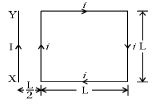
A square loop $ABCD$ carrying a current $i,$ is placed near and coplanar with a long straight conductor $XY$ carrying a current $I,$ the net force on the loop will be
- A
$\frac{{{\mu _0}Ii}}{{2\pi }}$
- B
$\;\frac{{2{\mu _0}IiL}}{{3\pi }}$
- C
$\;\frac{{{\mu _0}IiL}}{{2\pi }}$
- ✓
$\;\frac{{2{\mu _0}Ii}}{{3\pi }}$
AnswerCorrect option: D. $\;\frac{{2{\mu _0}Ii}}{{3\pi }}$
d
Force on arm $A B$ due to current in conductor $X Y$ is
${F_1} = \frac{{{\mu _0}}}{{4\pi }}\frac{{2IiL}}{{(L/2)}} = \frac{{{\mu _0}Ii}}{\pi }$
acting towards $X Y$ in the plane of loop. Force on arm $C D$ due to current in conductor $X Y$ is
${F_2} = \frac{{{\mu _0}}}{{4\pi }}\frac{{2IiL}}{{3(L/2)}} = \frac{{{\mu _0}Ii}}{{3\pi }}$
acting away from $X Y$ in the plane of loop.
$\therefore$ Net force on the loop $=F_{1}-F_{2}$
$=\frac{\mu_{0} I i}{\pi}\left[1-\frac{1}{3}\right]=\frac{2}{3} \frac{\mu_{0} I i}{\pi}$
View full question & answer→MCQ 291 Mark
A charge $q$ $coulomb$ moves in a circle at $n$ revolutions per second and the radius of the circle is $r$ $metre$. Then magnetic field at the centre of the circle is
- A
$\frac{{2\pi q}}{{nr}} \times {10^{ - 7}}$ $N/amp/metre$
- B
$\frac{{2\pi q}}{r} \times {10^{ - 7}}$ $N/amp/metre$
- ✓
$\frac{{2\pi nq}}{r} \times {10^{ - 7}}$ $N/amp/metre$
- D
$\frac{{2\pi q}}{r}$ $N/amp/metre$
AnswerCorrect option: C. $\frac{{2\pi nq}}{r} \times {10^{ - 7}}$ $N/amp/metre$
c
(c) The magnetic field at the centre of the circle $ = \frac{{{\mu _o}}}{{4\pi }} \times \frac{{2\pi i}}{r} = {10^{ - 7}} \times \frac{{2\pi (nq)}}{r} = \frac{{2\pi nq}}{r} \times {10^{ - 7}}\,N/A{\rm{ - }}m$
View full question & answer→MCQ 301 Mark
An infinitely long straight conductor is bent into the shape as shown in the figure. It carries a current of $i$ $ampere$ and the radius of the circular loop is $r$ $metre$. Then the magnetic induction at its centre will be
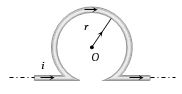
AnswerCorrect option: B. $\frac{{{\mu _0}}}{{4\pi }}\frac{{2i}}{r}(\pi - 1)$
b
(b) The given shape is equivalent to the following diagram
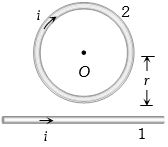
The field at $O$ due to straight part of conductor is ${B_1} = \frac{{{\mu _o}}}{{4\pi }}.\frac{{2i}}{r} \odot $. The field at $O$ due to circular coil is ${B_2} = \frac{{{\mu _0}}}{{4\pi }}.\frac{{2\pi i}}{r} \otimes $. Both fields will act in the opposite direction, hence the total field at $O$.
i.e. $B = {B_2} - {B_1} = \left( {\frac{{{\mu _o}}}{{4\pi }}} \right) \times (\pi - 1)\frac{{2i}}{r} = \frac{{{\mu _o}}}{{4\pi }}.\frac{{2i}}{r}(\pi - 1)$
View full question & answer→MCQ 311 Mark
A current $i$ ampere flows in a circular arc of wire whose radius is $R$, which subtend an angle $3\pi /2$ radian at its centre. The magnetic induction at the centre is
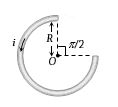
AnswerCorrect option: D. $\frac{{3{\mu _0}i}}{{8R}}$
d
(d) $B = \frac{{{\mu _0}}}{{4\pi }}\frac{{(2\pi - \theta )i}}{R} = \frac{{{\mu _0}}}{{4\pi }}\frac{{\left( {2\pi - \frac{\pi }{2}} \right) \times i}}{R}$$ = \frac{{3{\mu _0}i}}{{8R}}$
View full question & answer→MCQ 321 Mark
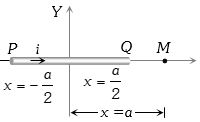
A straight section $PQ$ of a circuit lies along the $X$-axis from $x = - \frac{a}{2}$ to $x = \frac{a}{2}$ and carries a steady current $i$. The magnetic field due to the section $PQ$ at a point $X = + a$ will be
- A
Proportional to $a$
- B
Proportional to ${a^2}$
- C
Proportional to $1/a$
- ✓
Answerd
(d) Magnetic field at a point on the axis of a current carrying wire is always zero.
View full question & answer→MCQ 331 Mark
A helium nucleus makes a full rotation in a circle of radius $0.8$ metre in two seconds. The value of the magnetic field $B$ at the centre of the circle will be
- A
$\frac{{{{10}^{ - 19}}}}{{{\mu _0}}}$
- ✓
${10^{ - 19}}{\mu _0}$
- C
$2 \times {10^{ - 10}}{\mu _0}$
- D
$\frac{{2 \times {{10}^{ - 10}}}}{{{\mu _0}}}$
AnswerCorrect option: B. ${10^{ - 19}}{\mu _0}$
b
(b) $i = \frac{q}{T} = \frac{{2 \times 1.6 \times {{10}^{ - 19}}}}{2} = 1.6 \times {10^{ - 19}}A$
$\therefore \,B = \frac{{{\mu _o}i}}{{2r}} = \frac{{{\mu _o} \times 1.6 \times {{10}^{ - 19}}}}{{2 \times 0.8}} = {\mu _o} \times {10^{ - 19}}$
View full question & answer→MCQ 341 Mark
the magnetic induction at $O$ due to the whole length of the conductor is
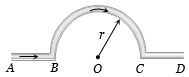
AnswerCorrect option: C. $\frac{{{\mu _0}i}}{{4r}}$
c
(c) The induction due to $AB$ and $CD$ will be zero. Hence the whole induction will be due to the semicircular part $BC$. $B = \frac{{{\mu _o}i}}{{4r}}$
View full question & answer→MCQ 351 Mark
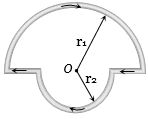
In the figure shown there are two semicircles of radii ${r_1}$ and ${r_2}$ in which a current $i$ is flowing. The magnetic induction at the centre $O$ will be
- A
$\frac{{{\mu _0}i}}{r}({r_1} + {r_2})$
- B
$\frac{{{\mu _0}i}}{4}({r_1} - {r_2})$
- ✓
$\frac{{{\mu _0}i}}{4}\left( {\frac{{{r_1} + {r_2}}}{{{r_1}{r_2}}}} \right)$
- D
$\frac{{{\mu _0}i}}{4}\left( {\frac{{{r_2} - {r_1}}}{{{r_1}{r_2}}}} \right)$
AnswerCorrect option: C. $\frac{{{\mu _0}i}}{4}\left( {\frac{{{r_1} + {r_2}}}{{{r_1}{r_2}}}} \right)$
c
(c) The magnetic induction due to both semicircular parts will be in the same direction perpendicular to the paper inwards.
$\therefore B = {B_1} + {B_2} = \frac{{{\mu _0}i}}{{4{r_1}}} + \frac{{{\mu _0}i}}{{4{r_2}}} = \frac{{{\mu _0}i}}{4}\left( {\frac{{{r_1} + {r_2}}}{{{r_1}{r_2}}}} \right) \otimes $
View full question & answer→MCQ 361 Mark
A particle carrying a charge equal to $100$ times the charge on an electron is rotating per second in a circular path of radius $0.8$ $metre$. The value of the magnetic field produced at the centre will be $({\mu _0} = $ permeability for vacuum)
AnswerCorrect option: B. ${10^{ - 17}}{\mu _0}$
b
(b) $i = \frac{q}{t} = 100 \times e$
${B_{{\rm{centre}}}} = \frac{{{\mu _o}}}{{4\pi }}.\frac{{2\pi i}}{r} = \frac{{{\mu _o}}}{{4\pi }}.\frac{{2\pi \times 100e}}{r}$
$ = \frac{{{\mu _o} \times 200 \times 1.6 \times {{10}^{ - 19}}}}{{4 \times 0.8}} = {10^{ - 17}}{\mu _o}$
View full question & answer→MCQ 371 Mark
In hydrogen atom, an electron is revolving in the orbit of radius $0.53\,{\mathop A\limits^o }$ with $6.6 \times {10^{15}}$ $rotations/second$. Magnetic field produced at the centre of the orbit is.......$wb/{m^2}$
- A
$0.125$
- B
$1.25$
- ✓
$12.5$
- D
$125$
AnswerCorrect option: C. $12.5$
c
(c) $B = \frac{{{\mu _0}}}{{4\pi }} \cdot \frac{{2\pi (q\nu )}}{r}$
$ = {10^{ - 7}} \times \frac{{2 \times 3.14 \times (1.6 \times {{10}^{ - 19}} \times 6.6 \times {{10}^{15}})}}{{0.53 \times {{10}^{ - 10}}}}$$ = 12.5\,Wb/{m^2}$
View full question & answer→MCQ 381 Mark
Two concentric circular coils of ten turns each are situated in the same plane. Their radii are $20$ and $40\, cm$ and they carry respectively $0.2$ and $0.3$ $ampere$ current in opposite direction. The magnetic field in $weber/{m^2}$ at the centre is
AnswerCorrect option: D. $\frac{5}{4}{\mu _0}$
d
(d) Two coils carrying current in opposite direction, hence net magnetic field at centre will be difference of the two fields.
i.e. ${B_{net}} = \frac{{{\mu _0}}}{{4\pi }} \cdot 2\pi N\left[ {\frac{{N{i_1}}}{{{r_1}}} - \frac{{{i_2}}}{{{r_2}}}} \right]$$ = \frac{{10{\mu _0}}}{2}\left[ {\frac{{0.2}}{{0.2}} - \frac{{0.3}}{{0.4}}} \right] = \frac{5}{4}{\mu _0}$
View full question & answer→MCQ 391 Mark
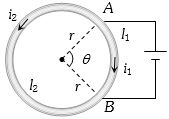
A cell is connected between two points of a uniformly thick circular conductor. The magnetic field at the centre of the loop will be
- ✓
- B
$\frac{{{\mu _0}}}{{2a}}({i_1} - {i_2})$
- C
$\frac{{{\mu _0}}}{{2a}}({i_1} + {i_2})$
- D
$\frac{{{\mu _0}}}{a}({i_1} + {i_2})$(Here ${i_1}$ and ${i_2}$ are the currents flowing in the two parts of the circular conductor of radius $‘a’$ and ${\mu _0}$ has the usual meaning)
Answera
(a) Directions of currents in two parts are different, so directions of magnetic fields due to these currents are opposite. Also applying Ohm’s law across $AB$
${i_1}{R_1} = {i_2}{R_2} \Rightarrow {i_1}{l_2} = {i_2}{l_2}$ $\left( {\;R = \rho \frac{l}{A}} \right)$
Also ${B_1} = \frac{{{\mu _o}}}{{4\pi }} \times \frac{{{i_1}{l_1}}}{{{r^2}}}$ and ${B_2} = \frac{{{\mu _o}}}{{4\pi }} \times \frac{{{i_2}{l_2}}}{{{r^2}}}$ ($\;l = r\theta $)
$\therefore \,\frac{{{B_2}}}{{{B_1}}} = \frac{{{i_1}{l_1}}}{{{i_2}{l_2}}} = 1$
Hence, two field induction’s are equal but of opposite direction. So, resultant magnetic induction at the centre is zero and is independent of $\theta $.
View full question & answer→MCQ 401 Mark
Due to $10\, ampere$ of current flowing in a circular coil of $10\, cm$ radius, the magnetic field produced at its centre is $3.14 \times {10^{ - 3}}\,Weber/{m^2}$. The number of turns in the coil will be
Answerc
(c) $B = \frac{{{\mu _0}}}{{4\pi }} \cdot \frac{{2\pi Ni}}{r}$
$==>$ $3.14 \times {10^{ - 3}} = \frac{{{{10}^{ - 7}} \times 2 \times 3.14 \times N \times 10}}{{(10 \times {{10}^{ - 2}})}}$ $==>$ $N = 50$
View full question & answer→MCQ 411 Mark
One metre length of wire carries a constant current. The wire is bent to form a circular loop. The magnetic field at the centre of this loop is $B$. The same is now bent to form a circular loop of smaller radius to have four turns in the loop. The magnetic field at the centre of this new loop is
- A
$4 B$
- ✓
$16 B$
- C
$B/2$
- D
$B/4$
AnswerCorrect option: B. $16 B$
b
(b) $B' = {n^2}B \Rightarrow B' = {(4)^2}B = B' = 16B$
View full question & answer→MCQ 421 Mark
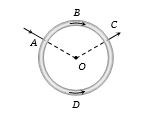
A uniform wire is bent in the form of a circle of radius $R$. A current $I$ enters at $A$ and leaves at $C$ as shown in the figure :If the length $ABC$ is half of the length $ADC,$ the magnetic field at the centre $O$ will be
- ✓
- B
$\frac{{{\mu _0}I}}{{2R}}$
- C
$\frac{{{\mu _0}I}}{{4R}}$
- D
$\frac{{{\mu _0}I}}{{6R}}$
Answera
(a) Directions of currents in two parts are different, so directions of magnetic fields due to these currents are opposite. Also applying Ohm’s law across $AB$
${i_1}{R_1} = {i_2}{R_2} \Rightarrow {i_1}{l_2} = {i_2}{l_2}$ $\left( {\;R = \rho \frac{l}{A}} \right)$
Also ${B_1} = \frac{{{\mu _o}}}{{4\pi }} \times \frac{{{i_1}{l_1}}}{{{r^2}}}$ and ${B_2} = \frac{{{\mu _o}}}{{4\pi }} \times \frac{{{i_2}{l_2}}}{{{r^2}}}$ ($\;l = r\theta $)
$\therefore \,\frac{{{B_2}}}{{{B_1}}} = \frac{{{i_1}{l_1}}}{{{i_2}{l_2}}} = 1$
Hence, two field induction’s are equal but of opposite direction. So, resultant magnetic induction at the centre is zero and is independent of $\theta $.
View full question & answer→MCQ 431 Mark
The earth's magnetic induction at a certain point is $7 \times {10^{ - 5}}\,Wb/{m^2}.$ This is to be annulled by the magnetic induction at the centre of a circular conducting loop of radius $5 \,cm$. The required current in the loop is......$A$
- A
$0.56$
- ✓
$5.6$
- C
$0.28$
- D
$2.8$
Answerb
(b) $\frac{{{\mu _0}}}{{4\pi }} \times \frac{{2\pi i}}{r} = H \Rightarrow \frac{{({{10}^{ - 7}}) \times 2 \times 3.142 \times i}}{{0.05}} = 7 \times {10^{ - 5}}$
$\therefore \,i = \frac{{7 \times 0.05 \times {{10}^{ - 5}}}}{{2 \times 3.142 \times {{10}^{ - 7}}}} = \frac{{35}}{{2 \times 3.142}} = 5.6$ $amp$
View full question & answer→MCQ 441 Mark
Magnetic field intensity at the centre of coil of $50$ $turns$, radius $0.5\, m$ and carrying a current of $2\, A$ is
- A
$0.5 \times {10^{ - 5}}\,T$
- ✓
$1.25 \times {10^{ - 4}}\,T$
- C
$3 \times {10^{ - 5}}\,T$
- D
$4 \times {10^{ - 5}}\,T$
AnswerCorrect option: B. $1.25 \times {10^{ - 4}}\,T$
b
(b) $B = \frac{{{\mu _0}Ni}}{{2r}} = \frac{{4\pi \times {{10}^{ - 7}} \times 50 \times 2}}{{2 \times 0.5}} = 1.25 \times {10^{ - 4}}\,T$
View full question & answer→MCQ 451 Mark
Magnetic field due to a ring having $n$ turns at a distance $x$ on its axis is proportional to (if $r$ = radius of ring)
- A
$\frac{r}{{({x^2} + {r^2})}}$
- B
$\frac{{{r^2}}}{{{{({x^2} + {r^2})}^{3/2}}}}$
- ✓
$\frac{{n{r^2}}}{{{{({x^2} + {r^2})}^{3/2}}}}$
- D
$\frac{{{n^2}{r^2}}}{{{{({x^2} + {r^2})}^{3/2}}}}$
AnswerCorrect option: C. $\frac{{n{r^2}}}{{{{({x^2} + {r^2})}^{3/2}}}}$
c
(c) Magnetic field on the axis of circular current
$B = \frac{{{\mu _0}}}{{4\pi }} \cdot \frac{{2\pi ni{r^2}}}{{{{({x^2} + {r^2})}^{3/2}}}}$ $==>$ $B \propto \frac{{n{r^2}}}{{{{({x^2} + {r^2})}^{3/2}}}}$
View full question & answer→MCQ 461 Mark
$A$ and $B$ are two concentric circular conductors of centre $O$ and carrying currents ${i_1}$ and ${i_2}$ as shown in the adjacent figure. If ratio of their radii is $1 : 2$ and ratio of the flux densities at $O$ due to $A$ and $B$ is $1 : 3$, then the value of ${i_1}/{i_2}$ is
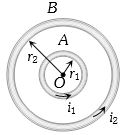
- ✓
$\frac{1}{6}$
- B
$\frac{1}{4}$
- C
$\frac{1}{3}$
- D
$\frac{1}{2}$
AnswerCorrect option: A. $\frac{1}{6}$
a
(a) ${r_1}:{r_2} = 1:2$ and ${B_1}:{B_2} = 1:3$ We know that
$B = \frac{{{\mu _0}}}{{4\pi }}.\frac{{2\pi ni}}{r} \Rightarrow \frac{{{i_1}}}{{{i_2}}} = \frac{{{B_1}{r_1}}}{{{B_2}{r_2}}} = \frac{{1 \times 1}}{{3 \times 2}} = \frac{1}{6}$
View full question & answer→MCQ 471 Mark
A straight wire carrying a current $10\, A$ is bent into a semicircular arc of radius $5\, cm.$ The magnitude of magnetic field at the center is
- A
$1.5 \times {10^{ - 5}}\,T$
- B
$3.14 \times {10^{ - 5}}\,T$
- ✓
$6.28 \times {10^{ - 5}}\,T$
- D
$19.6 \times {10^{ - 5}}\,T$
AnswerCorrect option: C. $6.28 \times {10^{ - 5}}\,T$
c
(c) $B = \frac{{{\mu _0}}}{{4\pi }} \times \frac{{\pi i}}{r} \Rightarrow B = {10^{ - 7}} \times \frac{{\pi \times 10}}{{5 \times {{10}^{ - 2}}}} = 6.28 \times {10^{ - 5}}\,T$
View full question & answer→MCQ 481 Mark
.......$A$ should be the current in a circular coil of radius $5\,cm$ to annul ${B_H} = 5 \times {10^{ - 5}}\,T$
Answerb
(b) $B = {10^{ - 7}}\frac{{2\pi i}}{r}$; according to question $B_H = B$
$ \Rightarrow 5 \times {10^{ - 5}} = {10^{ - 7}} \times \frac{{2 \times 3.14 \times i}}{{5 \times {{10}^{ - 2}}}} \Rightarrow i = 4\,A$
View full question & answer→MCQ 491 Mark
An electron moving in a circular orbit of radius $r$ makes $n$ rotation per second. The magnetic field produced at the centre has a magnitude of
- ✓
$\frac{{{\mu _0}ne}}{{2r}}$
- B
$\frac{{{\mu _0}{n^2}e}}{{2r}}$
- C
$\frac{{{\mu _0}ne}}{{2\pi r}}$
- D
AnswerCorrect option: A. $\frac{{{\mu _0}ne}}{{2r}}$
a
(a) Corresponding current $i = en$
So $B = \frac{{{\mu _0}}}{{4\pi }}.\frac{{2\pi \left( {en} \right)}}{r} = \frac{{{\mu _0}ne}}{{2r}}$
View full question & answer→MCQ 501 Mark
The ratio of the magnetic field at the centre of a current carrying coil of the radius $a$ and at a distance ‘$a$’ from centre of the coil and perpendicular to the axis of coil is
- A
$\frac{1}{{\sqrt 2 }}$
- B
$\sqrt 2 $
- C
$\frac{1}{{2\sqrt 2 }}$
- ✓
$2\sqrt 2 $
AnswerCorrect option: D. $2\sqrt 2 $
d
(d) $\frac{{{B_c}}}{{{B_a}}} = {\left( {1 + \frac{{{x^2}}}{{{a^2}}}} \right)^{3/2}} = {\left( {1 + \frac{{{a^2}}}{{{a^2}}}} \right)^{3/2}} = {\left( {1 + 1} \right)^{3/2}} = 2\sqrt 2 $
View full question & answer→