MCQ
A current carrying loop is placed in a uniform magnetic field. The torque acting on it does not depend upon
  • Shape of the loop
  • B
    Area of the loop
  • C
    Value of the current
  • D
    Magnetic field

Answer

Correct option: A.
Shape of the loop
a
(a) Because $\tau = NiAB\cos \theta $

Need a full question paper?

Generate a complete, print-ready paper with questions like this in minutes — across 16+ boards, with answer keys.
Start Generating Free

Similar questions

Neutrino is a particle, which is
A sphere of mass $10\; kg$ and radius $0.5\; m$ rotates about a tangent. The moment of inertia of the sphere is
The ratio of masses of a cubical block of wood and a chunk of concrete is $\frac{3}{5}$ so that the combination just floats with entire volume submerged under water. If specific gravity of wood is $0.5$, then specific gravity of concrete will be
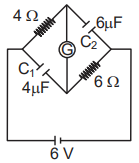
A galvanometer $( G )$ of $2 \Omega$ resistance is connected in the given circuit. The ratio of charge stored in $C _1$ and $C _2$ is:

Image
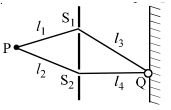
Two identical narrow slits $S_1$ and $S_2$ are illuminated by light of wavelength $\lambda$ from a point source $P$. If, as shown in the diagram above the light is then allowed to fall on a screen, and if $n$ is a positive integer, the condition for destructive interference at $Q$ is that
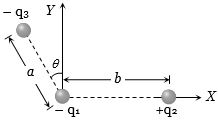
Three charges $ - {q_1},\,\, + {q_2}$ and $ - {q_3}$ are placed as shown in the figure. The $x$-component of the force on $ - {q_1}$ is proportional to
The displacement of a charge $Q$ in the electric field $E = {e_1}\hat i + {e_2}\hat j + {e_3}\hat k$ is $\hat r = a\hat i + b\hat j$. The work done is
A single slit Fraunhoffer diffraction pattern is formed with white light. For what wavelength of light the third secondary maximum in the diffraction pattern coincides with the second secondary maximum in the pattern for red light of wavelength $6500{\text{ }}\mathop {\text{A}}\limits^o $?........$\mathop A\limits^o $
 A nucleus  $_n{X^m}$ emits one $\alpha$ particle and two $\beta$ particles. The resulting nucleus is
A vehicle travels $4\,km$ with speed of $3\,km / h$ and another $4\,km$ with speed of $5\,km / h$, then its average speed is $..........km/h$