MCQ
Neutrino is a particle, which is
  • A
    Charged and has spin
  • B
    Charged and has no spin
  • Charge less and has spin
  • D
    Charge less and has no spin

Answer

Correct option: C.
Charge less and has spin
c
(c)

Need a full question paper?

Generate a complete, print-ready paper with questions like this in minutes — across 16+ boards, with answer keys.

Start Generating Free

Similar questions

A straight section $PQ$ of a circuit lies along the $X$-axis from $x = - \frac{a}{2}$ to $x = \frac{a}{2}$ and carries a steady current $i$. The magnetic field due to the section $PQ$ at a point $X = + a$ will be
Charge on $\alpha $ - particle is
Muon $(\mu ^{-1})$ is negatively charged $\left( {\left| q \right| = \left| e \right|} \right)$ with a mass $m_{\mu}\, = 200\,m_e$, where $m_e$ is the mass of the electron and $e$ is the electronic charge. If $\mu ^{-1}$ is bound to a proton to form a hydrogen like atom, identify the correct statements

$(A)$ Radius of the muonic orbit is $200$ times smaller than that of the electron

$(B)$ the speed of the $\mu ^{-1}$ in the $n^{th}$ orbit is $\frac{1}{{200}}$ times that of the election in the $n^{th}$ orbit

$(C)$ The Ionization energy of muonic atom is $200$ times more than that of an hydrogen atom

$(D)$ The momentum of the muon in the $n^{th}$ orbit is $200$ times more than that of the electron
An earthquake generates both transverse $(S)$ and longitudinal $(P)$ sound waves in the earth. The speed of $S$ waves is about $4.5 \,km/s$ and that of $P$ waves is about $8.0 \,km/s.$ A seismograph records $P$ and $S$ waves from an earthquake. The first $P$ wave arrives $4.0\, min$ before the first $S$ wave. The epicenter of the earthquake is located at a distance about .... $km$
$A$ ring of radius $R$ rolls without sliding with a constant velocity. The radius of curvature of the path followed by any particle of the ring at the highest point of its path will be
To avoid slipping while walking on ice, one should take smaller steps because of the
An infinite line charge of uniform electric charge density i. lies along the axis of an electrically conducting infinite cylindrical shell of radius $R$. At time $t=0$, the space inside the cylinder is filled with a material of permittivity $\varepsilon$ and electrical conductivity $\sigma$. The electrical conduction in the material follows Ohm's law. Which one of the following graphs best describes the subsequent variation of the magnitude of current censity $j(t)$ at any point in the material?
Two simple pendulums of length $1\, m$ and $4\, m$ respectively are both given small displacement in the same direction at the same instant. They will be again in phase after the shorter pendulum has completed number of oscillations equal to
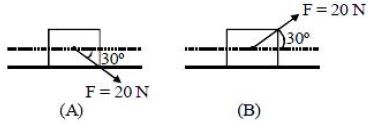
A block of mass $5\, \ kg$ is $(i)$ pushed in case $(A)$ and $(ii)$ pulled in case $(B)$, by a force $F = 20\, N$, making an angle of $30^\circ$ with the horizontal, as shown in the figures. The coefficient of friction between the block and floor is $\mu = 0.2$. The difference between the accelerations of the block, in case $(B)$ and case $(A)$ will be $........ ms^{-2}$ .$(g = 10\, ms^{-2})$
Given that: $\lambda  = a\,\cos \,\left( {\frac{t}{p} - qx} \right)$ , where $t$ represents time in second and $x$ represents distance in metre. Which of the following statements is true?