MCQ
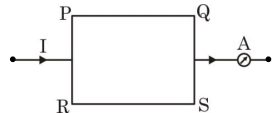
A current carrying rectangular loop PQRS is made of uniform wire. The length $PR = QS =5\,cm$ and $PQ = RS =100\,cm$. If ammeter current reading changes from I to $2 I$, the ratio of magnetic forces per unit length on the wire $P Q$ due to wire RS in the two cases respectively $f_{ PQ }^{ I }: f_{ PQ }^{2 I }$ is :
  • A
    $1: 2$
  • $1: 4$
  • C
    $1: 5$
  • D
    $1: 3$

Answer

Correct option: B.
$1: 4$
b
$F \propto I _1 I _2$

$F _{ I }: F _{2 I }=1: 4$

Need a full question paper?

Generate a complete, print-ready paper with questions like this in minutes — across 16+ boards, with answer keys.

Start Generating Free

Similar questions

In the given figure, when galvanometer shows no deflection, the current (in $A$) flowing through $5\,\Omega $ resistance will be
Two like charges are placed a certain distance apart in air. If a brass plate is introduced between them, the force between the two charges will:
The voltage of an $ac$ source varies with time according to the equation $V = 100\sin \,\left( {100\pi t} \right)\cos \,\left( {100\pi t} \right)$ where $t$ is in seconds and $V$ is in volts. Then
If two wires having resistance $R$ and $2R$. Both joined in series and in parallel then ratio of heat generated in this situation, applying the same voltage,
A point charge $2 \times 10^{-2}\,C$ is moved from $P$ to $S$ in a uniform electric field of $30\,NC ^{-1}$ directed along positive $x$-axis. If coordinates of $P$ and $S$ are $(1,2$, $0) m$ and $(0,0,0) m$ respectively, the work done by electric field will be $.........\,mJ$
Two parallel conductors A and B of equal lengths carry currents I and 10 I, respectively, in the same direction. Then
A parallel beam of light emerges from the opposite surface of the sphere when a point source of light lies at the surface of the sphere. The refractive index of the sphere is
Energy of an electron in an excited hydrogen atom is – 3.4 eV. Its angular momentum will be: $h=6.626 \times 10^{-34} \mathrm{~J}-\mathrm{s}$
Two charged spheres separated at a distance d exert a force F on each other. If they are immersed in a liquid of dielectric constant 2, then what is the force (if all conditions are same)
Total internal reflection can take place only if: