MCQ
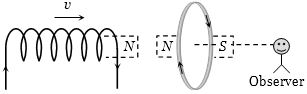
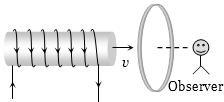
A current carrying solenoid is approaching a conducting loop as shown in the figure. The direction of induced current as observed by an observer on the other side of the loop will be
  • A
    Anticlockwise
  • Clockwise
  • C
    East
  • D
    West

Answer

Correct option: B.
Clockwise
b
(b) The direction of current in the solenoid is anti-clockwise as seen by observer. On displacing it towards the loop a current in the loop will be induced in a direction so as to oppose the approach of solenoid. Therefore the direction of induced current as observed by the observer will be clockwise.

Need a full question paper?

Generate a complete, print-ready paper with questions like this in minutes — across 16+ boards, with answer keys.

Start Generating Free

Similar questions

A wave on a string is travelling and the displacement of particles on it is given by $x = A\, sin\, (2t -0.1\, x)$. Then the wavelength of the wave is
Two identical short bar magnets, each having magnetic moment $M$ are placed a distance of $2d$ apart with axes perpendicular to each other in a horizontal plane. The magnetic induction at a point midway between them is 
If focal length of the objective lens is increased, then
An electron of mass $m_{e}$ and a proton of mass $m_{p}$ are accelerated through the same potential difference. The ratio of the de-Broglie wavelength associated with the electron to that with the proton is
A force of $100 \,dynes$ acts on a mass of $5\, gram$ for $10\, sec$. The velocity produced is ......... $cm/sec$
The dimension of $\frac{1}{2} \varepsilon_0 E ^2$, where $\varepsilon_0$ is permittivity of free space and $E$ is electric field, is
A diatomic gas $(\gamma=1.4)$ does $100 J$ of work in an isobaric expansion. The heat given to the gas is :
Under which of the following conditions is the law $PV = RT$ obeyed most closely by a real gas
In Young's double slit experiment, angular width of fringes is $0.20^o$ for sodium light of wavelength $5890 Å$. If complete system is dipped in water, then angular width of fringes becomes....$^o$
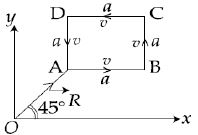
A particle of mass $m$ is moving along the side of a square of side '$a$', with a uniform speed $v$ in the $x-y$ plane as shown in the figure

Which of the following statement is false for the angular momentum $\vec L$ about the origin ?