A current $i$ is flowing in a conductor of length $l$. When it is bent in the form of a circular loop then its magnetic moment will be-
Medium


Download our appand get started for free
Experience the future of education. Simply download our apps or reach out to us for more information. Let's shape the future of learning together!No signup needed.*
Similar Questions
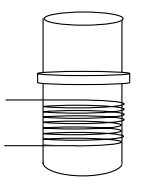
- 1$STATEMENT-1$ A vertical iron rod has a coil of wire wound over it at the bottom end. An alternating current flows in the coil. The rod goes through a conducting ring as shown in the figure. The ring can float at a certain height above the coil. BecauseView Solution
$STATEMENT- 2$ In the above situation, a current is induced in the ring which interacts with the horizontal component of the magnetic field to produce an average force in the upward direction.
- 2Two long and parallel straight wires $A$ and $B$ carrying currents of $8.0\; A$ and $5.0\; A$ in the same direction are separated by a distance of $4.0\; cm$. Estimate the force on a $10\; cm$ section of wire $A.$View Solution
- 3A proton of mass $1.67 \times {10^{ - 27}}\,kg$ and charge $1.6 \times {10^{ - 19}}\,C$ is projected with a speed of $2 \times {10^6}\,m/s$ at an angle of $60^\circ $ to the $X - $ axis. If a uniform magnetic field of $0.104$ $Tesla$ is applied along $Y - $ axis, the path of proton isView Solution
- 4View SolutionMotion of a moving electron is not affected by
- 5A electron experiences a force $\left( {4.0\,\hat i + 3.0\,\hat j} \right)\times 10^{-13} N$ in a uniform magnetic field when its velocity is $2.5\,\hat k \times \,{10^7} ms^{-1}$. When the velocity is redirected and becomes $\left( {1.5\,\hat i - 2.0\,\hat j} \right) \times {10^7}$, the magnetic force of the electron is zero. The magnetic field $\vec B$ is :View Solution
- 6A long solenoid is formed by winding $20$ $turns/cm$. The current necessary to produce a magnetic field of $20$ $milli\,tesla$ inside the solenoid will be approximately .....$A$ $(\frac{{{\mu _0}}}{{4\pi }} = {10^{ - 7}}\,tesla - metre/ampere)$View Solution
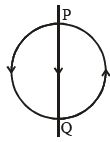
- 7A circular coil of wire carries a current. $PQ$ is a part of a very long wire carrying a current and passing close to the circular coil. If the directions of currents are those shown in figure, what is the direction of force acting on $PQ$ ?View Solution
- 8Current $i$ is carried in a wire of length $L$. If the wire is turned into a circular coil, the maximum magnitude of torque in a given magnetic field $B$ will beView Solution
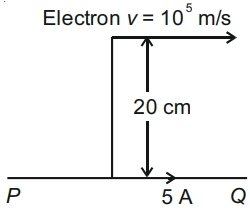
- 9An infinitely long straight conductor carries a current of $5 \,\mathrm{~A}$ as shown. An electron is moving with a speed of $10^{5} \, \mathrm{~m} / \mathrm{s}$ parallel to the conductor. The perpendicular distance between the electron and the conductor is $20 \, \mathrm{~cm}$ at an instant. Calculate the magnitude of the force experienced by the electron at that instant in $\times 10^{-20} \,N$View Solution
- 10An electron moving in a circular orbit of radius $r$ makes $n$ rotation per second. The magnetic field produced at the centre has a magnitude ofView Solution