An infinitely long straight conductor carries a current of $5 \,\mathrm{~A}$ as shown. An electron is moving with a speed of $10^{5} \, \mathrm{~m} / \mathrm{s}$ parallel to the conductor. The perpendicular distance between the electron and the conductor is $20 \, \mathrm{~cm}$ at an instant. Calculate the magnitude of the force experienced by the electron at that instant in $\times 10^{-20} \,N$
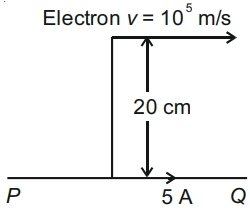
NEET 2021, Medium
Download our app for free and get started
$B =\frac{\mu_{0} I}{2 \pi R}$
$F =B V q \sin \theta$
$\theta =90^{\circ}$
$F =B V q$
$F=\frac{\mu_{0} I}{2 \pi R} \times V \times e=\frac{2 \times 10^{-7} \times 5}{20 \times 10^{-2}} \times 10^{5} \times 1.6 \times 10^{-19}$
$F=8 \times 10^{-20}\, \mathrm{~N}$

Download our appand get started for free
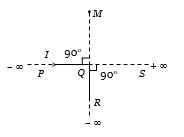
Experience the future of education. Simply download our apps or reach out to us for more information. Let's shape the future of learning together!No signup needed.*
Similar Questions
- 1View SolutionThe sensitiveness of a moving coil galvanometer can be increased by decreasing
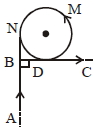
- 2A very long wire $ABDMNDC$ is shown in figure carrying current $I. AB$ and $BC$ parts are straight, long and at right angle. At $D$ wire forms a circular turn $DMND$ of radius $R. AB.$ $\mathrm{BC}$ parts are tangential to circular turn at $\mathrm{N}$ and $D$. Magnetic field at the centre of circle isView Solution
- 3Two coaxial solenoids of different radii carry current $I$ in the same direction. Let $\;{\overrightarrow {\;F} _1}$ be the magnetic force on the inner solenoid due to the outer one and $\;{\overrightarrow {\;F} _2}$ be the magnetic force on the outer solenoid due to the inner one. ThenView Solution
- 4View SolutionIf an ammeter is to be used in place of a voltmeter then we must connect with the ammeter a
- 5A spherical shell of radius $'R'$ carries uniformly distributed charge $'Q'$ is rotated about it's diameter with angular speed $\omega $ find it's magnetic momentView Solution
- 6View SolutionThe phosphor bronze strip is used in a moving coil galvanometer because
- 7A closely wounded circular coil of radius $5\,cm$ produces a magnetic field of $37.68 \times 10^{-4}\,T$ at its center. The current through the coil is $......A$. [Given, number of turns in the coil is $100$ and $\pi=3.14]$View Solution
- 8An electron having a charge e moves with a velocity $v$ in positive $x$ direction. A magnetic field acts on it in positive $y$ direction. The force on the electron acts in (where outward direction is taken as positive $z$-axis).View Solution
- 9View SolutionIf a positive ion is moving, away from an observer with same acceleration, then the lines of force of magnetic induction will be
- 10An infinitely long conductor $PQR$ is bent to form a right angle as shown. A current $I$ flows through $PQR$ The magnetic field due to this current at the point $M $ is $H_1$. Now another infinitely long straight conductor $QS$ is connected at $Q$ so that the current is $I/2$ in $QR$ as well as in $QS$, The current in $PQ$ remaining unchanged. The magnetic field at $M$ is now ${H_{2.}}$The ratio ${H_1}/{H_2}$ is given byView Solution