MCQ
A current loop placed in a magnetic field behaves like a
  • Magnetic dipole
  • B
    Magnetic substance
  • C
    Magnetic pole
  • D
    All are true

Answer

Correct option: A.
Magnetic dipole

Need a full question paper?

Generate a complete, print-ready paper with questions like this in minutes — across 16+ boards, with answer keys.
Start Generating Free

Similar questions

A man having height $6 \mathrm{~m}$. He observes image of $2 \mathrm{~m}$ height erect, then mirror used is
A two metre wire is moving with a velocity of $1 \mathrm{~m} / \mathrm{sec}$ perpendicular to a magnetic field of $0.5 \mathrm{weber} / \mathrm{m}$. The e.m.f. induced in it will be
A $12$ ohm resistor and a $0.21$ henry inductor are connected in series to an ac source operating at $20$ volts, $50$ cycle/second. The phase angle between the current and the source voltage is
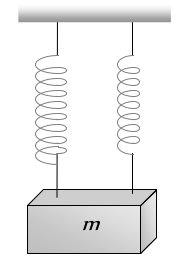
A mass $m$ is suspended separately by two different springs of spring constant $K$ and $K$ gives the time-period $t_1$ and $t_2$ respectively. If same mass $m$ is connected by both springs as shown in figure then time-period $t$ is given by the relationImage
The position vectors of points $A, B, \quad C$ and $D$ are $A=3 \hat{i}+4 \hat{j}+5 \hat{k}, B=4 \hat{i}+5 \hat{j}+6 \hat{k}, C=7 \hat{i}+9 \hat{j}+3 \hat{k} \quad$ and $D=4 \hat{i}+6 \hat{j}$ then the displacement vectors $A B$ and $C D$ are
A heavy mass is attached to a thin wire and is whirled in a vertical circle. The wire is most likely to break
Which one of the following modifications may ncrease the sensitivity of moving coil galvanometer?

$1^{st}$ Way : By using spring of smaller torsion constant.
$2^{nd}$ Way : By using a smaller coil
$3^{rd}$ Way : By using a stronger magnet
$4^{th}$ Way : By using a coil having fewer number of turns.

Heat is not being exchanged in a body. If its internal energy is increased, then
When fluids are heated from the bottom, convection currents are produced because
A particle of mass $m$ moving with a velocity $\vec{V}$ makes a head on elastic collision with another particle of same mass initially at rest. The velocity of the first particle after the collision will be