MCQ 11 Mark
When a ferromagnetic material is heated to temperature above its Curie temperature, the material
- A
Is permanently magnetized
- B
- C
Behaves like a diamagnetic material
- ✓
Behaves like a paramagnetic material
AnswerCorrect option: D. Behaves like a paramagnetic material
When a ferromagnetic material in heated above its curie temperature then it behaves like paramagnetic material.
View full question & answer→MCQ 21 Mark
The magnetic susceptibility of any paramagnetic material changes with absolute temperature $T$ as
- A
Directly proportional to $T$
- B
- ✓
Inversely proportional to $T$
- D
Exponentially decaying with $T$
AnswerCorrect option: C. Inversely proportional to $T$
View full question & answer→MCQ 31 Mark
Let $V$ and $H$ be the vertical and horizontal components of earth's magnetic field at any point on earth. Near the north pole
- ✓
$V > H$
- B
$V_1$
- C
$V=H$
- D
$V=H=0$
AnswerCorrect option: A. $V > H$
$V > H$
View full question & answer→MCQ 41 Mark
Which of the following statements is incorrect about hysteresis
- A
This effect is common to all ferromagnetic substances
- B
The hysteresis loop area is proportional to the thermal energy developed per unit volume of the material
- ✓
The hysteresis loop area is independent of the thermal energy developed per unit volume of the material
- D
The shape of the hysteresis loop is characteristic of the material
AnswerCorrect option: C. The hysteresis loop area is independent of the thermal energy developed per unit volume of the material
The energy lost per unit volume of a substance in a complete cycle of magnetisation is equal to the area of the hysteresis loop.
View full question & answer→MCQ 51 Mark
The angle of dip at a certain place is $30.$ If the horizontal component of the earth's magnetic field is $H$, the intensity of the total magnetic field is
- A
$\frac{H}{2}$
- ✓
$\frac{2 H}{\sqrt{3}}$
- C
$H \sqrt{2}$
- D
$H \sqrt{3}$
AnswerCorrect option: B. $\frac{2 H}{\sqrt{3}}$
$B_H=B \cos \phi \Rightarrow B=\frac{B_H}{\cos \phi}$
$ \Rightarrow B=\frac{B_H}{\cos 30^{\circ}}=\frac{2 B_H}{\sqrt{3}}$
View full question & answer→MCQ 61 Mark
Magnets $A$ and $B$ are geometrically similar but the magnetic moment of $A$ is twice that of $B$. If $T$ and $\mathrm{T}$ be the time periods of the oscillation when their like poles and unlike poles are kept together respectively, then $\frac{T_1}{T_2}$ will be
- A
$\frac{1}{3}$
- B
$\frac{1}{2}$
- ✓
$\frac{1}{\sqrt{3}}$
- D
$\sqrt{3}$
AnswerCorrect option: C. $\frac{1}{\sqrt{3}}$
$ T_{\text {Sum }}=2 \pi \sqrt{\frac{\left(I_1+I_2\right)}{\left(M_1+M_2\right) B_H}} $
$ T_{\text {diff }}=2 \pi \sqrt{\frac{I_1+I_2}{\left(M_1-M_2\right) B_H}} $
$ \Rightarrow \frac{T_s}{T_d}=\frac{T_1}{T_2}=\sqrt{\frac{M_1-M_2}{M_1+M_2}}=\sqrt{\frac{2 M-M}{2 M+M}}=\frac{1}{\sqrt{3}}$
View full question & answer→MCQ 71 Mark
Temperature above which a ferromagnetic substance becomes paramagnetic is called
MCQ 81 Mark
At a place, if the earth's horizontal and vertical components of magnetic fields are equal, then the angle of dip will be
- A
$30^{\circ}$
- B
$90^{\circ}$
- ✓
$45^{\circ}$
- D
$0^{\circ}$
AnswerCorrect option: C. $45^{\circ}$
$B_V=H_H \tan \phi$; If $B_V=B_H$, then $\tan \phi=1$ or $\phi=45^{\circ}$
View full question & answer→MCQ 91 Mark
A short magnet of moment $6.75 \mathrm{Am}$ produces a neutral point on its axis. If horizontal component of earth's magnetic field is $5 \times 10^{-5} \mathrm{~Wb} / \mathrm{m}^2$, then the distance of the neutral point should be
- A
$10 \mathrm{~cm}$
- B
$20 \mathrm{~cm}$
- ✓
$30 \mathrm{~cm}$
- D
$40 \mathrm{~cm}$
AnswerCorrect option: C. $30 \mathrm{~cm}$
At neutral point
$|\text{Magnetic field due to magnet}|=|\text {Magnetic field due to earth}|$
$\frac{\mu_0}{4 \pi} \cdot \frac{2 M}{d^3}=5 \times 10^{-5} \Rightarrow 10^{-7} \times \frac{2 \times 6.75}{d^3}=5 \times 10^{-5} $
$ \Rightarrow d=0.3 m=30\ cm$
View full question & answer→MCQ 101 Mark
The magnetic susceptibility is
- ✓
$\chi=\frac{I}{H}$
- B
$\chi=\frac{B}{H}$
- C
$\chi=\frac{M}{V}$
- D
$\chi=\frac{M}{H}$
AnswerCorrect option: A. $\chi=\frac{I}{H}$
View full question & answer→MCQ 111 Mark
Which of the following statements are true about the magnetic susceptibility $\chi_m$ of paramagnetic substance
- A
Value of $\chi_m$ is inversely proportional to the absolute temperature of the sample
- B
$\chi_{\text {. }}$ is positive at all temperature
- C
$\chi_m$ is negative at all temperature
- ✓
View full question & answer→MCQ 121 Mark
Two identical magnetic dipoles of magnetic moments $1.0 \mathrm{~A}-\mathrm{m}$ each, placed at a separation of $2 \mathrm{~m}$ with their axis perpendicular to each other. The resultant magnetic field at a point midway between the dipoles is
AnswerCorrect option: B. $\sqrt{5} \times 10^{-7} T$
View full question & answer→MCQ 131 Mark
For an isotropic medium $B, \mu, H$ and $M$ are related as (where $B, \mu_0, H$ and $M$ have their usual meaning in the context of magnetic material
- A
$(B-M)=\mu_0 H$
- B
$M=\mu_0(H+M)$
- C
$H=\mu_0(H+M)$
- ✓
$B=\mu_0(H+M)$
AnswerCorrect option: D. $B=\mu_0(H+M)$
(d) Net magnetic induction $B=B_0+B_m=\mu_0 H+\mu_0 M$
View full question & answer→MCQ 141 Mark
The intensity of magnetic field is $H$ and moment of magnet is $M$. The maximum potential energy is
- ✓
$\mathrm{MH}$
- B
$2 \mathrm{MH}$
- C
$3 \mathrm{MH}$
- D
$4 \mathrm{MH}$
AnswerCorrect option: A. $\mathrm{MH}$
Potential energy $U=-M B \cos \theta$$\Rightarrow U_{\max }=M H\left(\text { at } \theta=180^{\circ}\right)$
View full question & answer→MCQ 151 Mark
If a magnet of length $10 \mathrm{~cm}$ and pole strength $40 \mathrm{~A}-\mathrm{m}$ is placed at an angle of $45$ in an uniform induction field of intensity $2 \times 10^{-4}\ T$, the couple acting on it is
- A
$0.5656 \times 10^{-7} N-m$
- ✓
$0.565 \times 10^{-3} N-m$
- C
$0.656 \times 10^{-3} N-m$
- D
$0.656 \times 10^{-5} N-m$
AnswerCorrect option: B. $0.565 \times 10^{-3} N-m$
$\tau =M B \sin \theta=(m L) B \sin \theta $
$ =\left(40 \times 10 \times 10^{-2}\right) \times 2 \times 10^{-4} \times \sin 45^{\circ}$
$=0.565 \times 10^{-3} N-m$
View full question & answer→MCQ 161 Mark
A diamagnetic material in a magnetic field moves
- A
From weaker to the stronger parts of the field
- B
Perpendicular to the field
- ✓
From stronger to the weaker parts of the field
- D
In none of the above directions
AnswerCorrect option: C. From stronger to the weaker parts of the field
View full question & answer→MCQ 171 Mark
A magnet oscillating in a horizontal plane has a time period of $2$ second at a place where the angle of dip is $30$ and $3$ seconds at another place where the angle of dip is $60.$ The ratio of resultant magnetic fields at the two places is
- A
$\frac{4 \sqrt{3}}{7}$
- B
$\frac{4}{9 \sqrt{3}}$
- ✓
$\frac{9}{4 \sqrt{3}}$
- D
$\frac{9}{\sqrt{3}}$
AnswerCorrect option: C. $\frac{9}{4 \sqrt{3}}$
$ T \propto \frac{1}{\sqrt{B_H}}=\frac{1}{\sqrt{B \cos \phi}} \Rightarrow \frac{T_1}{T_2}=\sqrt{\frac{B_2 \cos \phi_2}{B_1 \cos \phi_1}} $
$ \Rightarrow \frac{B_1}{B_2}=\frac{T_2^2}{T_1^2} \times \frac{\cos \phi_2}{\cos \phi_1}=\left(\frac{3}{2}\right)^2 \times \frac{\cos 60^{\circ}}{\cos 30^{\circ}} \Rightarrow \frac{B_1}{B_2}=\frac{9}{4 \sqrt{3}}$
View full question & answer→MCQ 181 Mark
The given figure represents a material which is
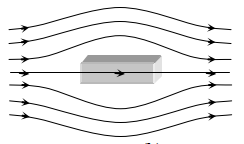
MCQ 191 Mark
A current carrying coil is placed with its axis perpendicular to $\mathrm{N}-\mathrm{S}$ direction. Let horizontal component of earth's magnetic field be $H$ and magnetic field inside the loop is $H$. If a magnet is suspended inside the loop, it makes angle $\theta$ with $H$. Then $\theta=$
- ✓
$\tan ^{-1}\left(\frac{H_0}{H}\right)$
- B
$\tan ^{-1}\left(\frac{H}{H_0}\right)$
- C
$\operatorname{cosec}^{-1}\left(\frac{H}{H_0}\right)$
- D
$\cot ^{-1}\left(\frac{H_0}{H}\right)$
AnswerCorrect option: A. $\tan ^{-1}\left(\frac{H_0}{H}\right)$
View full question & answer→MCQ 201 Mark
Susceptibility of ferromagnetic substance is
MCQ 211 Mark
View full question & answer→MCQ 221 Mark
The time period of a freely suspended magnet is 4 seconds. If it is broken in length into two equal parts and one part is suspended in the same way, then its time period will be
- A
$4 \mathrm{sec}$
- ✓
$2 \mathrm{sec}$
- C
$0.5 \mathrm{sec}$
- D
$0.25 \mathrm{sec}$
AnswerCorrect option: B. $2 \mathrm{sec}$
$\quad T=2 \pi \sqrt{\frac{I}{M B_H}}=4 \mathrm{sec}$When magnet is cut into two equal halves, then New magnetic moment $M^{\prime}=\frac{M}{2}$
New moment of inertia $I^{\prime}=\frac{(\mathrm{w} / 2)(l / 2)^2}{12}=\frac{1}{8} \cdot \frac{\mathrm{w} l^2}{12}$ Where $w$ is the initial mass of the magnet But $I=\frac{\mathrm{w} l^2}{12} ; \therefore I^{\prime}=\frac{I}{8}$
$\therefore$ New time period $T^{\prime}=2 \pi \sqrt{\frac{I^{\prime}}{M^{\prime} B_H}}$
$=2 \pi \sqrt{\frac{I / 8}{(M / 2) B_H}}=\frac{1}{2} 2 \pi \sqrt{\frac{I}{M_H}}=\frac{1}{2} \times T=\frac{1}{2} \times 4=2\mathrm{sec}$
View full question & answer→MCQ 231 Mark
The magnetic moment of atomic neon is
- ✓
- B
$\mu B / 2$
- C
$\mu B$
- D
$3 \mu B / 2$
Answer(a) Neon atom is diamagnetic, hence it's net magnetic moment is zero.
View full question & answer→MCQ 241 Mark
The number of turns and radius of cross-section of the coil of a tangent galvanometer are doubled. The reduction factor $K$ will be
Answer$K=\frac{2 R B_H}{\mu_0 N} \quad(R=$ radius, $N=$ number of turns $)$
View full question & answer→MCQ 251 Mark
Time period of a freely suspended magnet does not depend upon
- A
- B
Pole strength of the magnet
- C
Horizontal component of earth's magnetic field
- ✓
Length of the suspension thread
AnswerCorrect option: D. Length of the suspension thread
View full question & answer→MCQ 261 Mark
The vertical component of earth's magnetic field is zero at or The earth's magnetic field always has a vertical component except at the
AnswerAt magnetic equator, the angle of dip is 0 . Hence the vertical component $V=I \sin \phi=0$.
View full question & answer→MCQ 271 Mark
Two bar magnets of the same mass, length and breadth but magnetic moments $M$ and $2 M$ respectively, when placed in same position, time period is $3 \mathrm{sec}$. What will be the time period when they are placed in different position
AnswerCorrect option: B. $3 \sqrt{3} \mathrm{sec}$
(b) In sum position $T \propto \frac{1}{\sqrt{M_1+M_2}}$ and in difference position
$ T \propto \frac{1}{\sqrt{M_1-M_2}} $
$ \Rightarrow \frac{3^2}{T^2}=\frac{2 M-M}{2 M+M} \Rightarrow T^2=9 \times 3 \mathrm{sec}^2$
$\therefore T=3 \sqrt{3} \mathrm{sec}$
View full question & answer→MCQ 281 Mark
A dip needle in a plane perpendicular to magnetic meridian will remain
- ✓
- B
- C
- D
At an angle of dip to the horizontal
View full question & answer→MCQ 291 Mark
The period of oscillations of a magnetic needle in a magnetic field is $1.0 \mathrm{sec}$. If the length of the needle is halved by cutting it, the time period will be
- A
$1.0 \mathrm{sec}$
- ✓
$0.5 \mathrm{sec}$
- C
$0.25 \mathrm{sec}$
- D
$2.0 \mathrm{sec}$
AnswerCorrect option: B. $0.5 \mathrm{sec}$
$ T=2 \pi \sqrt{\frac{I}{M B}}=2 \pi \sqrt{\frac{\mathrm{w} l^2 / 12}{\text { Pole strength } \times 2 l \times B}}$
$ \therefore T \propto \sqrt{W l} $
$\therefore \frac{T_2}{T_1}=\sqrt{\frac{\mathrm{w}_2}{\mathrm{w}_1} \times \frac{l_2}{l_1}}=\sqrt{\frac{\mathrm{w}_1 / 2}{\mathrm{w}_1} \times \frac{l_1 / 2}{l_1}}=\frac{1}{2} $
$ \Rightarrow T_2=\frac{T_1}{2}=0.5 \mathrm{sec}$
View full question & answer→MCQ 301 Mark
The magnetic field to a small magnetic dipole of magnetic moment $M$, at distance $r$ from the centre on the equatorial line is given by (in M.K.S. system)
- A
$\frac{\mu_0}{4 \pi} \times \frac{M}{r^2}$
- ✓
$\frac{\mu_0}{4 \pi} \times \frac{M}{r^3}$
- C
$\frac{\mu_0}{4 \pi} \times \frac{2 M}{r^2}$
- D
$\frac{\mu_0}{4 \pi} \times \frac{2 M}{r^3}$
AnswerCorrect option: B. $\frac{\mu_0}{4 \pi} \times \frac{M}{r^3}$
(b) $B_{\text {equatorial }}=\frac{\mu_0}{4 \pi} \frac{M}{r^3}$
View full question & answer→MCQ 311 Mark
The vertical component of the earth's magnetic field is zero at a place where the angle of dip is
- ✓
$0^{\circ}$
- B
$45^{\circ}$
- C
$60^{\circ}$
- D
$90^{\circ}$
AnswerCorrect option: A. $0^{\circ}$
(a) The vertical component of earth's magnetic field is zero at equator where angle of dip is also zero.
View full question & answer→MCQ 321 Mark
The torque on a bar magnet due to the earth's magnetic field is maximum when the axis of the magnet is
AnswerCorrect option: A. Perpendicular to the field of the earth
Torque on a bar magnet in earths magnetic field $(B)$ is $\tau=M B_H \sin \theta . \tau$ will be maximum if $\sin \theta=$ maximum i.e. $\theta$ $=90$.
Hence axis of the magnet is perpendicular to the field of earth.
View full question & answer→MCQ 331 Mark
A bar magnet is situated on a table along east-west direction in the magnetic field of earth. The number of neutral points, where the magnetic field is zero, are
MCQ 341 Mark
Two lines of force due to a bar magnet
- A
Intersect at the neutral point
- B
Intersect near the poles of the magnet
- C
Intersect on the equatorial axis of the magnet
- ✓
View full question & answer→MCQ 351 Mark
Before using the tangent galvanometer, its coil is set in
- ✓
Magnetic meridian (or vertically north south)
- B
Perpendicular to magnetic meridian
- C
At angle of 45 to magnetic meridian
- D
It does not require any setting
AnswerCorrect option: A. Magnetic meridian (or vertically north south)
View full question & answer→MCQ 361 Mark
The magnet of a vibration magnetometer is heated so as to reduce its magnetic moment by $19 \%$. By doing this the periodic time of the magnetometer will
- A
Increase by $19 \%$
- B
Decrease by $19 \%$
- ✓
Increase by $11 \%$
- D
Decrease by $21 \%$
AnswerCorrect option: C. Increase by $11 \%$
$T=2 \pi \sqrt{\frac{I}{M B_H}} \Rightarrow T \propto \frac{1}{\sqrt{M}} \Rightarrow \frac{T_1}{T_2}=\sqrt{\frac{M_2}{M_1}}$If $M=100$ than $M(100-19)=81$
So $\frac{T_1}{T_2}=\sqrt{\frac{81}{100}}=\frac{9}{10} \Rightarrow T_2=\frac{10}{9} T_1=1.11 T_1$
$\Rightarrow$ Time period increases by $11 \%$
View full question & answer→MCQ 371 Mark
The time period of a vibration magnetometer is $T$. lts magnet is replaced by another magnet whose moment of inertia is $3$ times and magnetic moment is $1 / 3$ of the initial magnet. The time period now will be
- ✓
$3\ T$
- B
$T$
- C
$T_0 / \sqrt{3}$
- D
$T / 3$
AnswerCorrect option: A. $3\ T$
$ T=2 \pi \sqrt{\frac{I}{M B_H}} ; I \rightarrow 3$ times and $M \rightarrow \frac{1}{3}$ times So $T \rightarrow 3$ times i.e. $T^{\prime}=3 T_0$
View full question & answer→MCQ 381 Mark
A tangent galvanometer has a coil of $25$ turns and radius of $15 \mathrm{~cm}$. The horizontal component of the earth's magnetic field is $3 \times 10 . T$. The current required to produce a deflection of $45$ in it, is
AnswerCorrect option: A. $0.29 \mathrm{~A}$
$ i=\frac{2 r B_H}{\mu_0 N} \tan \theta $
$ \Rightarrow i=\frac{2 \times 15 \times 10^{-2} \times 3 \times 10^{-5}}{4 \pi \times 10^{-7} \times 25} \times \tan 45^{\circ} \Rightarrow i=0.29 \mathrm{~A}$
View full question & answer→MCQ 391 Mark
A magnet of magnetic moment $50 \hat{i} A-m^2$ is placed along the $x$ axis in a magnetic field $\vec{B}=(0.5 \hat{i}+3.0 \hat{j}) T$. The torque acting on the magnet is
AnswerCorrect option: B. $150\ \hat{k} N-m$
$ \vec{\tau}=\vec{M} \times \vec{B} \Rightarrow \vec{\tau}=50 \hat{i}\times(0.5 \hat{i}+3 \hat{j})$
$ =150(\hat{i} \times \hat{j})=150\ \hat{k} N \times m$
View full question & answer→MCQ 401 Mark
At a certain place, the horizontal component $B_0$ and the vertical component $V_0$ of the earth's magnetic field are equal in magnitude. The total intensity at the place will be
- A
$B_0$
- B
$B_0^2$
- C
$2 B_0$
- ✓
$\sqrt{2} B_0$
AnswerCorrect option: D. $\sqrt{2} B_0$
(d) $B_0=V_0$ also total intensity $B=\sqrt{B_0^2+V_0^2} \Rightarrow B=\sqrt{2} B_0$
View full question & answer→MCQ 411 Mark
The time period of a freely suspended magnet is $2 \mathrm{sec}$. If it is broken in length into two equal parts and one part is suspended in the same way, then its time period will be
- A
$4 \mathrm{sec}$
- B
$2 \mathrm{sec}$
- C
$\sqrt{2} \mathrm{sec}$
- ✓
$1 \mathrm{sec}$
AnswerCorrect option: D. $1 \mathrm{sec}$
(d) $T^{\prime}=\frac{T}{n} \Rightarrow T^{\prime}=\frac{2}{2}=1 \mathrm{sec}$
View full question & answer→MCQ 421 Mark
A short bar magnet placed with its axis at $30^{\circ}$ with a uniform external magnetic field of $0.16$ Tesla experiences a torque of magnitude $0.032$ Joule. The magnetic moment of the bar magnet will be
- A
$0.23$ Joule/Tesla
- ✓
$0.40$ Joule/Tesla
- C
$0.80$ oule/Tesla
- D
$0$
AnswerCorrect option: B. $0.40$ Joule/Tesla
$ \tau=M B_H \sin \theta \Rightarrow 0.032=M \times 0.16 \times \sin 30^{\circ} $
$ \Rightarrow M=0.4 J / \text { tesla }$
View full question & answer→MCQ 431 Mark
When $\sqrt{3}$ ampere current is passed in a tangent galvanometer, there is a deflection of $30^{\circ}$ in it. The deflection obtained when 3 amperes current is passed, is
- A
$30^{\circ}$
- ✓
$45^{\circ}$
- C
$60^{\circ}$
- D
$75^{\circ}$
AnswerCorrect option: B. $45^{\circ}$
(b) $i \propto \tan \theta \Rightarrow \frac{i_1}{i_2}=\frac{\tan \theta_1}{\tan \theta_2} \Rightarrow \frac{\sqrt{3}}{3}=\frac{\tan 30^{\circ}}{\tan \theta_2} \Rightarrow \theta=45^{\circ}$
View full question & answer→MCQ 441 Mark
A certain amount of current when flowing in a properly set tangent galvanometer, produces a deflection of $45^{\circ}$. If the current be reduced by a factor of $\sqrt{3}$, the deflection would
- A
Decrease by $30^{\circ}$
- ✓
Decrease by $15^{\circ}$
- C
Increase by $15^{\circ}$
- D
Increase by $30^{\circ}$
AnswerCorrect option: B. Decrease by $15^{\circ}$
In tangent galvanometer, $I \propto \tan \theta$
$ \therefore \frac{I_1}{I_2}=\frac{\tan \theta_1}{\tan \theta_2} \Rightarrow \frac{I_1}{I_1 / \sqrt{3}}=\frac{\tan 45^{\circ}}{\tan \theta_2} $
$ \Rightarrow \sqrt{3} \tan \theta_2=1 \Rightarrow \tan \theta_2=\frac{1}{\sqrt{3}} \Rightarrow \theta_2=30^{\circ}$
So deflection will decrease by $45^{-}-30=15$,
View full question & answer→MCQ 451 Mark
Two magnets are held together in a vibration magnetometer and are allowed to oscillate in the earth's magnetic field with like poles together, $12$ oscillations per minute are made but for unlike poles together only $4$ oscillations per minute are executed. The ratio of their magnetic moments is
- A
$3: 1$
- B
$1: 3$
- C
$3: 5$
- ✓
$5: 4$
AnswerCorrect option: D. $5: 4$
(d) In the sum and difference method of vibration magnetometer$\frac{M_1}{M_2}=\frac{T_2^2+T_1^2}{T_2^2-T_1^2}$
Here $T_1=\frac{1}{n_1}=\frac{60}{12}=5 \mathrm{sec} \cdot T_2=\frac{1}{n_2}=\frac{60}{4}=15 \mathrm{sec}$
$\therefore \frac{M_1}{M_2}=\frac{15^2+5^2}{15^2-5^2}=\frac{225+25}{225-25}=\frac{5}{4}$
View full question & answer→MCQ 461 Mark
When the $N$-pole of a bar magnet points towards the south and $S$ pole towards the north, the null points are at the
- ✓
- B
- C
Perpendicular divider of magnetic axis
- D
$N$ and $S$ poles
View full question & answer→MCQ 471 Mark
Using a bar magnet $P$, a vibration magnetometer has time period 2seconds. When a bar $Q$ (identical to $P$ in mass and size) is placed on top of $P$, the time period is unchanged. Which of the following statements is true
- A
(a) $Q$ is of non-magnetic material
- ✓
(b) $Q$ is a bar magnet identical to $P$, and its north pole placed on top of $P_s$ north pole
- C
(c) $Q$ is of unmagnetized ferromagnetic material
- D
(d) Nothing can be said about $Q$ s properties
AnswerCorrect option: B. (b) $Q$ is a bar magnet identical to $P$, and its north pole placed on top of $P_s$ north pole
(b) $T=2 \pi \sqrt{\frac{I}{M B_H}}$. If $Q$ is an identical bar magnet then time period of system will be $T^{\prime}=2 \pi \sqrt{\frac{2 I}{(2 M) B_H}}=T$
View full question & answer→MCQ 481 Mark
Magnetic lines of force due to a bar magnet do not intersect because
- ✓
A point always has a single net magnetic field
- B
The lines have similar charges and so repel each other
- C
The lines always diverge from a single point
- D
The lines need magnetic lenses to be made to intersect
AnswerCorrect option: A. A point always has a single net magnetic field
View full question & answer→MCQ 491 Mark
The earth's magnetic field at a certain place has a horizontal component $0.3$ Gauss and the total strength $0.5$ Gauss. The angle of dip is
- A
$\tan ^{-1} \frac{3}{4}$
- B
$\sin ^{-1} \frac{3}{4}$
- ✓
$\tan ^{-1} \frac{4}{3}$
- D
$\sin ^{-1} \frac{3}{5}$
AnswerCorrect option: C. $\tan ^{-1} \frac{4}{3}$
$B^2=B_V^2+B_H^2 $
$\Rightarrow B_V=\sqrt{B^2-B_H^2}=\sqrt{(0.5)^2-(0.3)^2}=0.4$
Now $\tan \phi=\frac{B_V}{B_H}=\frac{0.4}{0.3}=\frac{4}{3} \Rightarrow \phi=\tan ^{-1}\left(\frac{4}{3}\right)$.
View full question & answer→MCQ 501 Mark
At the magnetic north pole of the earth, the value of horizontal component of earth's magnetic field and angle of dip are, respectively