Question
A current of 1.0A is established in a tightly wound solenoid of radius 2cm having 1000 turns/ metre. Find the magnetic energy stored in each metre of the solenoid.

Answer

i = 1.0A, r = 2cm, n = 1000 turn/m Magnetic energy stored $=\frac{\text{B}^2\text{V}}{2\mu_0}$ Where B → Magnetic field, V → Volume of Solenoid.$=\frac{\mu_0\text{n}^2\text{i}^2}{2\mu_0}\times\pi\text{r}^2\text{h}$
$=\frac{4\pi\times10^{-7}\times10^6\times1\times\pi\times4\times10^{-4}\times1}{2} \ [\text{h}=1\text{m}]$
$=8\pi\times10^{-5}$
$78.956\times10^{-5}=7.9\times10^{-4}\text{J}$.

Need a full question paper?

Generate a complete, print-ready paper with questions like this in minutes — across 16+ boards, with answer keys.
Start Generating Free

Similar questions

One mole of an ideal gas undergoes a process $\text{p}=\frac{\text{p}_0}{1+\Big(\frac{\text{V}}{\text{V}_0}\Big)^2}$ where $P_0$ and $V_0$ are constants. Find the temperature of the gas when $V = V_0$.
Three point masses m,, m, and m, are located at the vertices of an equilateral triangle of side length a. What is the moment of inertia about an axis along the altitude of the triangle passing through $m_1$?
Explain why.
There is no atmosphere on moon.
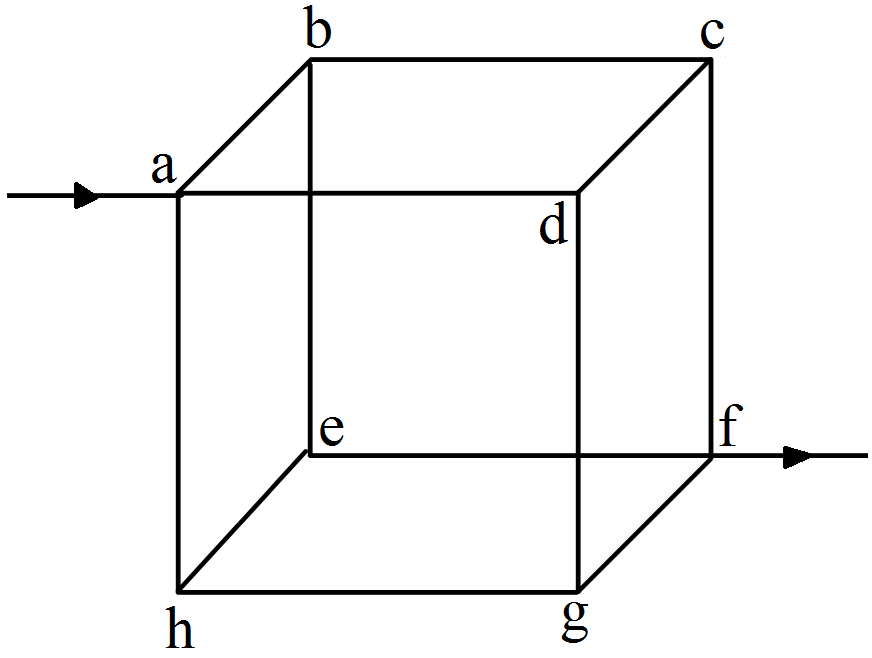
Twelve wires, each of equal resistance r, are joined to form a cube, as shown in the figure. Find the equivalent resistance between the diagonally opposite points a and f.
One day in the morning, Ramesh filled up 1/ 3 bucket of hot water from geyser, to take bath. Remaining 2/ 3 was to be filled by cold water (at room temperature) to bring mixture to a comfortable temperature. Suddenly Ramesh had to attend to something which would take some times, say 5-10 minutes before he could take bath. Now he had two options:
  1. Fill the remaining bucket completely by cold water and then attend to the work.
  2. First attend to the work and fill the remaining bucket just before taking bath. Which option do you think would have kept water warmer? Explain.
Air is pumped into an automobile tyre's tube up to a pressure of 200kPa in the morning when the air temperature is 20°C. During the day the temperature rises to 40°C and the tube expands by 2%. Calculate the pressure of the air in the tube at this temperature.
A copper calorimeter of mass $100$ g contains $200$ g of a mixture of ice and water. Steam at $100^{\circ} \mathrm{C}$ under normal pressure is passed into the calorimeter and the temperature of the mixture is allowed to rise to $50^{\circ} \mathrm{C}$. If the mass of the calorimeter and its contents is now $330$ g , what was the ratio of ice and water in the beginning? Neglect heat losses. Given. Specific heat capacity of copper $0.42 \times 10^3 \mathrm{~J} / \mathrm{kg}^{-1} \mathrm{~K}^{-1}$ Specific heat capacity of water $=4.2 \times 10^3 \mathrm{~J} / \mathrm{kg}^{-}$ ${ }^1 \mathrm{~K}^{-1}$ Latent heat of fusion of ice $=3.36 \times 10^5 \mathrm{~J} / \mathrm{kg}^{-1}$ Latent heat of condensation of steam $=22.5 \times 10^5 \mathrm{~J} / \mathrm{kg}^{-1}$
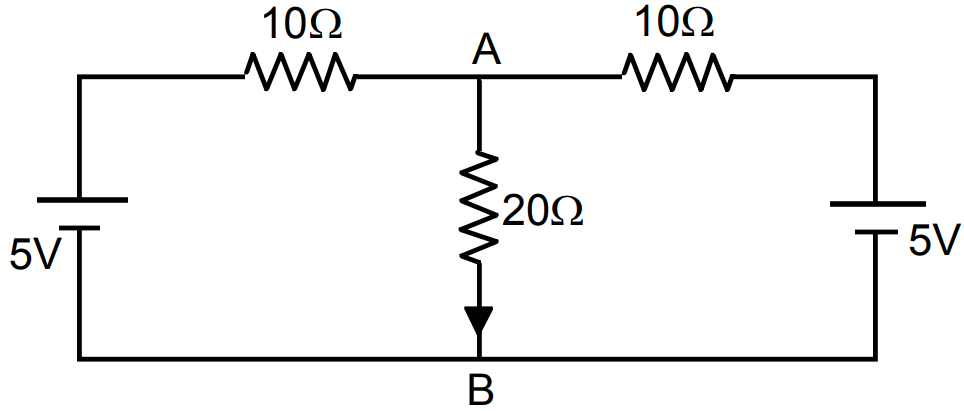
(a) Find the current in the $20\Omega$ resistor shown in the figure. (b) If a capacitor of capacitance $4\mu\text{F}$ is joined between the points A and B, what would be the electrostatic energy stored in it in steady state?
An LR circuit with emf $\in$ is connected at t = 0.
  1. Find the charge Q which flows through the battery during 0 to t.
  2. Calculate the work done by the battery during this period.
  3. Find the heat developed during this period.
  4. Find the magnetic field energy stored in the circuit at time t.
  5. Verify that the results in the three parts above are consistent with energy conservation.
A uniform disc of radius r is to be suspended through a small hole made in the disc. Find the minimum possible time period of the disc for small oscillations. What should be the distance of the hole from the centre for it to have minimum time period?