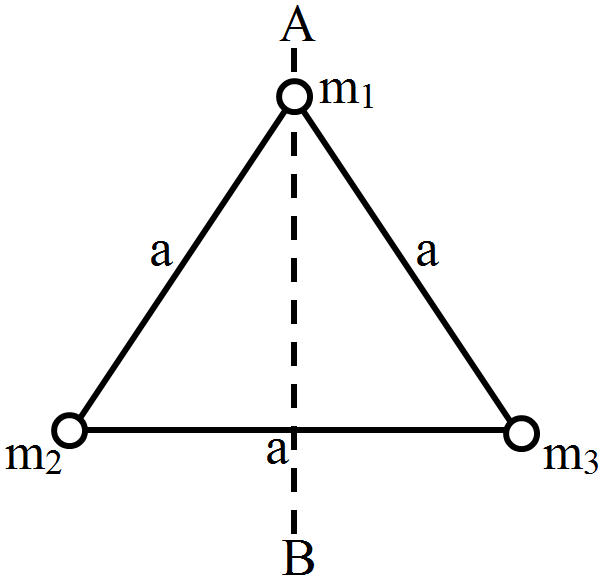
Three point masses m,, m, and m, are located at the vertices of an equilateral triangle of side length a. What is the moment of inertia about an axis along the altitude of the triangle passing through $m_1$?
Download our app for free and get started
The masses are arranged as shown below. AB is the axis about which moment of inertia is to be found. Since $m_1$ is on the axis and $m_2, m_3$ are at a distance $\frac{\text{a}}{2}$ from it, the moment of inertia is, $\text{I}=(\text{m}_2+\text{m}_3)\Big(\frac{\text{a}}{2}\Big)^2$

Download our appand get started for free
Experience the future of education. Simply download our apps or reach out to us for more information. Let's shape the future of learning together!No signup needed.*
Similar Questions
- 1Calculate the angular momentum and rotational kinetic energy of earth about its own axis. How long could this amount of energy supply one kilowatt power to each of the $3.5 \times 10^9$ persons on earth? (Mass of earth = $6.0 \times 1024kg$ and radius = $6.4 \times 10^{24}km)$.View Solution
- 2View SolutionFind the components along the x, y, z axes of the angular momentum l of a particle, whose position vector is r with components x, y, z and momentum is p with components px, py and pz. Show that if the particle moves only in the x-y plane the angular momentum has only a z-component.
- 3View SolutionFind the components along the x, y, z axes of the angular momentum l of a particle, whose position vector is r with components x, y, z and momentum is p with components px, py and pz. Show that if the particle moves only in the x-y plane the angular momentum has only a z-component.
- 4A solid sphere of mass 0.50kg is kept on a horizontal surface. The coefficient of static friction between the surfaces in contact is $\frac{2}{7}.$ What maximum force can be applied at the highest point in the horizontal direction so that the sphere does not slip on the surface?View Solution
- 5View SolutionThe door of an almirah is 6ft high, 1.5ft wide and weighs 8kg. The door is supported by two hinges situated at a distance of 1ft from the ends. If the magnitudes of the forces exerted by the hinges on the door are equal, find this magnitude.
- 6A disc of mass $5kg$ and radius $50cm$ rolls on the ground at the rate of $10ms^{-1}$. Calculate the K.E. of the disc. $\Big(\text{Given}:\text{I}=\frac{1}{2}\text{MR}^2\Big)$View Solution
- 7A star of mass twice the solar mass and radius $106km$ rotates about its axis with an angular speed of $10^{‑6}$ rad per sec. What is the angular speed of the star when it collapses (due to inward gravitational forces) to a radius of $10^4km$? Solar mass = $1.99 \times 10^{23}kg$.View Solution
- 8A cylinder of mass $5kg$ and radius $30cm$ and free to rotate about its axis, receives an angular impulse of $3kgm^2 s^{-1}$ followed by a similar impulse after every $4$ seconds. What is the angular speed of the cylinder $30s$ after the initial impulse? The cylinder is at rest initially.View Solution
- 9View SolutionA metal bar 70 cm long and 4.00 kg in mass supported on two knifeedges placed 10 cm from each end. A 6.00 kg load is suspended at 30 cm from one end. Find the reactions at the knife-edges. (Assume the bar to be of uniform cross section and homogeneous.)
- 10As shown in the two sides of a step ladder BA and CA are 1.6m long and hinged at A. A rope DE, 0.5m is tied half way up. A weight 40kg is suspended from a point F, 1.2m from B along the ladder BA. Assuming the floor to be frictionless and neglecting the weight of the ladder, find the tension in the rope and forces exerted by the floor on the ladder. (Take $g = 9.8m/s^2$) (Hint: Consider the equilibrium of each side of the ladder separately).View Solution