A current of $5\; {A}$ is passing through a non-linear magnesium wire of cross-section $0.04\; {m}^{2}$. At every point the direction of current density is at an angle of $60^{\circ}$ with the unit vector of area of cross-section. The magnitude of electric field at every point of the conductor is ....${V} / {m}$ (Resistivity of magnesium is $\rho=44 \times 10^{-8}\, \Omega m$)
JEE MAIN 2021, Diffcult
Download our app for free and get started
$I=\vec{J} \cdot \vec{A}=J A \cos (\theta)$
$5=J\left(\frac{4}{100}\right) \times \cos (60)$
$J=5 \times 50=250\, {A} / {m}^{2}$
Now, $\vec{E}=\rho \cdot \vec{J}$
$=44 \times 10^{-8} \times 250=11 \times 10^{-5}\, {V} / {m}$

Download our appand get started for free
Experience the future of education. Simply download our apps or reach out to us for more information. Let's shape the future of learning together!No signup needed.*
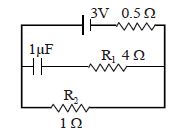
Similar Questions
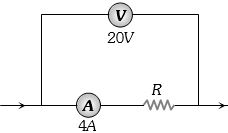
- 1In the diagram shown, the reading of voltmeter is $20\, V$ and that of ammeter is $4\, A$. The value of $R$ should be (Consider given ammeter and voltmeter are not ideal)View Solution
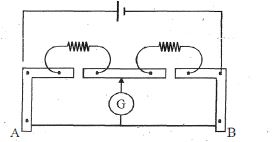
- 2A meter bridge set up as shown to determine end correction at $A$ and $B$ . When a resistance of $15\,\Omega $ is used in left gap and of $20\,\Omega $ in right gap, then null point comes at a distance $42\ cm$ from $A$ . When these resistances are interchanged null point comes at a distance $57\ cm$ from $A$ . Values of end corrections areView Solution
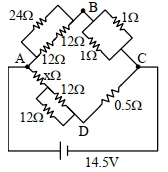
- 3The value of unknown resistance $(x)$ for which the potential difference between $B$ and $D$ will be zero in the arrangement shown, is:View Solution
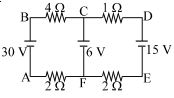
- 4The figure shows a network of four resistances and three batteries The current through the branch $CF$ is ............... $A$View Solution
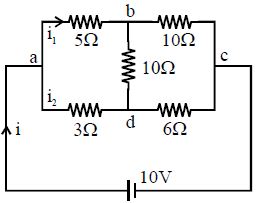
- 5Find current through the branch $ad$ of the circuit shown in figure. :-............. $A$View Solution
- 6In a potentiometer wire experiment the $\mathrm{emf}$ of a battery in the primary circuit is $20\,V$ and its internal resistance is $5\,\Omega$ . There is a resistance box in series with the battery and the potentiometer wire, whose resistance can be varied from $120\,\Omega$ to $170\,\Omega$ . Resistance of the potentiometer wire is $75\,\Omega$ . The following potential differences can be measured using this potentiometer.View Solution
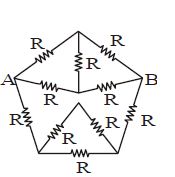
- 7The effective resistance between $A$ and $B$ of the shown network, where resistance of each resistor is $R$ , isView Solution
- 8The potential difference in open circuit for a cell is $2.2\, volts$. When a $4\, ohm$ resistor is connected between its two electrodes the potential difference becomes $2\, volts$. The internal resistance of the cell will be .............. $ohm$View Solution
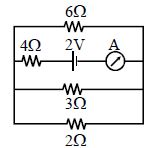
- 9The reading of the ammeter in the adjoining figure will be .............. $A$View Solution
- 10A $1\,\mu F$ capacitor is connected in the circuit shown below. The emf of the cell is $3\ volts$ and internal resistance is $0.5\ ohms$ . The resistors $R_1$ and $R_2$ have values $4\ ohms$ and $1\ ohm$ respectively. The charge on the capacitor in steady state must be.......$\mu C$View Solution