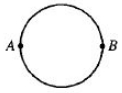
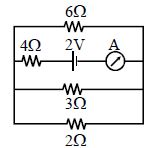
The reading of the ammeter in the adjoining figure will be .............. $A$
Medium
Download our app for free and get started
In the given circuit, the resistances $6\, \Omega, 3\, \Omega$ and $2\, \Omega$ are connected in parallel. their effective resistance will be.
$\frac{1}{R_{p}}=\frac{1}{6}+\frac{1}{3}+\frac{1}{2}=\frac{1+2+3}{6}=\frac{6}{6}$
or $\mathrm{R}_{\mathrm{p}}=1\, \Omega$
the equivalent circuit is as shown in the figure.
Current in the circuit, $\mathrm{I}=\frac{2}{5}=0.4 \mathrm{\,A}$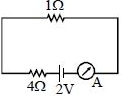

Download our appand get started for free
Experience the future of education. Simply download our apps or reach out to us for more information. Let's shape the future of learning together!No signup needed.*
Similar Questions
- 1Two wires $A$ and $B$ are made up of the same material and have the same mass. Wire A has radius of $2.0 \mathrm{~mm}$ and wire $B$ has radius of $4.0 \mathrm{~mm}$. The resistance of wire B is $2 \Omega$. The resistance of wire $\mathrm{A}$ is_______. $\Omega$.View Solution
- 2Electric room radiator which operates at $225\, volts$ has resistance of $50\, ohms$. Power of the radiator is approximately ............... $W$View Solution
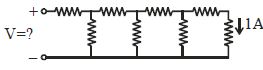
- 3Each element in the finite chain of resistors shown in the figure is $1\,\Omega $. A current of $1\, A$ flows through the final element. Then what is the potential difference $V$ across input terminals of the chain ............... $\mathrm{volt}$View Solution
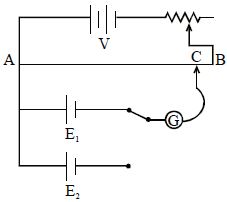
- 4The circuit shown here is used to compare the emf of two cells $E_1$ and $E_2 (E_1 > E_2)$. The null point is at $C$ when the galvanometer is connected to $E_1$. When the galvanometer is connected to $E_2$, the null point will beView Solution
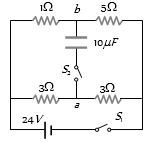
- 5In the circuit shown in figure, switch $S_1$ is initially closed and $S_2$ is open. Find $V_a -V_b$ .............. $V$View Solution
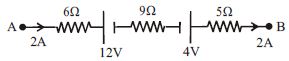
- 6The potential difference between $A$ and $B$ in the Figure is .............. $V$View Solution
- 7Column $- I$ gives certain physical terms associated with flow of current through a metallic conductor. Column $- II$ gives some mathematical relations involving electrical quantities. Match Column $- I$ and Column $- II$ with appropriate relations.View Solution
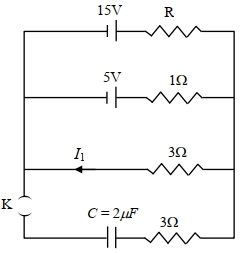
Column $- I$ Column $- II$ $(A)$ Drift Velocity $(P)$ $\frac{m}{n e^{2} \rho}$ $(B)$ Electrical Resistivity $(Q)$ $\mathrm{ne} v_{\mathrm{d}}$ $(C)$ Relaxation Period $(R)$ $\frac{\mathrm{eE}}{\mathrm{m}} \tau$ $(D)$ Current Density $(S)$ $\frac{E}{J}$ - 8In a circuit shown in the figure, the capacitor $C$ is initially uncharged and the key $K$ is open. In this condition, a current of $1 \mathrm{~A}$ flows through the $1 \Omega$ resistor. The key is closed at time $t=t_0$. Which of the following statement($s$) is(are) correct?View Solution
[Given: $\mathrm{e}^{-1}=0.36$ ]
($A$) The value of the resistance $R$ is $3 \Omega$.
($B$) For $t$
($C$) At $t=t_0+7.2 \mu \mathrm{s}$, the current in the capacitor is $0.6 \mathrm{~A}$.
($D$) For $t \rightarrow \infty$, the charge on the capacitor is $12 \mu C$.
- 9View SolutionA conductor behaves as a superconductor
- 10A wire of resistance $12\,ohms$ per meter is bent to form a complete circle of radius $10\, cm.$ The resistance between its two diametrically opposite points, $A$ and $B$ as shown in the figure isView Solution