MCQ
$A$ current passes through a wire of nonuniform cross section. Which of the following quantities are independent of the cross-section?
  • A
    the charge crossing in a given time interval.
  • B
    drift speed
  • C
    free-electron density.
  • Both $(A)$ and $(C)$

Answer

Correct option: D.
Both $(A)$ and $(C)$
d
As the current passes, the value of current at any point in the circuit remains the same. Therefore the charge crossing in any given interval is same and does not change with the cross section of the wire

$I=J A$

As $A -cross$ section of wire changes, $J -current$ density changes and $I$ current remains same.

The free electron density is a property of the material and doesnot change when current passes.

As the cross section changes, current density changes and hence the drift velocity changes.

Need a full question paper?

Generate a complete, print-ready paper with questions like this in minutes — across 16+ boards, with answer keys.
Start Generating Free

Similar questions

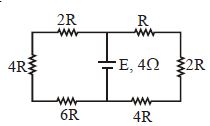
A battery of internal resistance $4\,\Omega $ is connected to the network of the resistance as shown in Fig. If the maximum power can be delivered to the network, the magnitude of $R$ in $\Omega $ should be
The two rails of a railways track, insulated from each other and the ground, are connected to a milli voltmeter. What is the reading of the milli voltmeter when a train travels at a speed of $20 ms^{-1}$ along the track, given that the vertical component of the earth's magnetic field is $0.2 \times 10^{-4} Wbm ^{-2}$ and the rails are separated by $1 m$ ?
Young's experiment is performed in air and then performed in water, the fringe width
Time taken by a $836\; W$ heater to heat $1\; litre$ of water from $10^{\circ} C$ to $40^{\circ} C$ is
Assertion : An $emf$ $\vec E$ is induced in a closed loop where magnetic flux is varied. The induced $\vec E$ is not a conservative field.

Reason : The line integral $\vec E.d\vec l$ around the closed loop is nonzero.

The plane faces of two identical plano-convex lenses, each having focal Jength of $40 \,cm$, are placed against each other to form a usual convex lens. The distance from this lens at which an object must be placed to obtain a real, inverted image with magnification $-1$ is ...... $cm$
Which of the following sometimes requires initiation from a neutron?
Why was Rutherford’s atomic model unstable?
What type of modulation is employed in India for radio transmission
Assertion : The film which appears bright in reflected system will appear dark in the transmitted light and vice-versa.
Reason : The conditions for film to appear bright or dark in reflected light are just reverse to those in the transmitted light.