Question

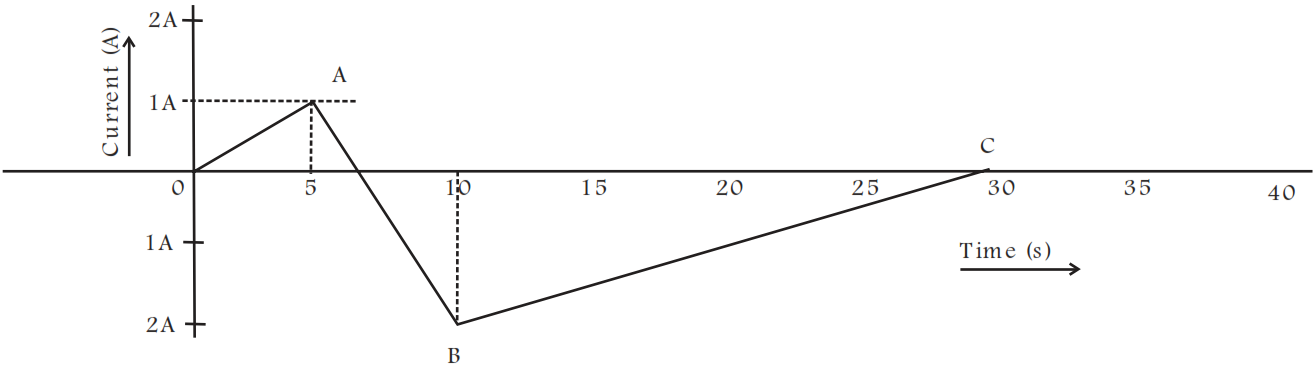
A (current vs time) graph of the current passing through a solenoid is shown in Fig. For which time is the back electromotive force (u) a maximum. If the back emf at t = 3s is e, find the back emf at t = 7s, 15s and 40s. OA, AB and BC are straight line segments.
Answer

Key concept: Whenever the electric current passing through a coil or circuit changes, the magnetic flux linked with it will also change. As a result of this, in accordance with 'Faraday's laws of electromagnetic induction, an emf is induced in the coil or the circuit which opposes the change that causes this induced emf is called back emf, the current so produced in the coil is called induced current. The induced emf is given by, $\in=-\frac{\text{d}(\text{N}\phi_\text{B})}{\text{dt}}$ $\in=-\text{L}\frac{\text{dl}}{\text{dt}}$ Thus, negative sign indicates that induced emf (e) apposes any change (increase of decrease) of current in the coil. When the rate of change of current is maximum, then back emf in solenoid is (u) a maximum. This occurs in AB part of the graph. So, maximum back emf will be obtained between 5s < t < 10s. Since, the back emf at t = 3s is e. Also, the rate of change of current at t = 3, and slope (s) of OA $(\text{from t}=0\text{s to t}=5\text{s})=\frac{1}{5}\frac{\text{A}}{\text{S}}$. So, we have If $\text{u}=\text{L}\frac{1}{5}\Big(\text{for t}=3\text{s},\frac{\text{dI}}{\text{dt}}=\frac{1}{5}\Big).$ where, L is a constant (coefficient of self-induction). And emf is $\in=-\text{L}\frac{\text{dI}}{\text{dt}}$ Similarly, we have for other values. For $5\text{s}<\text{t}<10\text{s},\text{u}_1=-\text{L}\frac{3}{5}=-\frac{3}{5}\text{L}=-3\text{e}$ Thus, at $\text{t}=7\text{s},\text{u}_1=-3\text{e}$ For $10\text{s}<\text{t}<30\text{s}$ $\text{u}_2=\text{L}\frac{2}{20}=\frac{\text{L}}{10}=\frac{1}{2}\text{e}$ for $\text{t}>30\text{s},\text{u}_2=0$ Thus, the back emf ar t = 7s, 15s and 40s are $-3\text{e},\frac{\text{e}}{2}$ and 0 respectively.

Need a full question paper?

Generate a complete, print-ready paper with questions like this in minutes — across 16+ boards, with answer keys.

Start Generating Free

Similar questions

Find the currents through the resistances in the circuits shown in figure.
(a) Prove that the mean power supplied to the inductor in a complete cycle is zero. (b) If in an LCR alternatin current circuit $R =$ $24 \Omega, X _{ L }=110 \Omega$, and $X _{ C }=110 \Omega$, then find the impednce of the current.
A light beam of wavelength 400 run is incident on a metal plate of work function 2.2eV.
  1. A particular electron absorbs a photon and makes two collisions before coming out of the metal. Assuming that 10% of the extra energy is lost to the metal in each collision, find the kinetic energy of this electron as it comes out of the metal.
  2. Under the same assumptions, find the maximum number of collisions the electron can suffer before it becomes unable to come out of the metal.
Consider a solid sphere of radius r and mass m that has a charge q distributed uniformly over its volume. The sphere is rotated about its diameter with an angular speed $\omega.$ Show that the magnetic moment $\mu$ and the angular momentum l of the sphere are related as $\mu=\frac{\text{q}}{2\text{m}}\text{l}.$
The left end of a copper rod (length = 20cm area of cross section = 0.20cm) is maintained at $20^\circ C$ and the right end is maintained at $80^\circ C$. Neglecting any loss of heat through radiation, find,
  1. The temperature at a point 11cm from the left end
  2. The heat current through the rod. Thermal conductivity of copper $=385\text{Wm}^{-1}{^{\circ}}\text{C}^{-1}.$
  1. In the explanation of photo electric effect, we asssume one photon of frequency ν collides with an electron and transfers its energy. This leads to the equation for the maximum energy $E_{max}$ of the emitted electron as,
$\text{E}_\text{max}=\text{hv}-\phi_0$

where $\phi_0$ is the work function of the metal. If an electron absorbs 2 photons (each of frequency ν ) what will be the maximum energy for the emitted electron?
  1. Why is this fact (two photon absorption) not taken into consideration in our discussion of the stopping potential?
Two long, straight wires, each carrying a current of 5A, are placed along the X and Y-axes respectively. The currents point along the positive directions of the axes. Find the magnetic fields at the points (a) (1m, 1m), (b) (-1m, 1m), (c) (-1m,-1m) and (d) (1m, -1m),
An adiabatic vessel of total volume V is divided into two equal parts by a conducting separator. The separator is fixed in this position. The part on the left contains one mole of an ideal gas (U = 1.5nRT) and the part on the right contains two moles of the same gas. Initially, the pressure on each side is p. The system is left for sufficient time so that a steady state is reached. Find,
  1. The work done by the gas in the left part during the process.
  2. The temperature on the two sides in the beginning.
  3. The final common temperature reached by the gases.
  4. The heat given to the gas in the right part.
  5. The increase in the internal energy of the gas in the left part.
Two point charges of $+5 \times 10^{-19}C$ and $+20 \times 10^{-19}C$ are separated by a distance of 2m. Find the point on the line joining them at which electric field intensity is zero.
State Biot-Savart law. Use it to derive an expression for the magnetic field at the centre of a circular loop of radius R carrying a steady current I. Sketch the magnetic field lines for such a current carrying loop.