Question
Consider a solid sphere of radius r and mass m that has a charge q distributed uniformly over its volume. The sphere is rotated about its diameter with an angular speed $\omega.$ Show that the magnetic moment $\mu$ and the angular momentum l of the sphere are related as $\mu=\frac{\text{q}}{2\text{m}}\text{l}.$
Answer


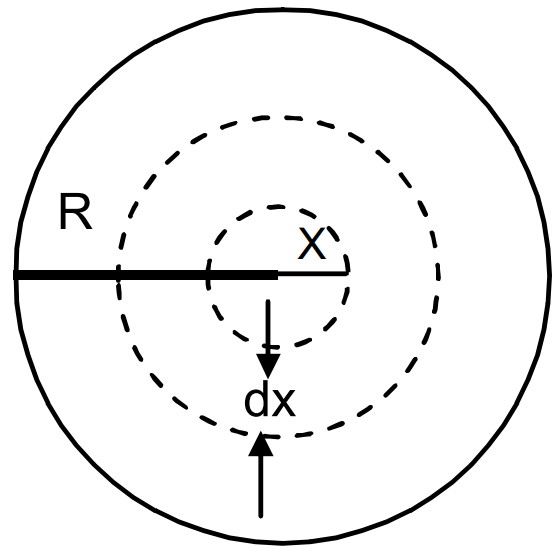
Considering a strip of width dx at a distance x from centre,
$\text{di}\frac{\text{dp}}{\text{dt}}=\frac{\text{q}4\pi\text{x}^2\text{dx}}{\Big(\frac{4}{3}\Big)\pi\text{R}^3\text{}}4\pi\text{x}^2\text{dx}$
$\text{di}=\frac{\text{dq}}{\text{dt}}=\frac{\text{q}4\pi\text{x}^2\text{dx}}{\Big(\frac{4}{3}\Big)\pi\text{R}^3\text{t}}=\frac{3\text{q}\text{x}^2\text{dx}\omega}{\text{R}^32\pi}$
$\text{d}\mu=\text{di}\times\text{A}=\frac{3\text{q}\text{x}^2\text{d}\text{x}\omega}{\text{R}^32\pi}\times4\pi\text{x}^{2\ =\ \frac{6\text{q}\omega}{\text{R}^3}\text{x}^4\text{dx}}$
$\mu=\int\limits_0^{\mu}\text{d}\mu\int\limits_0^{\text{R}}\frac{6\text{q}\omega}{\text{R}^3}\text{x}^4\text{dx}=\frac{6\text{q}\omega}{\text{R}^3}\Big[\frac{\text{x}^5}{5}\Big]_0$
$\text{R}=\frac{\text{6}\text{q}\omega\text{R}^5}{\text{R}^3}\frac{\text{R}^5}{5}=\frac{6}{5}\text{q}\omega\text{R}^2$

Need a full question paper?

Generate a complete, print-ready paper with questions like this in minutes — across 16+ boards, with answer keys.

Start Generating Free

Similar questions

  1. Find the radius of the circular orbit of a satellite moving with an angular speed equal to the angular speed of earth's rotation.
  2. If the satellite is directly above the north pole at some instant, find the time it takes to come over the equatorial plane. Mass of the earth $= 6 \times 10^{24}kg.$
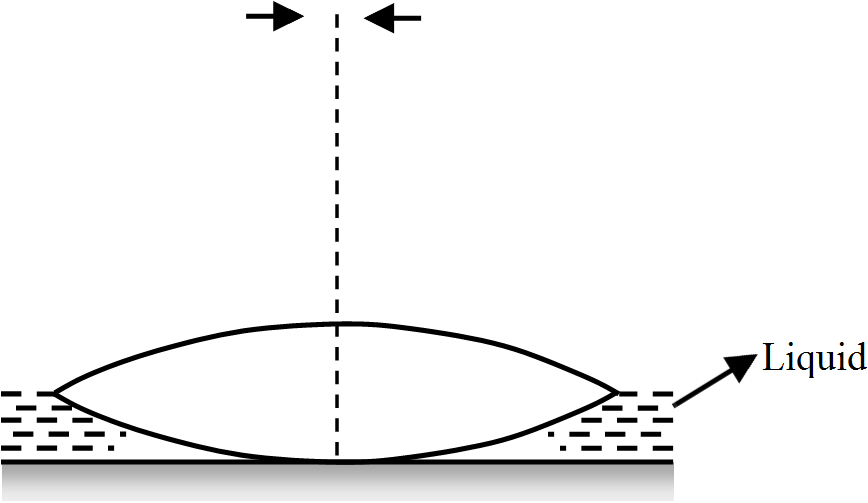
  1. An equiconvex lens with radii of curvature of magnitude r each, is put over a liquid layer poured on top of a plane mirror. A small needle, with its tip on the principal axis of the lens, is moved along the axis until its inverted real image coincides with the needle itself. The distance of the needle from the lens is measured to be 'a'. On removing the liquid layer and repeating the experiment the distance is found to be 'b'.
Given that two values of distances measured represent the focal length values in the two cases, obtain a formula for the refractive index of the liquid.
  1. If r = 10cm, a = 15cm, b = 10cm, find the refractive index of the liquid.
An inductor-coil of inductance 20mH having resistance $10\Omega$ is joined to an ideal battery of emf 5.0V. Find the rate of chenge of the induced emf at:
  1. t = 0
  2. t = 10ms
  3. t = 1.0s.
A particle of mass m and charge q is released from the origin in a region in which the electric field and magnetic field are given by
$\overrightarrow{\text{B}}=-\text{B}_0\overrightarrow{\text{j}}$ and $\overrightarrow{\text{E}}=\text{E}_0\overrightarrow{\text{k}}.$ Find the speed of the particle as a function of its z-coordinate.
Draw the symbolic representation of a (i) p-n-p, (ii) n-p-n transistor. Why is the base region of transistor thin and lightly doped? With proper circuit diagram, show the biasing of a p-n-p transistor in common base configuration. Explain the movement of charge carriers through different parts of the transistor in such a configuration and show that $\text{I}_{E}= \text{I}_{C} =\text{I}_{B}$.
A load resistor of $2\text{k}\Omega$ is connected in the collector branch of an amplifier circuit using a transistor in common-emitter mode. The current gain $\beta=50.$ The input resistance of the transistor is $0.50\text{k}\Omega.$ If the input current is changed by $50\mu\text{A}.$
  1. By what amount does the output voltage change?
  2. By what amount does the input voltage change?
  3. What is the power gain?
Suppose the entire system of the previous question is kept inside an elevator which is coming down with an acceleration a < g. Repeat parts (a) and (b).
A parallel beam of light of wavelength 100nm passes through a sample of atomic hydrogen gas in ground state. (a) Assume that when a photon supplies some of its energy to a hydrogen atom, the rest of the energy appears as another photon. Neglecting the light emitted by the excited hydrogen atoms in the direction of the incident beam, what wavelengths may be observed in the transmitted beam? (b) A radiation detector is placed near the gas to detect radiation coming perpendicular to the incident beam. Find the wavelengths of radiation that may be detected by the detector.
A motorcycle has to move with a constant speed on an overbridge which is in the form of a circular arc of radius R and has a total length L. Suppose the motorcycle starts from the highest point.
  1. What can its maximum velocity be for which the contact with the road is not broken at the highest point?
  2. If the motorcycle goes at speed $\frac{1}{\sqrt2}$ times the maximum found in part (a), where will it lose the contact with the road?
  3. What maximum uniform speed can it maintain on the bridge if it does not lose contact anywhere on the bridge?
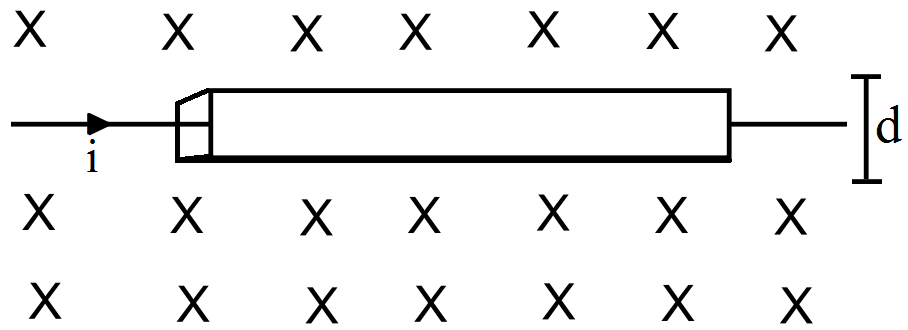
A current i is passed through a silver strip of width d and area of cross-section A. The number of free electrons per unit volume is n.
  1. Find the drift velocity v of the electrons.
  2. If a magnetic field B exists in the region, as shown in the figure, what is the average magnetic force on the free electrons?
  3. Due to the magnetic force, the free electrons get accumulated on one side of the conductor along its length. This produces a transverse electric field in the conductor, which opposes the magnetic force on the electrons. Find the magnitude of the electric field which will stop further accumulation of electrons.
  4. What will be the potential difference developed across the width of the conductor due to the electron-accumulation? The appearance of a transverse emf, when a current-carrying wire is placed in a magnetic field, is called Hall effect.