A curved in a level road has a radius $75\, m$. The maximum speed of a car turning this curved road can be $30 \,m / s$ without skidding. If radius of curved road is changed to $48\, m$ and the coefficient of friction between the tyres and the road remains same, then maximum allowed speed would be .........$m / s$.
JEE MAIN 2022, Medium
Download our app for free and get started
$f _{ smax }=\frac{ mv ^{2}}{ R }$
$\mu mg =\frac{ mv ^{2}}{ R }$
$v =\sqrt{\mu Rg }$
$\frac{ v _{2}}{ v _{1}}=\sqrt{\frac{ R _{2}}{ R _{1}}}$
$\frac{ v _{2}}{30}=\sqrt{\frac{48}{75}}$
$v _{2}=24 \,m / s$

Download our appand get started for free
Experience the future of education. Simply download our apps or reach out to us for more information. Let's shape the future of learning together!No signup needed.*
Similar Questions
- 1View SolutionTo avoid slipping while walking on ice, one should take smaller steps because of the
- 2A $500 \,kg$ car takes a round turn of radius $50 \,m$ with a velocity of $36 \,km/hr$. The centripetal force is .......... $N$View Solution
- 3$A$ block of mass $M$ is placed on $a$ horizontal surface and it is tied with an inextensible string to $a$ block of mass, as shown in figure. A block of mass $m_0$ is also placed on $M$ In previous problem, the tension in the string will beView Solution

- 4A horizontal force of $40\,N$ is applied to a $5\, kg$ block which is at rest on the horizontal surface. If the coefficient of kinetic friction is $0.4$, then the acceleration of the block is ........ $m/s^2$ $(g = 10 \,m/s^2)$View Solution
- 5A body is sliding down an inclined plane having coefficient of friction $0.5$. If the normal reaction is twice that of the resultant downward force along the incline, the angle between the inclined plane and the horizontal is ....... $^o$View Solution
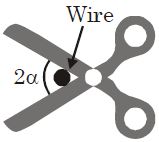
- 6Someone is using a scissors to cut a wire of circular cross section and negligible weight. The wire slides in the direction away from the hinge until the angle between the scissors blades becomes $2 \alpha$. The friction coefficient between the blades and the wire, is :-View Solution
- 7A body takes $1\frac{1}{3}$ times as much time to slide down a rough identical but smooth inclined plane. If the angle of inclined plane is $45^o$, the coefficient of friction isView Solution
- 8A brick of mass $2\, kg$ begins to slide down on a plane inclined at an angle of $45^° $ with the horizontal. The force of friction will beView Solution
- 9A $2 \mathrm{~kg}$ brick begins to slide over a surface which is inclined at an angle of $45^{\circ}$ with respect to horizontal axis. The co-efficient of static friction between their surfaces is:View Solution
- 10A car is moving with a constant speed of $20\,m / s$ in a circular horizontal track of radius $40\,m$. A bob is suspended from the roof of the car by a massless string. The angle made by the string with the vertical will be : (Take $g =10$ $\left.m / s ^2\right)$View Solution