Question
A cyclotron’s oscillator frequency is 10 MHz. What should be the operating magnetic field for accelerating protons? If the radius of its ‘dees’ is 60 cm, calculate the kinetic energy (in MeV) of the proton beam produced by the accelerator.

Answer

Magnetic field 𝐵 $ = 2\pi\text{mv}/\text{q}$
$ = \frac{2\times3.14 \times1.67\times 10^{−27}\times 10^{7}}{1.6\times 10^{−19}} = 0.66\text{T}$
Final velocity of proton $\text{v} =\text{R} \times2\pi\text{v} = 0.6\times 2 \times 3.14 \times 10^{7} = 3.77 \times 10^{7}\text{𝑚/𝑠}$
$\text{Energy} =\frac{1}{2}\text{mv}^{2}=\frac{1}{2}\times 1.67 \times 10^{−27}\times (3.77 \times 10^{7})^2\text{𝑗} = 7.4\text{ 𝑀𝑒𝑉}$.

Need a full question paper?

Generate a complete, print-ready paper with questions like this in minutes — across 16+ boards, with answer keys.
Start Generating Free

Similar questions

The first excited energy of a He+ ion is the same as the ground state energy of hydrogen. Is it always true that one of the energies of any hydrogen-like ion will be the same as the ground state energy of a hydrogen atom?
Double - convex lenses are to be manufactured from a glass of refractive index 1.55, with both faces of the same radius of curvature. What is the radius of curvature required if the focal length is to be 20cm?
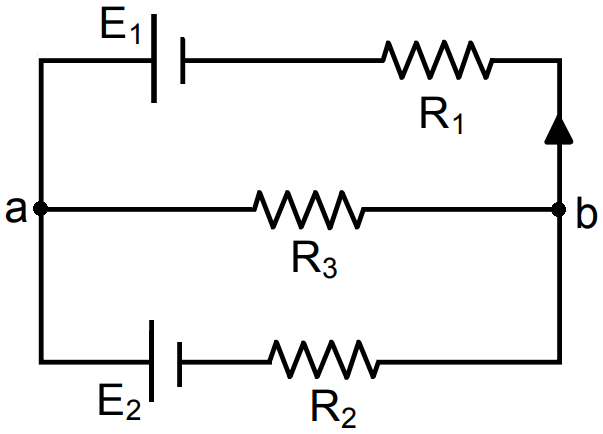
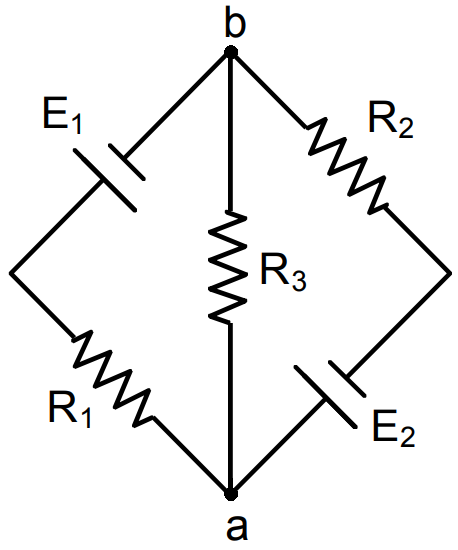
Find the potential difference Va - Vb in the circuits shown in figure.


Radius of a disc of copper is 10 cm . It is rotating about an axis which is perpendicular to its plane and passing through its centre at the rate of $20 \pi rad /$ second. Uniform magnetic field of 0.2 T is working perpendicular to the disc. (i) Calculate potential difference between axis and circumference of the disc. (ii) If resistance of disc is 2 , then what is the magnitude of induced current?
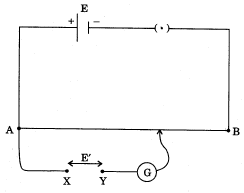
For the potentiometer circuit shown in the given figure, points X and Y reprensent the two terminals of an unknown emf E'. A student observed that when the jockey in moved from the end A to the end B of the potentiometer wire, the deflection in the galvanometer remains in the same direction.What may be the two possible faults in the circuit that could result in this obsevation?
If the galvanometer deflection at the end B is (i) more, (ii) less, than that at the end A, which of the two faults, listed above, would be there in the circuit?
Give reasons in support of your answer in each case.
Can two equipotential surfaces cut each other?
Draw a schematic diagram of the experimental arrangement used by Davisson and Germer to establish the wave nature of electrons. Explain briefly how the de-Broglie relation was experimentally verified in case  of electrons.
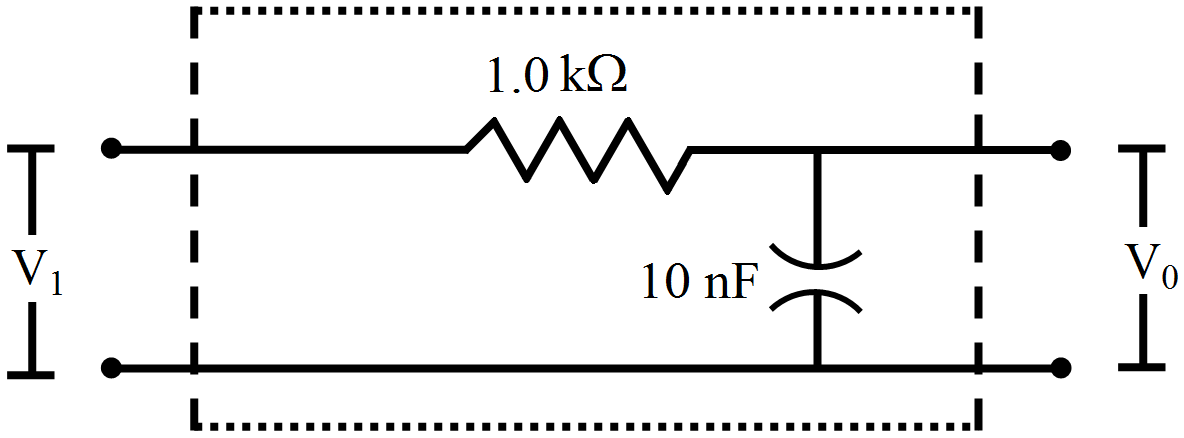
Figure shows a typical circuit for a low-pass filter. An AC input Vi = 10mV is applied at the left end and the output V0 is received at the right end. Find the output voltage for ν = 10kHz, 1.0MHz and 10.0MHz. Note that as the frequency is increased the output decreases and, hence, the name low-pass filter.

Two neutral particles are kept 1m apart. Suppose by some mechanism some charge is transferred from one particle to the other and the electric potential energy lost is completely converted into a photon. Calculate the longest and the next smaller wavelength of the photon possible.
Explain, with the help of a nuclear reaction in each of the following cases, how the neutron to proton ratio changes during (i) alpha-decay (ii) beta-decay?