Question
Find the potential difference Va - Vb in the circuits shown in figure.
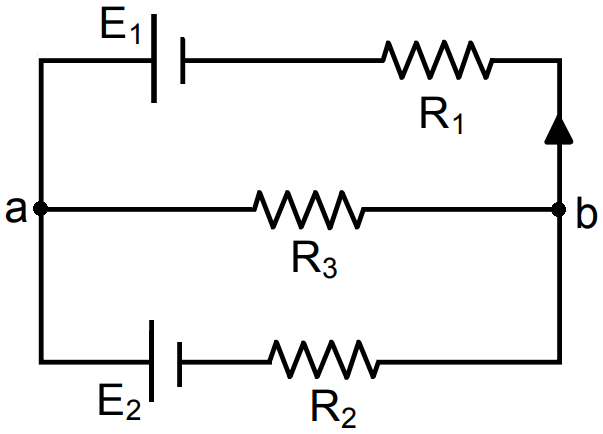
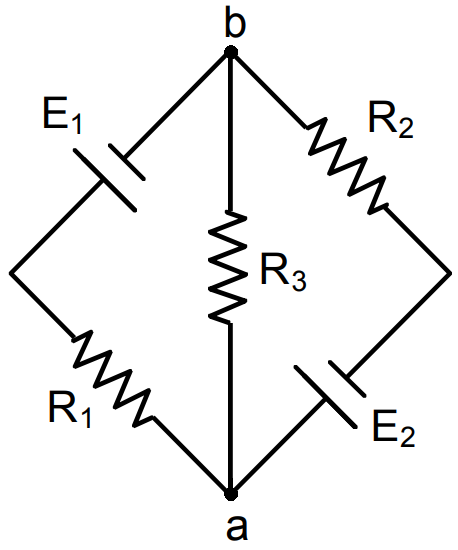
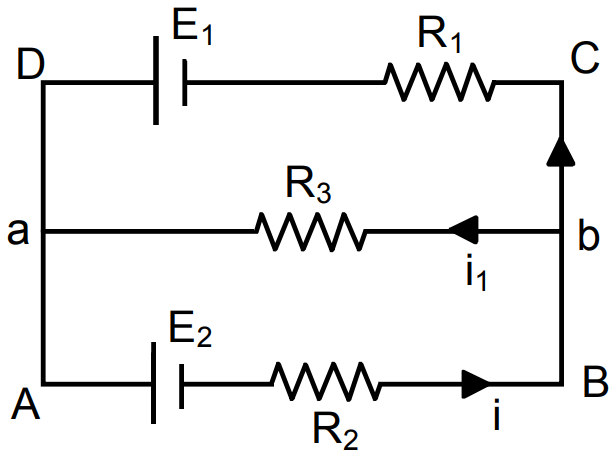
$\text{E}_2+\text{iR}_2+\text{i}_1\text{R}_3=0$
In circuit, $\text{i}_1\text{R}_3+\text{E}_1-(\text{i}-\text{i}_1)\text{R}_1=0$
$\Rightarrow\text{i}_1\text{R}_3+\text{E}_1-\text{iR}_1+\text{i}_1\text{R}_1=0$
$[\text{iR}_2+\text{i}_1\text{R}_3\ \ \ \ \ \ \ \ \ \ \ \ \ \ \ \ \ \ \ \ \ \ =-\text{E}_2]\text{R}_1\\ [\text{iR}_2-\text{i}_1(\text{R}_1+\text{R}_3)\ \ \ \ \ \ \ \ \ =\text{E}_1]\text{R}_2\\\underline{\ \ \ \ \ \ \ \ \ \ \ \ \ \ \ \ \ \ \ \ \ \ \ \ \ \ \ \ \ \ \ \ \ \ \ \ \ \ \ \ \ \ \ \ \ \ \ \ \ \ \ \ \ \ \ \ \ }\\\text{iR}_2\text{R}_1+\text{i}_1\text{R}_3\text{R}_1\ \ \ \ \ \ \ \ \ \ \ \ \ =-\text{E}_2\text{R}_1\\\text{iR}_2\text{R}_1-\text{i}_1\text{R}_2(\text{R}_1+\text{R}_3)=\ \ \ \text{E}_1\text{R}_2\\\underline{ \ \ \ \ \ \ \ \ \ \ \ \ \ \ \ \ \ \ \ \ \ \ \ \ \ \ \ \ \ \ \ \ \ \ \ \ \ \ \ \ \ \ \ \ \ \ \ \ \ \ \ \ \ \ \ \ \ }$
$\text{iR}_3\text{R}_1+\text{i}_1\text{R}_2\text{R}_1+\text{i}_1\text{R}_2\text{R}_3=\text{E}_1\text{R}_2-\text{E}_1\text{R}_1$
$\Rightarrow\text{i}_1(\text{R}_3\text{R}_1+\text{R}_2\text{R}_1+\text{R}_2\text{R}_3)=\text{E}_1\text{R}_2-\text{E}_2\text{R}_1$
$\Rightarrow\text{i}_1=\frac{\text{E}_1\text{R}_2-\text{E}_2\text{R}_1}{\text{R}_3\text{R}_1+\text{R}_2\text{R}_1+\text{R}_2\text{R}_3}$
$\Rightarrow\frac{\text{E}_1\text{R}_2\text{R}_3-\text{E}_2\text{R}_1\text{R}_3}{\text{R}_3\text{R}_1+\text{R}_2\text{R}_1+\text{R}_2\text{R}_3}=\Bigg(\frac{\frac{\text{E}_1}{\text{R}_1}-\frac{\text{E}_2}{\text{R}_2}}{\frac{1}{\text{R}_2}+\frac{1}{\text{R}_1}+\frac{1}{\text{R}_3}}\Bigg)$
Generate a complete, print-ready paper with questions like this in minutes — across 16+ boards, with answer keys.