MCQ
$A$ cylinder and a ring of same mass $M$ and radius $R$ are placed on the top of a rough inclined plane of inclination $\theta$ . Both are released simultaneously from the same height $h$. Choose the correct statement $(s)$ related to the motion of each body
  • A
    The friction force acting on each body opposes the motion of its centre of mass
  • B
    The friction force provides the necessary torque to rotate the body about its centre of mass
  • C
    Without friction none of the two bodies can roll
  • All of the above

Answer

Correct option: D.
All of the above
d

Need a full question paper?

Generate a complete, print-ready paper with questions like this in minutes — across 16+ boards, with answer keys.

Start Generating Free

Similar questions

Which of the following is the weakest force?
To determine the Young's modulus of a wire, the formula is $Y = \frac{FL}{A\Delta L};$ where $L$ = length, $A = $area of cross-section of the wire, $\Delta L = $change in length of the wire when stretched with a force $F$. The conversion factor to change it from $CGS$ to $MKS$ system is .............. $10^{-1}\mathrm{N/m}^{2}$
A particle $P$ is moving in a circle of radius $'a'$ with a uniform speed $v$ . $C$ is the centre of the circle and $AB$ is a diameter. When passing through $B$ the angular velocity of $P$ about $A$ and $C$ are in the ratio 
A rope of length $L$ and mass $M$ hangs freely from the ceiling. If the time taken by a transverse wave to travel from the bottom to the top of the rope is $T$, then time to cover first half length is
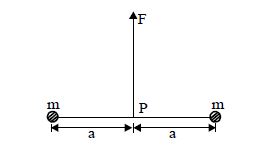
Two particles of mass $m$ each are tied at the ends of a light string of length $2a$ . The whole system is kept on a frictionless horizontal surface with the string held tight so that each mass is at a distance $'a'$ from the centre $P$ (as shown in the figure). Now, the mid-point of the string is pulled vertically upwards with a small but constant force $F$ . As a result, the particles move towards each other on the surface. The magnitude of acceleration, when the separation between them becomes $2x$ , is
Velocity $-$ time graph of a body with uniform velocity is a straight line:
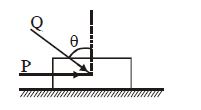
A block of mass $m$ lying on a rough horizontal plane is acted upon by a horizontal force $P$ and another force $Q$ inclined an at an angle $\theta $ to the vertical. The minimum value of coefficient of friction between the block and the surface for which the block will remain in equilibrium is
Which one of the following represents the displacement time graph of two objects $A$ and $B$ moving with zero relative speed?
A point moves such that its displacement as a function of time is given by $x^3$ = $t^3 + 1$. Its acceleration as a function of time $t$ will be
If the volume of the gas containing $n$ number of molecules is $V,$ then the pressure will decrease due to force of intermolecular attraction in the proportion