MCQ
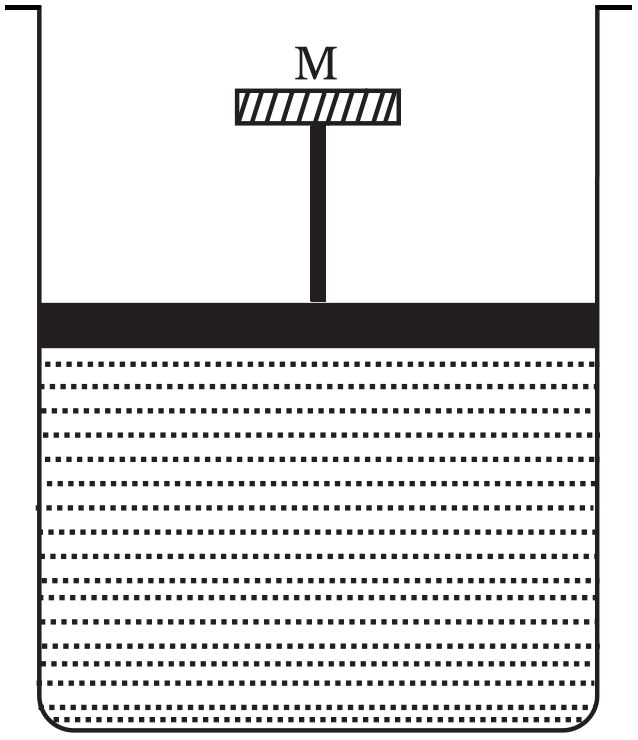
A cylinder containing an ideal gas is in vertical position and has a piston of mass M that is able to move up or down without friction ( figure). If the temperature is increased.
  • A
    Both P and V of the gas will change.
  • B
    Only P will increase according to Charles’ law.
  • V will change but not P.
  • D
    P will change but not V.

Answer

Correct option: C.
V will change but not P.
c. V will change but not P.
Explanation:
The pressure on the ideal gas does not changes from initial to final position. According to the given arrangement P = Mg/ A which shows that pressure is constant. As piston and cylinder is frictionless so by ideal gas equation, PV = nRT.

Need a full question paper?

Generate a complete, print-ready paper with questions like this in minutes — across 16+ boards, with answer keys.

Start Generating Free

Similar questions

The velocity of a particle is zero at $t = 0$.
$A.$ The acceleration at $t = 0$ must be zero.
$B.$ The acceleration at $t = 0$ may be zero.
$C.$  If the acceleration is zero from $t = 0$ to $t = 10s,$ the speed is also zero in this interval.
$D.$ If the speed is zero from $t = 0$ to $t = 10s$ the acceleration is also zero in this interval.
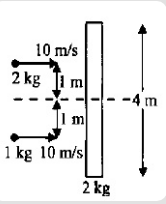
A long slender rod of mass $2\ kg$ and length $4m$ is placed on a smooth horizontal table. Two particles of masses $2\ kg$ and $1\ kg$ strike the rod simultaneously and stick to the rod after collision as shown in Figure. Velocity of the centre of mass of the rod after collision is:
The components of $\vec a = 2\hat i + 3\hat j$ along the direction of vector $\left( {\hat i + \hat j} \right)$ is
A neutron star with magnetic moment of magnitude $m$ is spinning with angular velocity $\omega$ about its magnetic axis. The electromagnetic power $P$ radiated by it is given by $\mu_{0}^{x} m^{y} \omega^{z} c^{u}$, where $\mu_{0}$ and $c$ are the permeability and speed of light in free space, respectively. Then,
Two particle of masses $1\,kg$ and $3\,kg$ have position vector $2\hat i + 3\hat j + 4\hat k$ and $ - 2\hat i + 3\hat j - 4\hat k$ respectively. The centre of mass has a position vector
A body cools down from $65^\circ C$ to $60^\circ C$ in $5$ minutes. It will cool down from $60^\circ C$ to $55^\circ C$ in:
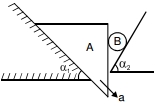
Find the acceleration of $B$.
A pin or a needle floats on the surface of water, the reason for this is
Bernoulli’s principle is based on the law of conservation of
The amount of heat that a body can absorb by radiation: