Question
A cylinder of length 20cm and radius 10cm is rotating about its central axis at an angular speed of 100rad/s. What tangential force will stop the cylinder at a uniform rate in 10 seconds? The moment of inertia of the cylinder about its axis of rotation is 0.8kgm2.
Answer

$\alpha=\frac{\omega-\omega_0}{\text{t}}=-10\text{rad/s}^2$
$\text{F.R}=\text{I }\alpha$
$\text{F}=\frac{\text{I }\alpha}{\text{R}}$
$=\frac{(0.8\text{kgm}^2)(-10\text{rad/s}^2)}{0.1\text{m}}=-80\text{N}.$

Need a full question paper?

Generate a complete, print-ready paper with questions like this in minutes — across 16+ boards, with answer keys.

Start Generating Free

Similar questions

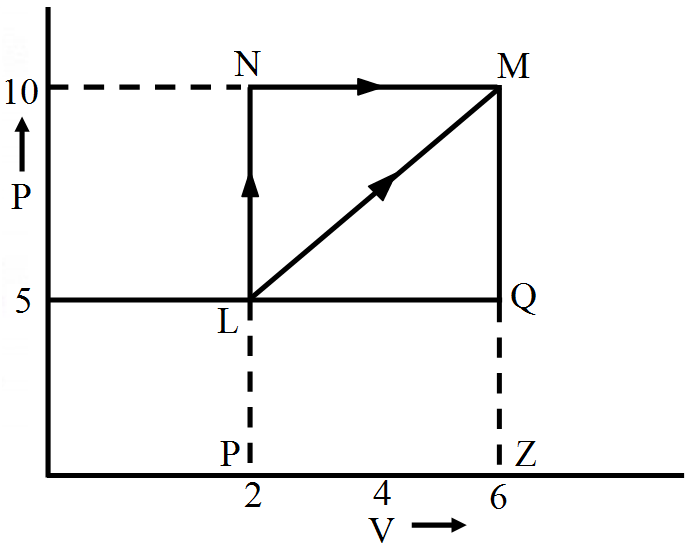
An ideal gas changes its state from L to M by two path LNM and LM.

  1. Is the work done same for two paths?
  2. The internal energy of gas at L is 20J and the amount of heat needed to change its state through LM is 400J. What is the internal energy of gas at M?
Repeat the previous exercise if the angle between each pair of springs is 120° initially.
Given below are some examples of wave motion. State in each case if the motion is transverse, longitudinal or a combination of both.
  1. Motion of a kink in a long coil spring produced by displacing one end of the spring sideways.
  2. Wave produced in a cylinder containing water by moving its piston back and forth.
  3. Wave produced by a motorboat sailing in water.
  4. Ultrasonic waves in air produced by a vibrating crystal.
Consider Galileo's method of measuring the speed of light using two lanterns. To get an accuracy of about 10%, the time taken by the experimenter in closing or opening the shutter should be about one tenth of the time taken by the light in going from one experimenter to the other. Assume that it takes $\frac{1}{100}$ second for an experimenter to close or open the shutter. How far should the two experimenters be to get a 10% accuracy? What are the difficulties in having this separation?
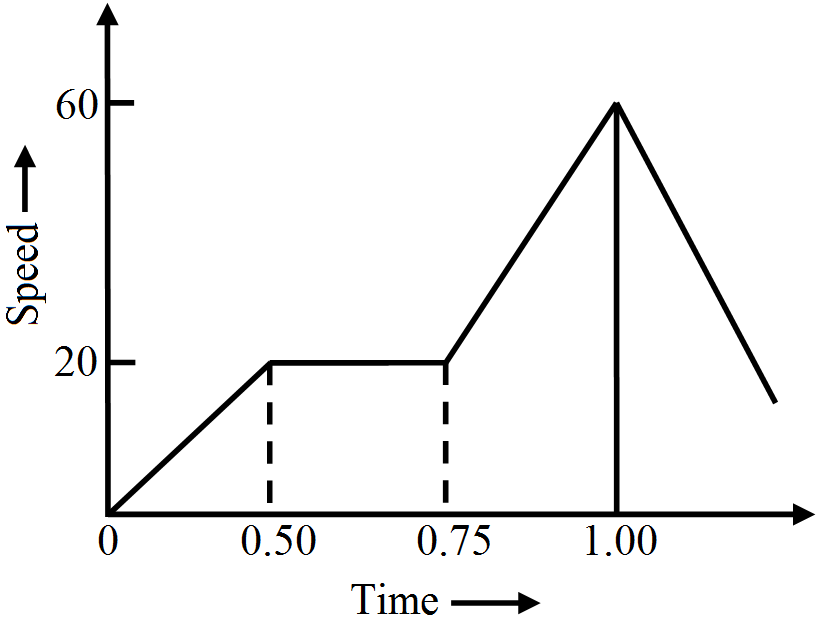
A train moves from one station to another in two hours time. Its speed during the motion is shown in the graph. Determine the maximum acceleration during the journey. Also calculate the distance covered during the time interval from 0.75h to 1 hour.

Give example of a situation in which an applied force does not result in a change in kinetic energy.
If the frequency (n) of a tunning fork depends on length (1), density (d) and Young's modulus of elasticity (y) then establish the correct formula.
The farthest objects in our Universe discovered by modern astronomers are so distant that light emitted by them takes billions of years to reach the Earth. These objects (known as quasars) have many puzzling features, which have not yet been satisfactorily explained. What is the distance in km of a quasar from which light takes 3.0 billion years to reach us?
An adult weighing 600N raises the centre of gravity of his body by 0.25m while taking each step of 1m length in jogging. If he jogs for 6km, calculate the energy utilised by him in jogging assuming that there is no energy loss due to friction of ground and air. Assuming that the body of the adult is capable of converting 10% of energy intake in the form of food, calculate the energy equivalents of food that would be required to compensate energy utilised for jogging.
Read each statement below carefully and state, with reasons and examples, if it is true or false :
A scalar quantity is one that
(a) is conserved in a process
(b) can never take negative values
(c) must be dimensionless
(d) does not vary from one point to another in space
(e) Has the same value for observers with different orientations of axes.