MCQ
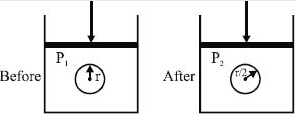
A cylinder with a movable piston contains air under a pressure $p_1$ and a soap bubble of radius $'r'$ . The pressure $p_2$ to which the air should be compressed by slowly pushing the piston into the cylinder for the soap bubble to reduce its size by half will be: (The surface tension is $\sigma $ , and the temperature $T$ is maintained constant)
  • $\left[ {8{p_1} + \frac{{24\sigma }}{r}} \right]$
  • B
    $\left[ {4{p_1} + \frac{{24\sigma }}{r}} \right]$
  • C
    $\left[ {2{p_1} + \frac{{24\sigma }}{r}} \right]$
  • D
    $\left[ {2{p_1} + \frac{{12\sigma }}{r}} \right]$
Answer

Correct option: A.
$\left[ {8{p_1} + \frac{{24\sigma }}{r}} \right]$
a
Lets say, initially, the pressure due to air inside the bubble is $\mathrm{P}_{\mathrm{air}}$ 

$\Rightarrow P_{\operatorname{air}}-P_{1}=\frac{4 \sigma}{r}$      $...(i)$

Finally, the radius becomes half; so volume becomes $\frac{1}{8}$ th and hence pressure becomes $8 \mathrm{P}_{\text {air: }}$

So  $8 \mathrm{P}_{\mathrm{air}}-\mathrm{P}_{2}=\frac{4 \sigma}{\mathrm{r} / 2}$   $...(ii)$

Solving $(i)$ and $(ii)$

$\operatorname{get} \mathrm{P}_{2}=8 \mathrm{P}_{1}+\frac{24 \sigma}{\mathrm{r}}$

Need a full question paper?

Generate a complete, print-ready paper with questions like this in minutes — across 16+ boards, with answer keys.

Start Generating Free

Similar questions

The pressure $P$ and density $p$ of a gas are related as:
A capillary tube made of glass of radius $0.15\, mm$ is dipped vertically in a beaker filled with methylene iodide (surface tension $=0.05\, Nm ^{-1},$ density $\left.=667\, kg m ^{-3}\right)$ which rises to height $h$ in the tube. It is observed that the two tangents drawn from liquid-glass interfaces (from opp. sides of the capillary) make an angle of $60^{\circ}$ with one another. Then $h$ is close to $......m$

$\left(g=10\, ms ^{-2}\right)$

A particle $(\mathrm{m}=1\; \mathrm{kg})$ slides down a frictionless track $(AOC)$ starting from rest at a point $A$ (height $2\; \mathrm{m}$ ). After reaching $\mathrm{C}$, the particle continues to move freely in air as a projectile. When it reaching its highest point $P$ (height $1 \;\mathrm{m}$ ). the kinetic energy of the particle (in $\mathrm{J}$ ) is : (Figure drawn is schematic and not to scale; take $\left.g=10 \;\mathrm{ms}^{-2}\right)$
If $R$ and $L$ represent resistance and self$-$inductance respectively, which of the following combinations has the dimensions of frequency?
Orbit of a planet around a star is
A wire has a mass $0.3 \pm 0.003\text{g},$ radius $0.5 \pm 0.005\text{mm}$ and length $6 \pm 0.06\text{cm}.$ The maximum percentage error in the measurement of its density is
The distance travelled by a body moving along a line in time $t$ is proportional to $t^3$. The acceleration-time $(a, t)$ graph for the motion of the body will be
Consider the situation of the previous problem. The directions of the magnetic field due to the dipole are opposite at:
Unit vector does not have any .......
Centripetal acceleration of a cyclist completing $7$ rounds in a minute along a circular track of radius $5 \,m$ with a constant speed, is ......... $m / s ^2$