A cylindrical block of wood (density $= 650\, kg\, m^{-3}$), of base area $30\,cm^2$ and height $54\, cm$, floats in a liquid of density $900\, kg\, m^{-3}$ . The block is depressed slightly and then released. The time period of the resulting oscillations of the block would be equal to that of a simple pendulum of length ..... $cm$ (nearly)
JEE MAIN 2015, Medium
Download our app for free and get started
Required equivalent length
$=\frac{\rho_{\text {wood }}}{\rho_{\text {liquid }}} \times$ height of block
$=\frac{650}{900} \times 54 \times 10^{-2}$
$\Rightarrow l=0.39 \mathrm{m}=39 \mathrm{cm}$

Download our appand get started for free
Experience the future of education. Simply download our apps or reach out to us for more information. Let's shape the future of learning together!No signup needed.*
Similar Questions
- 1View SolutionA simple pendulum is vibrating in an evacuated chamber, it will oscillate with
- 2View SolutionWhen the displacement is half the amplitude, the ratio of potential energy to the total energy is
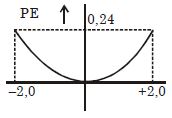
- 3A particle executing $S.H.M.$ its potential energy $V/S$ displacement graph is given by The value of restoring force constant is ..... $N/m$View Solution
- 4A particle executes linear simple harmonic motion with an amplitude of $2\, cm$. When the particle is at $1\, cm$ from the mean position the magnitude of its velocity is equal to that of its acceleration. Then its time period in seconds isView Solution
- 5A body is executing $S.H.M.$ When its displacement from the mean position is $4\, cm$ and $5\, cm$, the corresponding velocity of the body is $10 \,cm/sec$ and $8\, cm/sec$. Then the time period of the body isView Solution
- 6The function $sin^2\,(\omega t)$ representsView Solution
- 7The displacement of a particle executing simple harmonic motion is given byView Solution
$\mathrm{y}=\mathrm{A}_{0}+\mathrm{A} \sin \omega \mathrm{t}+\mathrm{B} \cos \omega \mathrm{t}$
Then the amplitude of its oscillation is given by
- 8Function $x$ = $A sin^2 wt + B cos^2 wt + C sin wt \ cos wt$ does not represents $SHM$ for this conditionView Solution
- 9The periodic time of a simple pendulum of length $1\, m $ and amplitude $2 \,cm $ is $5\, seconds$. If the amplitude is made $4\, cm$, its periodic time in seconds will beView Solution
- 10A body performs $S.H.M.$ Its kinetic energy $K$ varies with time $t$ as indicated by graphView Solution