A cylindrical conductor of radius $'R'$ carries a current $'i'$. The value of magnetic field at a point which is $R/4$ distance inside from the surface is $10\, T$. Find the value of magnetic field at point which is $4\,R$ distance outside from the surface
Medium
Download our app for free and get started
(b) Magnetic field inside the cylindrical conductor
${B_{in}} = \frac{{{\mu _0}}}{{4\pi }}.\frac{{2ir}}{{{R^2}}}$ ($R$ = Radius of cylinder, $r$ = distance of observation point from axis of cylinder)
Magnetic field out side the cylinder at a distance $r'$ from it’s axis ${B_{out}} = \frac{{{\mu _0}}}{{4\pi }}.\frac{{2i}}{{r'}}$
$ \Rightarrow \frac{{{B_{in}}}}{{{B_{out}}}} = \frac{{rr'}}{{{R^2}}} \Rightarrow \frac{{10}}{{{B_{out}}}} = \frac{{\left( {R - \frac{R}{4}} \right)\;(R + 4R)}}{{{R^2}}}$ $ \Rightarrow {B_{out}} = \frac{8}{3}\,T$
${B_{in}} = \frac{{{\mu _0}}}{{4\pi }}.\frac{{2ir}}{{{R^2}}}$ ($R$ = Radius of cylinder, $r$ = distance of observation point from axis of cylinder)
Magnetic field out side the cylinder at a distance $r'$ from it’s axis ${B_{out}} = \frac{{{\mu _0}}}{{4\pi }}.\frac{{2i}}{{r'}}$
$ \Rightarrow \frac{{{B_{in}}}}{{{B_{out}}}} = \frac{{rr'}}{{{R^2}}} \Rightarrow \frac{{10}}{{{B_{out}}}} = \frac{{\left( {R - \frac{R}{4}} \right)\;(R + 4R)}}{{{R^2}}}$ $ \Rightarrow {B_{out}} = \frac{8}{3}\,T$

Download our appand get started for free
Experience the future of education. Simply download our apps or reach out to us for more information. Let's shape the future of learning together!No signup needed.*
Similar Questions
- 1An iron rod of length $L$ and magnetic moment $M$ is bent in the form of a semicircle. Now its magnetic moment will beView Solution
- 2A proton, an electron, and a Helium nucleus, have the same energy. They are in circular orbitals in a plane due to magnetic field perpendicular to the plane. Let $r_p, r_e$ and $r_{He}$ be their respective radii, thenView Solution
- 3A long conducting wire having a current $I$ flowing through it, is bent into a circular coil of $N$ turns.Then it is bent into a circular coil of $n$ tums. The magnetic field is calculated at the centre of coils in both the cases. The ratio of the magnetic field in first case to that of second case is:View Solution
- 4Through two parallel wires $A$ and $B$, $10$ and $2$ $ampere$ of currents are passed respectively in opposite direction. If the wire $A$ is infinitely long and the length of the wire $B$ is $ 2\, m$, the force on the conductor $B$, which is situated at $10\, cm$ distance from $A$ will beView Solution
- 5A milli voltmeter of $25\,millivolt$ range is to be converted in to an ammeter of $25\,A$ range. The value (in $ohm$) of necessary shunt will beView Solution
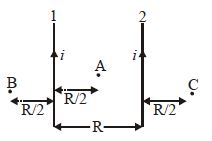
- 6Two long parallel wires are at a distance $R$ apart. They carry steady equal currents in the same directions as shown in the figure. The ratio of magnetic fields at $A, B$ and $C$ respectively, isView Solution
- 7An electron is moving along the positive $X$-axis. You want to apply a magnetic field for a short time so that the electron may reverse its direction and move parallel to the negative $X$-axis. This can be done by applying the magnetic field alongView Solution
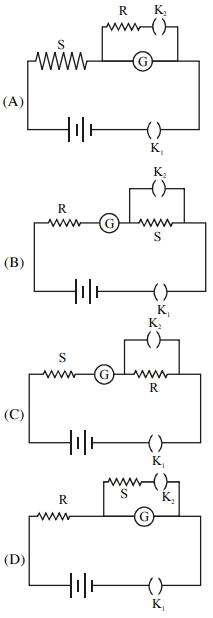
- 8In the circuit diagrams $(A, B, C$ and $D$) shown below, $R$ is a high resistance and $S$ is a resistance of the order of galvanometer resistance $G$. The correct circuit, corresponding to the half deflection method for finding the resistance and figure of merit of the galvanometer, is the circuit labelled asView Solution
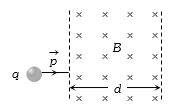
- 9A particle with charge $q$, moving with a momentum $p$, enters a uniform magnetic field normally. The magnetic field has magnitude $B$ and is confined to a region of width $d$, where $d < \frac{p}{{Bq}}$, The particle is deflected by an angle $\theta $ in crossing the fieldView Solution
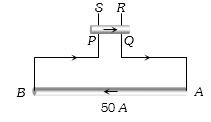
- 10A long wire $AB$ is placed on a table. Another wire $PQ$ of mass $1.0\, g$ and length $50\, cm$ is set to slide on two rails $PS$ and $QR$. A current of $50\,A$ is passed through the wires. At what distance above $AB$, will the wire $PQ$ be in equilibrium.....$mm$View Solution