Through two parallel wires $A$ and $B$, $10$ and $2$ $ampere$ of currents are passed respectively in opposite direction. If the wire $A$ is infinitely long and the length of the wire $B$ is $ 2\, m$, the force on the conductor $B$, which is situated at $10\, cm$ distance from $A$ will be
Medium


Download our appand get started for free
Experience the future of education. Simply download our apps or reach out to us for more information. Let's shape the future of learning together!No signup needed.*
Similar Questions
- 1View SolutionThe time period of a charged particle undergoing a circular motion in a uniform magnetic field is independent of its
- 2A uniform magnetic field $B$ and a uniform electric field $E$ act in a common region. An electron is entering this region of space. The correct arrangement for it to escape undeviated isView Solution
- 3View SolutionOne Tesla is equal to
- 4A long solenoid of radius $2\, cm$ has $100\, turns/cm$ and carries a current of $5\,A$. A coil of radius $1\, cm$ having $100\, turns$ and a total resistance of $20\,\Omega $ is placed inside the solenoid coaxially. The coil is connected to a galvanometer. If the current in the solenoid is reversed in direction, find the charge flown through the galvanometerView Solution
- 5Biot-Savart, law indicates that the moving electrons (velocity $v$) produce a magnetic field $B$ such thatView Solution
- 6Which one of the following options represents the magnetic field $\vec{B}$ at $O$ due to the current flowing in the given wire segments lying on the $x y$ plane?View Solution
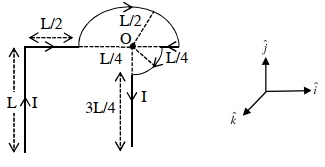
- 7View SolutionMagnetic effect of current was discovered by
- 8The electrostatic force $\left(\vec{F}_1\right)$ and magnetic force $\left(\vec{F}_2\right)$ acting on a charge $q$ moving with velocity $v$ can be written :View Solution
- 9In a hydrogen atom, an electron of mass $m$ and charge $e$ revolves in an orbit of radius $r$ making $n$ revolutions per second. If the mass of hydrogen nucleus is $M$, the magnetic moment associated with the orbital motion of electron isView Solution
- 10A long straight wire carries a current of $\pi \,amp.$ The magnetic field due to it will be $5 \times {10^{ - 5}}{\rm{ }}\,weber/{m^{\rm{2}}}$ at what distance from the wire $[{\mu _o} = $ permeability of air]View Solution