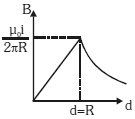
A cylindrical conductor of radius $R$ is carrying a constant current. The plot of the magnitude of the magnetic field, $B$ with the distance $d$, from the centre of the conductor, is correctly represented by the figure$.....$
NEET 2019, Medium
Download our app for free and get started
$B=\left\{\begin{array}{l}{\frac{\mu_{0}Id}{2 \pi R^{2}}: d \leq R} \\ {\frac{\mu_{0} I}{2 \pi d} d > R}\end{array}\right.$

Download our appand get started for free
Experience the future of education. Simply download our apps or reach out to us for more information. Let's shape the future of learning together!No signup needed.*
Similar Questions
- 1The horizontal component of earth's magnetic field at a place is $3.5 \times 10^{-5} \mathrm{~T}$. A very long straight conductor carrying current of $\sqrt{2} A$ in the direction from South east to North West is placed. The force per unit length experienced by the conductor is$..............$ $\times 10^{-6} \mathrm{~N} / \mathrm{m}$.View Solution
- 2The magnetic field due to a current carrying circular loop of radius $3\, cm$ at a point on the axis at a distance of $4\, cm$ from the centre is $54\, \mu T$. What will be its value at the centre of the loop.......$\mu T$View Solution
- 3Work done by magnetic field of $1\,tesla$ on a particle of chargs $1\,C$ moving with speed $5\,m/s$ in one second........$J$View Solution
- 4View SolutionWhen a magnetic field is applied in a direction perpendicular to the direction of cathode rays, then their
- 5Two long and parallel straight wires $A$ and $B$ carrying currents of $8.0\, A$ and $5.0\, A$ in the same direction are separated by a distance of $4.0\, cm$. Estimate the force on a $10\, cm$ section of wire $A$View Solution
- 6View SolutionAssertion : Voltmeter is connected in parallel with the circuit.
Reason : Resistance of a voltmeter is very large.
- 7There are $50$ $turns$ of a wire in every $cm$ length of a long solenoid. If $4\, ampere$ current is flowing in the solenoid, the approximate value of magnetic field along its axis at an internal point and at one end will be respectivelyView Solution
- 8An electron moves in a circular orbit with a uniform speed $v$. It produces a magnetic field $B$ at the centre of the circle. The radius of the circle is proportional toView Solution
- 9View SolutionTesla is a unit for measuring
- 10A voltmeter has a resistance of $G\, ohms$ and range $V\, volts$. The value of resistance used in series to convert it into a voltmeter of range $nV$ $volts$ isView Solution