A cylindrical vessel open at the top is $20$ $cm $ high and $10$ $cm$ in diameter. A circular hole whose cross-sectional area $1$ $cm^2$ is cut at the centre of the bottom of the vessel. Water flows from a tube above it into the vessel at the rate $100$ $cm^3$ $s^{^{-1}}$. The height of water in the vessel under steady state is ....... $cm$ (Take $g$ $=$ $1000 $ $cm s^{^{-2}})$
Medium
Download our app for free and get started
In steady state,
Volume flow rate entering the vessel
$=$ volume flow rate leaving the vessel
$\therefore Q=a v=a \sqrt{2 g h}$ or $h=\frac{Q^{2}}{2 g a^{2}}$
$=\frac{\left(10^{2}\right)^{2}}{(2 \times 1000)(1)^{2}}=5 \mathrm{cm}$

Download our appand get started for free
Experience the future of education. Simply download our apps or reach out to us for more information. Let's shape the future of learning together!No signup needed.*
Similar Questions
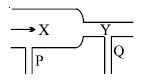
- 1A steady flow of water passes along a horizontal tube from a wide section $X$ to the narrower section $Y$, see figure. Manometers are placed at $P$ and $Q$ at the sections. Which of the statements $A, B, C, D, E$ is most correct?View Solution
- 2A nurse measures the blood pressure of a seated patient to be $190 \,mm$ of $Hg$.View Solution
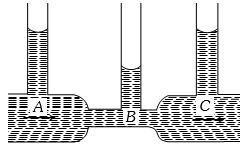
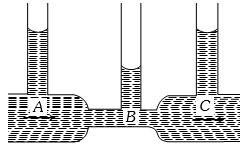
- 3In the following fig. is shown the flow of liquid through a horizontal pipe. Three tubes $A, B$ and $ C$ are connected to the pipe. The radii of the tubes $A, B $ and $C$ at the junction are respectively $ 2 cm, 1 cm$ and $2 cm.$ It can be said that theView Solution
- 4$Assertion : $ Machine parts are jammed in winter.View Solution
$Reason :$ The viscosity of lubricant used in machine parts increase at low temperatures. - 5A bubble of radius $R$ in water of density $\rho$ is expanding uniformly at speed $v$. Given that water is incompressible, the kinetic energy of water being pushed isView Solution
- 6A plane is in level flight at constant speed and each of its two wings has an area of $40 \mathrm{~m}^2$. If the speed of the air is $180 \mathrm{~km} / \mathrm{h}$ over the lower wing surface and $252 \mathrm{~km} / \mathrm{h}$ over the upper wing surface, the mass of the plane is______ $\mathrm{kg}$. (Take air density to be $1 \mathrm{~kg} \mathrm{~m}^{-3}$ and $\mathrm{g}=10 \mathrm{~ms}^{-2}$ )View Solution
- 7In a test experiment on a model aeroplane in wind tunnel, the flow speeds on the upper and lower surfaces of the wings are $70 \mathrm{~ms}^{-1}$ and $65 \mathrm{~ms}^{-1}$ respectively. If the wing area is $2 \mathrm{~m}^2$ the lift of the wing is__________ $\mathrm{N}$.View Solution
(Given density of air $=1.2 \mathrm{~kg} \mathrm{~m}^{-3}$ )
- 8Given below are two statements :View Solution
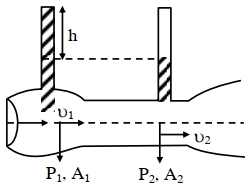
Statement $I$ : When speed of liquid is zero everywhere, pressure difference at any two points depends on equation $\mathrm{P}_1-\mathrm{P}_2=\rho \mathrm{g}\left(\mathrm{h}_2-\mathrm{h}_1\right)$
Statement $II$ : In ventury tube shown $2 \mathrm{gh}=v_1^2-v_2^2$
In the light of the above statements, choose the most appropriate answer from the options given below.
- 9In the following fig. is shown the flow of liquid through a horizontal pipe. Three tubes $A, B$ and $ C$ are connected to the pipe. The radii of the tubes $A, B $ and $C$ at the junction are respectively $ 2 cm, 1 cm$ and $2 cm.$ It can be said that theView Solution
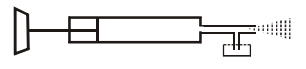
- 10A spray gun is shown in the figure where a piston pushes air out of a nozzle. A thin tube of uniform cross section is connected to the nozzle. The other end of the tube is in a small liquid container. As the piston pushes air through the nozzle, the liquid from the container rises into the nozzle and is sprayed out. For the spray gun shown, the radii of the piston and the nozzle are $20 \ mm$ and $1 \ mm$ respectively. The upper end of the container is open to the atmosphere. $Image$View Solution
$1.$ If the piston is pushed at a speed of $5 \ mms ^{-1}$, the air comes out of the nozzle with a speed of
$(A)$ $0.1 \ ms ^{-1}$ $(B)$ $1 \ ms ^{-1}$ $(C)$ $2 \ ms ^{-1}$ $(D)$ $8 \ ms ^{-1}$
$2.$ If the density of air is $\rho_{ a }$ and that of the liquid $\rho_{\ell}$, then for a given piston speed the rate (volume per unit time) at which the liquid is sprayed will be proportional to
$(A)$ $\sqrt{\frac{\rho_{ a }}{\rho_{\ell}}}$ $(B)$ $\sqrt{\rho_a \rho_{\ell}}$ $(C)$ $\sqrt{\frac{\rho_{\ell}}{\rho_{ a }}}$ $(D)$ $\rho_{\ell}$
Give the answer question $1$ and $2.$