MCQ
A cylindrical vessel partially filled with water is rotated about its vertical central axis. It’s surface will
  • A
    Rise equally
  • Rise from the sides
  • C
    Rise from the middle
  • D
    Lowered equally

Answer

Correct option: B.
Rise from the sides
b
(b)Due to centrifugal force.

Need a full question paper?

Generate a complete, print-ready paper with questions like this in minutes — across 16+ boards, with answer keys.
Start Generating Free

Similar questions

A particle covers $50\, m$ distance when projected with an initial speed. On the same surface it will cover a distance, when projected with double the initial speed ......... $m$
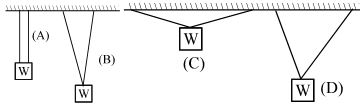
A weight can be hung in any of the following four ways by string of same type. In which case is the string most likely to break?
A container of volume $1{m^3}$is divided into two equal compartments by a partition. One of these compartments contains an ideal gas at $300 K$. The other compartment is vacuum. The whole system is thermally isolated from its surroundings. The partition is removed and the gas expands to occupy the whole volume of the container. Its temperature now would be ..... $K$
If we can throw a ball upto a maximum height $H$, the maximum horizontal distance to which we can throw it is
A body rotates about a fixed axis with an angular acceleration of $3 \,rad / s ^2$. The angle rotated by it during the time when its angular velocity increases from $10 \,rad / s$ to $20 \,rad / s$ (in radian) is ..........
A block of base $10 \mathrm{~cm} \times 10 \mathrm{~cm}$ and height $15 \mathrm{~cm}$ is kept on an inclined plane. The coefficient of friction between them is $\sqrt{3}$. The inclination $\theta$ of this inclined plane from the horizontal plane is gradually increased from $0^{\circ}$. Then
In the resonance tube experiment, first resonant length is $l_1$ and second  resonant length is $l_2$ then the third resonant length will be
When $x\, grams$ of steam at $100\,^oC$ is mixed  with $y\,grams$ of ice at $0\,^oC$ , We obtain $(x + y)\,grams$ of water at $100\,^oC$  . What is the ratio $y/x$ ?
The displacement of a particle executing periodic motion is given by :
$y = 4cos^2\,(t/2)sin\,(1000t)$
This expression may be considered to be a result of superposition of
In an elliptical orbit under gravitational force, in general